
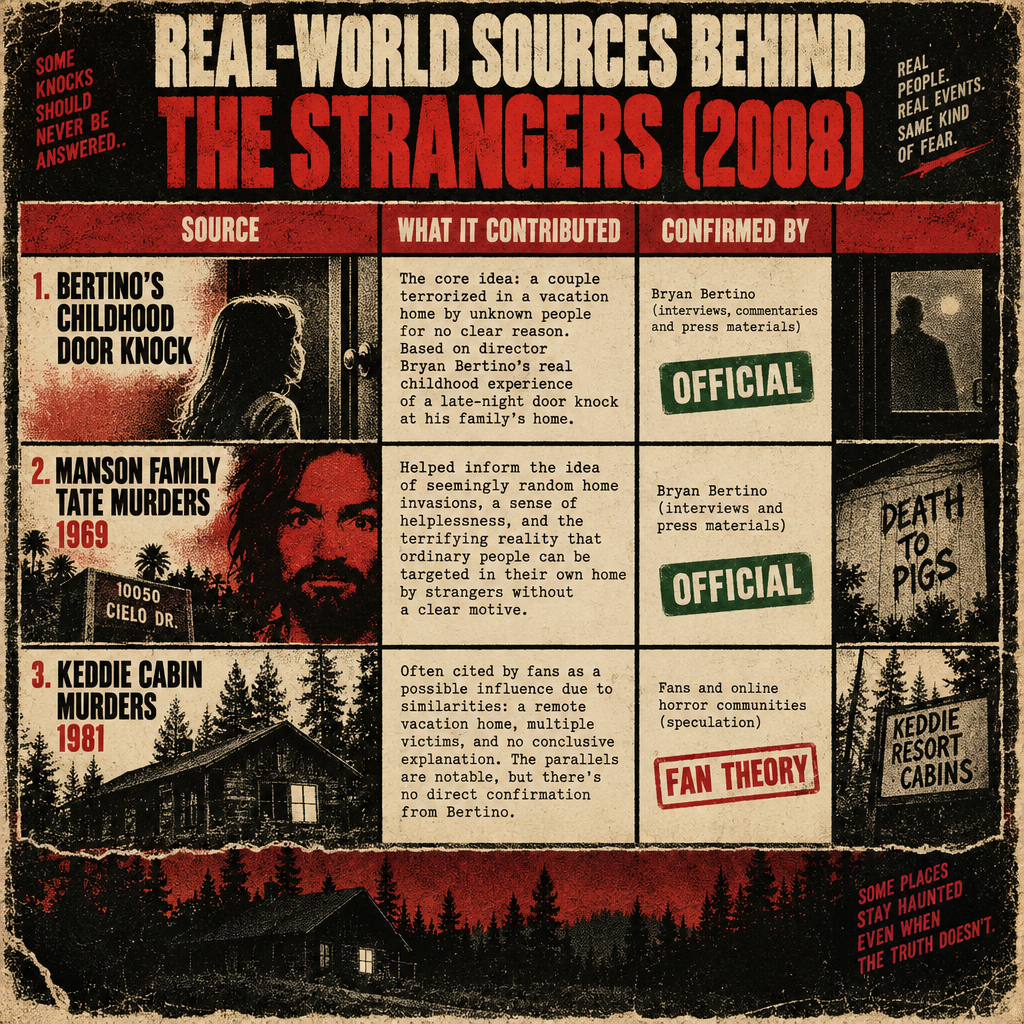
The Strangers (2008) is not the true story of a real couple. Writer-director Bryan Bertino built it from a strange knock on his family’s door when he was a kid, and he has also pointed to the Manson Family’s 1969 killings as a touchstone. The 1981 Keddie cabin murders get linked to it constantly online, but that connection comes from fans, not from Bertino.
Spoiler warning
This explainer spoils the plot and ending of The Strangers (2008) and touches on major events in The Strangers: Prey at Night (2018) and The Strangers: Chapter 1 (2024).
Is The Strangers Based on a True Story? The Short Answer
No, not in the way the opening narration wants you to believe. There was no real Kristen McKay or James Hoyt, no summer home attacked on the night of February 11, 2005, and no unsolved FBI case behind the script. The voiceover that opens the film is a storytelling device, the same trick horror has used for decades to make an audience lean forward and stop feeling safe.
What Bertino did take from real life is smaller and, honestly, scarier. As a child he lived in a house in an isolated spot. One night while his parents were out, someone knocked on the door asking for a person who didn’t live there. The family later learned that people had been knocking on doors around the area and breaking into the houses where nobody answered. That single memory is the seed of the whole film, including the most quoted moment in it, a young woman on the porch at 4 a.m. asking, “Is Tamara home?”
I’ve spent a lot of time with the “true story” horror shelf, from the “amityville horror true story” to the “conjuring true story,” and The Strangers is unusual in that the real inspiration is so ordinary. No demon, no haunted doll, no famous investigator. Just a knock that came at the wrong time and a kid’s brain filling in what might have happened next.
The Three Real-World Threads, Graded by Reliability
People throw a lot of claims around about this movie, so here is how I sort them. I’m grading each one by where it comes from, because “I read it on a forum” and “the director said it in his own production material” are not the same thing.
| Real-world source | When | What it contributed | Who says so | Reliability |
|---|---|---|---|---|
| Bertino’s childhood door knock | Bertino’s childhood, rural U.S. | The “Is Tamara home?” opening and the idea of strangers testing whether anyone is home | Bryan Bertino, in the film’s production notes and interviews | Official, from the filmmaker |
| Manson Family Tate murders | August 8 to 9, 1969, Los Angeles | The randomness of the violence and killers with no personal link to the victims | Bertino, in coverage around the 2008 release | Official, from the filmmaker, though he named it as an influence rather than a template |
| Keddie Cabin 28 murders | April 11 to 12, 1981, Keddie, California | Nothing confirmed | Fan sites, YouTube videos and listicles | Community speculation, never confirmed by Bertino |
The first two are things the filmmaker has talked about himself. The third is an internet theory that has been repeated so often it now shows up as fact on a lot of pages. I’ll walk through all three.
The Knock on the Door: Bryan Bertino’s Childhood Memory
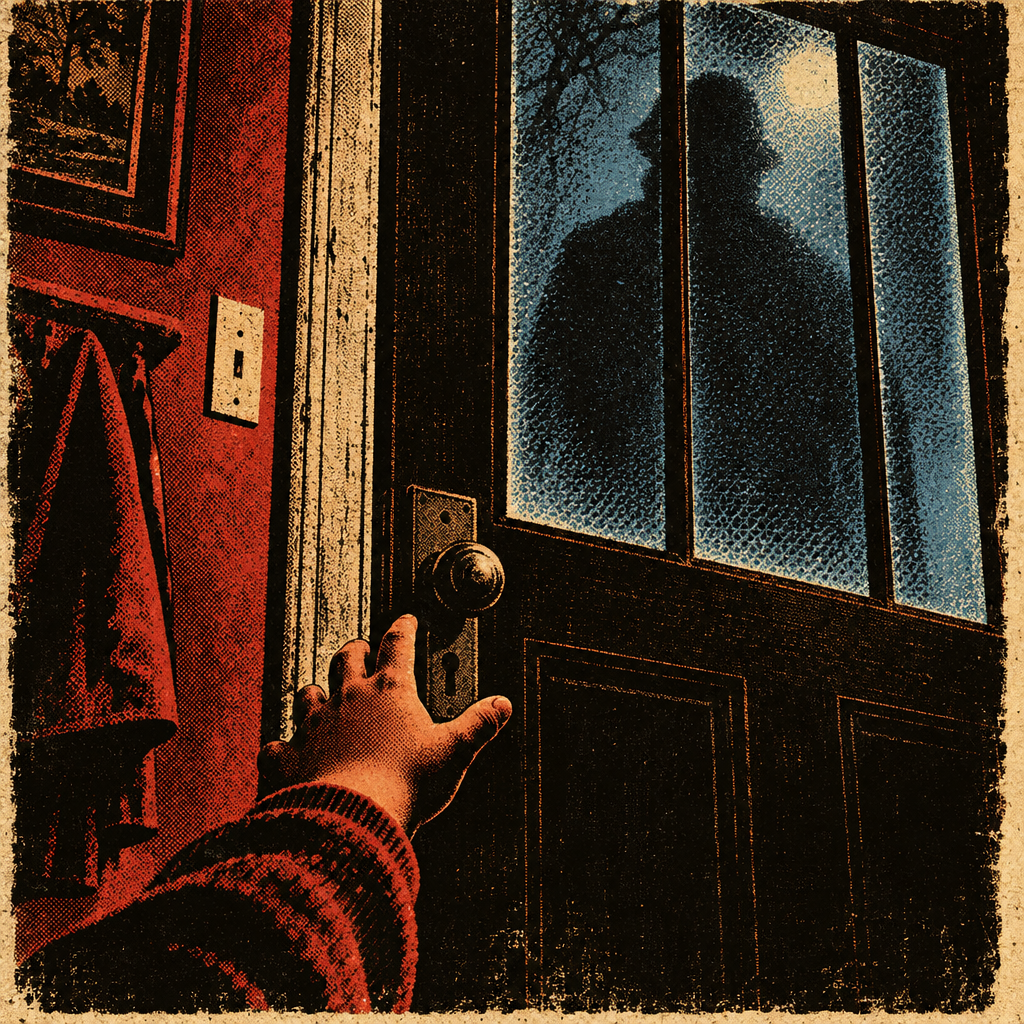
Bertino was an unknown when he wrote The Strangers. The script was his first produced feature, and Rogue Pictures, Universal’s genre label at the time, released it on May 30, 2008. When the press asked him where the idea came from, he kept returning to the same story.
His family lived somewhere remote, on a road where a visitor after dark was rare. With the parents out, someone came to the door and asked for a person who wasn’t there. Nothing happened that night. The unsettling part came later, when the family found out that people in the area had been doing exactly that: knocking to see whether a house was occupied, then breaking in if no one answered.
Think about how that would hit a child. The knock was harmless. The knowledge that came afterward rewrote it. Someone had stood on your porch, looked at your house and decided whether you were worth the trouble. Bertino’s film takes that moment and asks a nastier question. What if they knocked, you answered, and they came in anyway?
That is why the opening of The Strangers feels so specific. Kristen and James are sitting in silence after a failed proposal when a knock comes at roughly 4 a.m. A young woman in shadow asks for Tamara. James tells her she has the wrong house. She leaves, and asks again later. It plays like a home invasion that hasn’t quite started yet, and it is lifted almost directly from a real memory.
Why the memory works better than a real crime would
Here is my take as a fan: Bertino was smart not to adapt a famous case. A real murder comes with a known ending, a known killer and a trial transcript. The audience walks in already knowing too much. A half-remembered knock has no ending at all, which leaves the film free to invent the worst one.
It also gives the movie its central fear. The danger is not that something supernatural picked you. The danger is that someone picked you for no reason, which is a lot harder to rationalize when you’re lying in bed listening to the house settle.
The Manson Family and the Tate Murders
The second thread is much darker and much better documented. On the night of August 8 to 9, 1969, followers of Charles Manson entered the house at 10050 Cielo Drive in Los Angeles and murdered actress Sharon Tate, who was eight and a half months pregnant, along with Jay Sebring, Wojciech Frykowski, Abigail Folger and Steven Parent. The killers were Charles “Tex” Watson, Susan Atkins and Patricia Krenwinkel, with Linda Kasabian acting as lookout. The next night, members of the group killed Leno and Rosemary LaBianca in their home in Los Feliz.
The Tate murders shocked Los Angeles in large part because the victims had no meaningful connection to the people who killed them. Prosecutor Vincent Bugliosi later laid out the case in the 1974 book Helter Skelter, which became one of the best-selling true crime books ever published and which shaped how a generation thought about senseless violence.
Bertino named the Manson killings as an influence in coverage around the film’s release. I want to be precise here, because a lot of pages overstate it. He did not say The Strangers retells the Tate murders. The film has no cult, no Manson figure, no celebrity victims and no attempt to start a race war. What it borrows is the feeling: young people turning up at a house in the middle of the night and destroying the lives inside with no personal motive.
“Because you were home”
The line everyone remembers from The Strangers is the clearest bridge to that real-world horror. Late in the film, a battered Kristen asks the masked trio why they are doing this. Dollface answers: “Because you were home.”
It is a brutal piece of writing. In five words it denies the audience the comfort of a reason. There was no grudge, no inheritance, no ex-lover, no hidden past. The Manson murders left people asking that same question, and the honest answer for the victims at Cielo Drive was not much different. They were in the house.
If you want the other end of this tradition, a killer whose real crimes left investigators asking “why” for very different reasons, our “ed gein netflix” piece covers how the Wisconsin case fed films like Psycho and The Texas Chain Saw Massacre.
The Keddie Cabin Murders: The Link Everyone Repeats
Search “the strangers true story” and you will find dozens of articles stating flatly that the movie is based on the Keddie cabin murders. I understand the appeal of the theory. I also think it is unsupported, and I want to show why.
What happened in Keddie
Keddie is a small former railroad resort in Plumas County, California. On the night of April 11 to 12, 1981, Glenna “Sue” Sharp, 36, her son John Sharp, 15, and John’s friend Dana Wingate, 17, were killed inside Cabin 28. Sue’s 12-year-old daughter Tina was missing. Three younger boys sleeping in another room survived, and another daughter who had spent the night at a neighbor’s home found the scene the next morning. In 1984, part of Tina’s skull was found in neighboring Butte County.
The case was never solved. In 2016, the Plumas County Sheriff’s Office announced the discovery of a hammer believed to be connected to the killings, in a pond near the cabin, and the case drew a fresh wave of attention. It remains one of California’s best-known cold cases.
These were real people, and their families have lived with this for more than four decades. That matters when a horror fan site starts talking about “inspiration,” so I’m sticking to the public record here.
Why the theory doesn’t hold up
The Keddie theory survives because the two stories share a mood: a remote cabin, a brutal night, no clear motive. Beyond that, the overlap breaks down fast.
- No source. I have not seen Bertino cite Keddie in any interview or production material. The connection comes from fan writing and video essays, and it has spread mostly by being copied from page to page.
- Different victims and setting. Keddie involved a mother, teenagers and children in a rented resort cabin. The film follows an adult couple alone at a family summer house after a wedding reception.
- Different crime. The film’s antagonists play an extended game of psychological terror over hours: knocking, appearing in the background, moving objects, smashing windows. Nothing in the published reporting on Keddie describes anything like that.
- Bertino already told us his sources. When a filmmaker has openly named a childhood memory and the Manson case, the simplest reading is to believe him.
So my grade for the Keddie link is community speculation with no confirmation. If you read a site that presents it as settled fact, treat the rest of that page with some caution.
What the Opening Title Card Actually Claims
The film opens with a voiceover that frames everything as a real case. It cites FBI figures on violent crime in America, states that on the night of February 11, 2005, Kristen McKay and James Hoyt went to a wedding reception and came back to the Hoyt family’s summer home, and adds that what happened there is still not entirely known.
Every specific in that narration is invented. The names, the date, the house. The FBI does publish violent crime statistics every year, which is exactly why the line works: the one checkable thing in it is real enough to borrow credibility for everything else.
A long horror tradition
This move is older than most of us. Tobe Hooper’s The Texas Chain Saw Massacre (1974) opened with a scrolling crawl presenting the story as a real tragedy, when in fact it was loosely inspired by Ed Gein’s crimes and otherwise made up. The Coen brothers did a cheekier version in Fargo (1996). The “found footage” boom that followed The Blair Witch Project (1999) leaned on the same instinct.
The difference with The Strangers is that the claim fit so neatly with the film’s style that a lot of viewers walked out believing it. I’ve had people tell me with total confidence that they “read about the case.” They didn’t, because there was no case. If you enjoy untangling where the poster ends and the history starts, our “exorcist true story” piece covers a film whose real-world roots are far more documented.
Fact vs fiction at a glance
| Detail in the film | Real or invented? | What actually exists |
|---|---|---|
| “Inspired by true events” | Partly real | Bertino’s childhood door knock and the influence of the Tate murders |
| Kristen McKay and James Hoyt | Invented | No such victims; fictional characters played by Liv Tyler and Scott Speedman |
| February 11, 2005 | Invented | No matching crime on record |
| The Hoyt family summer home | Invented | The film was shot on a constructed and dressed location, not a crime scene |
| “Is Tamara home?” | Real basis | Mirrors the stranger asking for an absent person at Bertino’s childhood home |
| Masked killers with no motive | Thematic link | Echoes the randomness of the Manson Family killings |
| Keddie Cabin 28 connection | Unconfirmed | Fan theory; never cited by the filmmaker |
| FBI violent crime statistics | Real | The FBI publishes national crime data annually |
Why the Realistic Scenario Is So Disturbing
Knowing it isn’t true doesn’t make The Strangers less scary for me. If anything it gets scarier, because what Bertino built is a scenario that could happen almost anywhere with no special ingredients. Here is where I think the realism really lives, moment by moment.
The house is already broken before anyone arrives
Kristen and James come home from a friend’s wedding with their relationship in pieces. James had proposed and Kristen said no. Rose petals sit in the bath, champagne goes unopened, and the two of them can barely look at each other. The film spends real time on this, and it pays off. By the time the knock comes, the audience is already sitting in an uncomfortable, too-quiet house. The strangers walk into a home that already feels hostile.
The Man in the Mask standing in the background
The most famous shot in the movie is quiet. Kristen is alone in the kitchen, and behind her, in soft focus, the Man in the Mask simply stands in the hallway, watching. Then he steps away. She never sees him. You do.
That shot is the engine of the whole film. The killers are not rushing the house. They are inside it, close enough to touch, choosing not to act yet. It turns every dark doorway on screen into a question, and it is exactly the kind of fear the childhood knock suggests: someone was right there, and you had no idea.
Three masks, no faces, no names
The trio are credited only as the Man in the Mask (Kip Weeks), Dollface (Gemma Ward) and Pin-Up Girl (Laura Margolis). We never learn their names or see their faces in a way that lets us know them. Compare that to a franchise slasher like “michael meyers,” who gets a sister, a backstory and decades of sequels explaining him. The Strangers refuses all of that, and the refusal is what makes them feel like actual people who could be anyone.
Small, plausible violence
For most of the runtime the strangers do things a real person could do. They knock. They bang on walls. They move a record player. They take Kristen’s phone. They write on a window. When James’s friend Mike (Glenn Howerton) arrives to pick him up, the death that follows comes from James himself, firing a shotgun in panic and hitting his friend. It’s a horribly believable mistake, and it lands harder than any elaborate kill could.
The ending offers no catharsis
In the final stretch the strangers tie Kristen and James to chairs in the living room, unmask in front of them (we only see it from the victims’ side), and stab them. Two Mormon boys handing out pamphlets find the bodies the next morning. Kristen screams awake in the final second, which tells you she survived, but the film never tells you what her life looks like after.
There’s no detective, no justice, no explanation. That ending is why The Strangers sticks with people for years. Real crime rarely gives you an epilogue, and Bertino didn’t either.
I’d point The Strangers at anyone who finds slow dread scarier than monsters, and away from anyone who lives alone in the countryside and wants to sleep tonight. The gore is mostly confined to the final act, so it’s manageable if blood bothers you, but the tension through the middle hour is relentless. It runs a lean 86 minutes in its theatrical cut, and an unrated cut also exists on home video.
Prey at Night: The Sequel Drops the “True Story” Angle
Ten years later, the masked trio came back in The Strangers: Prey at Night, released March 9, 2018 by Aviron Pictures. Johannes Roberts (47 Meters Down) directed from a script by Bryan Bertino and Ben Ketai. Bertino’s original concept for a follow-up had been circulating since shortly after the first film succeeded.
This time the victims are a family. Cindy (Christina Hendricks) and Mike (Martin Henderson) are driving their troubled daughter Kinsey (Bailee Madison) to boarding school, with son Luke (Lewis Pullman) along for the ride. They stop overnight at a relative’s mobile home park, which is closed for the off-season and nearly empty. Then someone knocks and asks for Tamara.
Is the sequel based on a true story?
No, and to its credit the film doesn’t really pretend to be. Prey at Night plays more openly as a stylized slasher. It leans hard into 1980s influences, with a synth-heavy score and pop songs like Bonnie Tyler’s “Total Eclipse of the Heart” blaring during the much-loved swimming pool sequence. It’s a John Carpenter homage at heart, with a pickup truck that clearly owes a debt to Christine.
That shift in tone actually confirms what I’ve been saying about the original. The first film’s “true story” power came from Bertino’s restraint and its documentary-like framing. Once the sequel embraced neon lighting and slow-motion fights, nobody walked out wondering whether it had really happened.
Why the realism still sort of works
Even so, Prey at Night keeps the core idea that makes the franchise unsettling. The family is targeted for no reason. The location is a believable, ordinary place: a cheap lakeside trailer park, not a gothic mansion. And the masked strangers still move with that patient, almost bored menace. When Kinsey asks why, the answer is no more comforting than before.
I’d recommend Prey at Night to slasher fans who like their horror loud, stylish and a bit silly, and as a lighter group watch than the original. It’s more fun than frightening, and the pool scene alone is worth the rental. If the first film’s quiet dread was too much for you, this is the easier entry.
The Reboot Trilogy: The Strangers: Chapter 1 and Beyond
The franchise took a big swing in the 2020s. Lionsgate backed a trilogy directed by Renny Harlin (Die Hard 2, Cliffhanger, Deep Blue Sea), written by Alan R. Cohen and Alan Freedland, and shot back to back in Slovakia standing in for rural Oregon. The idea was to retell the original’s premise and then follow a survivor across three films.
The Strangers: Chapter 1 opened on May 17, 2024. Maya (Madelaine Petsch) and her boyfriend Ryan (Froy Gutierrez) are driving cross-country when their car breaks down near the small town of Venus, Oregon. They rent an isolated cabin for the night. You can guess who knocks.
A remake in all but name
Chapter 1 is effectively a remake of the 2008 film with new characters, and it hits many of the same beats: the late-night knock, the woman asking for Tamara, the masked figure in the background, the “because you were home” ethos. Its genuine new idea is the town itself, where locals seem oddly unwelcoming and the trilogy hints at something larger and more organized than three random drifters.
That’s a real departure from the original’s spirit. Bertino’s 2008 strangers matter because they are unexplained. A trilogy that sets out to explain them is chasing a different kind of story, closer to a mystery thriller than the stark, real-life fear that defined the first film.
Chapter 1 suits younger viewers or horror newcomers who’d never sit through a 2008 film, and it’s a gentle on-ramp to home invasion horror. Longtime fans will spend most of it comparing it shot for shot with the original, and the original wins. The Strangers: Chapter 2 followed on September 26, 2025, picking up with Maya’s fight to survive, and Lionsgate positioned a third chapter to close the story.
How The Strangers Turned Into a Franchise
A $9 million thriller with two leads, one house and three masked extras is not most people’s idea of a franchise launcher. But the numbers in 2008 were impossible for a studio to ignore. The film opened to about $21 million domestically against heavy summer competition and finished around $82 million worldwide.
Here’s the series at a glance. Box office figures are reported totals from industry trackers, rounded, and budgets are as reported at the time of release.
| Film | Release date | Director | Distributor | Reported budget | Worldwide gross |
|---|---|---|---|---|---|
| The Strangers | May 30, 2008 | Bryan Bertino | Rogue Pictures (Universal) | About $9 million | About $82.4 million |
| The Strangers: Prey at Night | March 9, 2018 | Johannes Roberts | Aviron Pictures | About $5 million | About $31.4 million |
| The Strangers: Chapter 1 | May 17, 2024 | Renny Harlin | Lionsgate | About $8.5 million | About $48 million |
| The Strangers: Chapter 2 | September 26, 2025 | Renny Harlin | Lionsgate | Shot alongside Chapter 1 | Not covered here |
A few patterns stand out to me. The original is still the biggest hit by a wide margin, which suggests its realistic, “could happen to you” approach connected with mainstream audiences in a way the stylized sequels didn’t match. The gap between films is also enormous. Ten years separated the first two, and Prey at Night spent years in development limbo before it finally shot.
The trilogy model was Lionsgate’s attempt to remove that gap, filming everything at once so the studio could release chapters quickly. Whether that approach pays off creatively is a debate I’ll happily have in the comments of any Ecto-Web post, but it’s a very different strategy from Bertino’s single, self-contained nightmare.
Bertino’s career after The Strangers
Bryan Bertino never became a franchise director. He went on to write and direct small, intense horror films: Mockingbird (2014), The Monster (2016), The Dark and the Wicked (2020) and Vicious (2025). The Dark and the Wicked in particular feels like a spiritual cousin to The Strangers, another isolated rural house and another family facing something that will not explain itself. If the 2008 film is your favorite in the series, his later work is worth tracking down before any of the sequels.
Where to Watch and What to Buy
Streaming rights for all four films rotate between services often, so I won’t promise you a platform that might be gone by the time you read this. Before Halloween night, check a streaming tracker or your service’s search. All the films have generally been available to rent or buy digitally through the major storefronts.
For collectors, Scream Factory released a Collector’s Edition Blu-ray of the 2008 film in 2018 that includes both the theatrical and unrated cuts, and it’s the version I’d recommend if you want the original on your shelf. The unrated cut is slightly longer and a touch more vicious, though the theatrical cut is tighter and, to my taste, scarier.
Which Strangers Film Should You Watch, and in What Order?
Since the trilogy is a soft remake rather than a continuation, story order and release order line up neatly with one exception: you can skip straight from the 2008 film to Prey at Night, or start fresh with Chapter 1, without missing anything essential.
My recommendations by mood:
- You want the real deal: The Strangers (2008). It’s the one that made people check their locks.
- You want a fun group scare: Prey at Night (2018). Louder, sillier, and great with friends.
- You’re new to horror or watching with a teenager: The Strangers: Chapter 1 (2024). Familiar beats, slicker production, less punishing.
- You want the full story: Watch the 2008 original first, then the Harlin trilogy in chapter order, and save Prey at Night as a standalone treat.
If you liked this
Them (Ils, 2006): the lean French home invasion film from David Moreau and Xavier Palud that many fans see as The Strangers’ closest cousin.
Funny Games (1997): Michael Haneke’s cruel, chilly study of polite young men terrorizing a family, also remade by Haneke in a version released in 2008.
You’re Next (2011): Adam Wingard’s masked home invasion movie, with a victim who fights back hard.
Why This “True Story” Keeps Getting Retold
Every Halloween the same question pops up again: is The Strangers a true story? I think the reason it never goes away is that the film’s real inspiration is so universal. Very few of us have been haunted or possessed. Lots of us have heard a knock at the wrong hour, opened the door to someone asking for a name we didn’t recognize, and felt that small chill when they walked away.
Bertino took that chill and stretched it to feature length. He let the Manson killings shape its moral emptiness, he dressed it in a fake true-crime frame, and then the internet did the rest, gluing on Keddie and plenty of other cases he never mentioned. What’s left is a film that isn’t true, built from a feeling that absolutely is.
FAQ
Is The Strangers based on a real murder?
No. Bryan Bertino has said the film was inspired by a childhood memory of a stranger knocking at his family’s door asking for someone who wasn’t there, along with the broader influence of the Manson Family’s 1969 Tate murders. The couple, the date and the house in the film are all fictional.
Is The Strangers based on the Keddie murders?
There is no evidence of that. The Keddie Cabin 28 murders in Plumas County, California, in April 1981 are often linked to the film online, but Bertino has never cited them. The connection is a fan theory based on a shared mood, not on anything the filmmaker said.
What does “Is Tamara home?” mean?
It’s a direct echo of Bertino’s childhood experience, when someone came to his family’s door asking for a person who didn’t live there. In the film, it’s how the strangers test whether the house is occupied and who is inside.
Who are the killers in The Strangers?
They are credited only as the Man in the Mask, Dollface and Pin-Up Girl, played by Kip Weeks, Gemma Ward and Laura Margolis in the 2008 film. They are never named or given a backstory, which is a deliberate choice to keep them feeling like real, random people.
Does Kristen survive at the end of The Strangers?
Yes. In the final moment, Kristen wakes and screams after the Mormon boys find the couple, revealing she survived the attack. James does not. The film doesn’t show what happens to her afterward.
Is Prey at Night based on a true story?
No. The 2018 sequel drops the original’s “true events” framing and plays as a stylish, 1980s-flavored slasher. Bryan Bertino co-wrote it, but it doesn’t claim any real-world basis.
Do I need to see the 2008 film before The Strangers: Chapter 1?
No. Chapter 1 is a fresh start with new characters and works as a standalone remake of the original premise. I’d still watch the 2008 film first, because it’s the better movie and the source of everything the trilogy reworks.