

The Exorcist (1973) is based on a real exorcism performed in 1949 on a boy from suburban Maryland, known in church records and later books by the pseudonym “Roland Doe.” Jesuit priests from Saint Louis University carried out the rite over several weeks that spring. William Peter Blatty heard about it as a Georgetown student and turned it into his 1971 novel, and almost everything you remember from the film sits somewhere between documented fact, secondhand diary entry and outright invention.
Spoiler warning
This piece discusses the plot and ending of The Exorcist (1973) and the outcome of the real 1949 case.
The short answer: what’s real and what Blatty invented
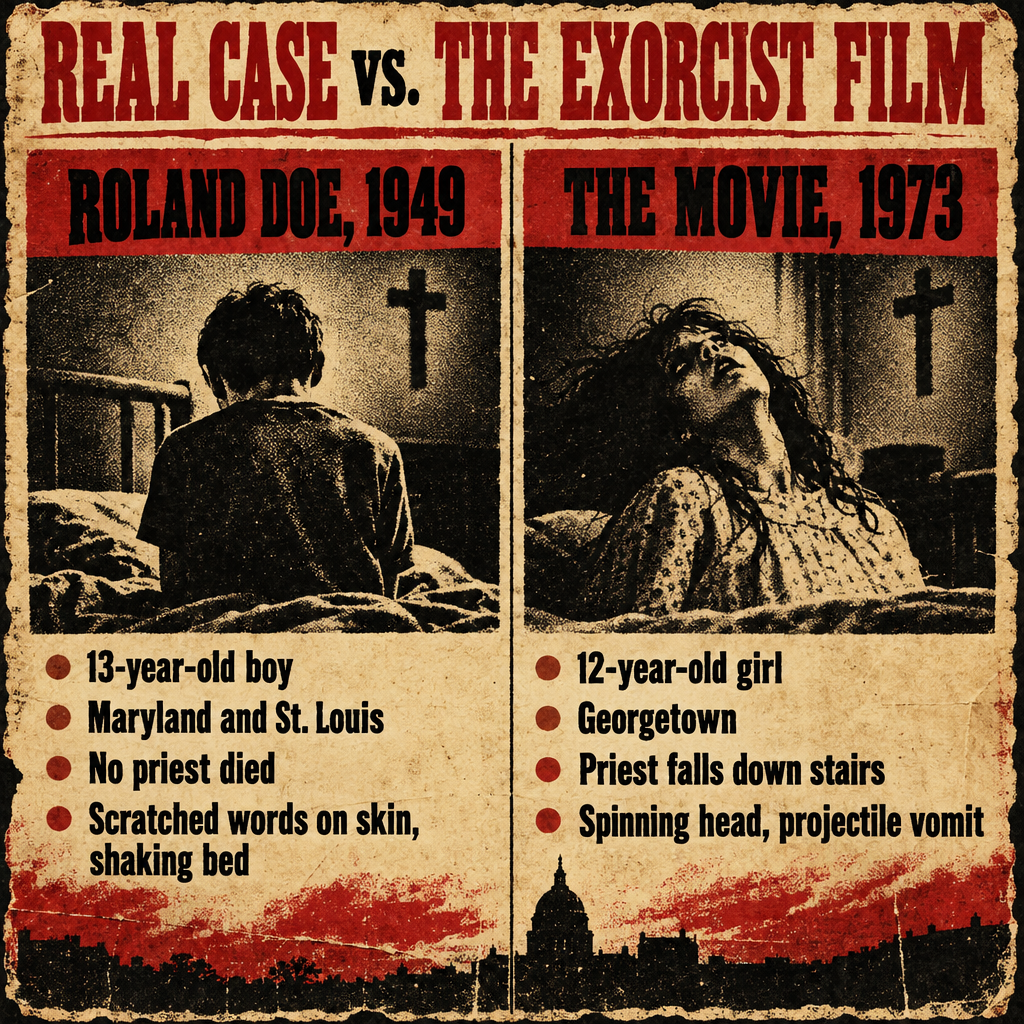
The real case involved a boy of about 13, not a 12-year-old girl. It took place in Maryland and St. Louis, not Georgetown. No priest died, and nobody threw himself down a flight of stairs. Blatty kept the core: a family desperate for help, a reluctant Catholic hierarchy, a long and exhausting ritual, and a Jesuit who had doubts.
The spinning head, the projectile vomit and the crucifix scene come from Blatty and William Friedkin. The scratched words on skin, the shaking bed and the boy’s violent outbursts appear in the priests’ own account. Whether those things were supernatural is a different question, and the people closest to the case did not fully agree.
A boy in Maryland, an aunt and a Ouija board
The boy was an only child in a Lutheran family living in Cottage City, Maryland, just outside Washington, D.C. Early newspaper coverage placed the family in nearby Mount Rainier. Researcher Mark Opsasnick later traced them to Cottage City, and his version is now widely accepted.
The story usually starts with his aunt, Harriet, a spiritualist who lived in St. Louis and visited the family. Accounts say she introduced her nephew to the Ouija board and talked with him about contacting spirits. She died in January 1949.
That death is the hinge of the whole case. According to the priests’ records, the boy kept using the board after she died, possibly trying to reach her. Within weeks, the family began reporting things they could not explain.
Strange and stranger things in the house
The first reports sound like a classic haunting rather than a possession. The family described scratching noises in the walls, which they first blamed on rats. They also heard footsteps, saw objects move and found water appearing with no clear source.
Then the activity reportedly centered on the boy himself. His mattress was said to shake. A picture of Jesus on the wall was described as moving. Furniture was said to slide when he was nearby.
Here is where you have to start reading carefully. Almost all of this comes from the family, filtered through priests who wrote it down later. No independent witness verified the early events at the time.
Seeking help: a minister, a priest and a disputed hospital scene
The family went through ordinary channels first. Doctors and a psychiatrist reportedly found nothing physically wrong. Then they turned to their Lutheran minister, the Rev. Luther Miles Schulze.
Schulze took the case seriously enough to have the boy stay overnight at his own home in February 1949. He later told colleagues he saw an armchair tip over with the boy sitting in it and bedding that seemed to move. Schulze eventually suggested the family speak to the Catholic Church. In his view, Catholics had more experience with this kind of thing.
The Georgetown hospital legend
This next part is the most contested episode in the whole story. In Thomas B. Allen’s 1993 book Possessed, a local priest, Father E. Albert Hughes, attempted an exorcism at Georgetown University Hospital. The boy supposedly worked a spring loose from the bed and slashed Hughes’s arm badly enough to need stitches.
Opsasnick investigated in the late 1990s and found no solid evidence it happened. People who knew Hughes recalled no injury. If you want to separate fact from legend, this is the first big red flag. A dramatic, widely repeated scene rests on thin sourcing.
St. Louis: SLU’s Jesuits step in
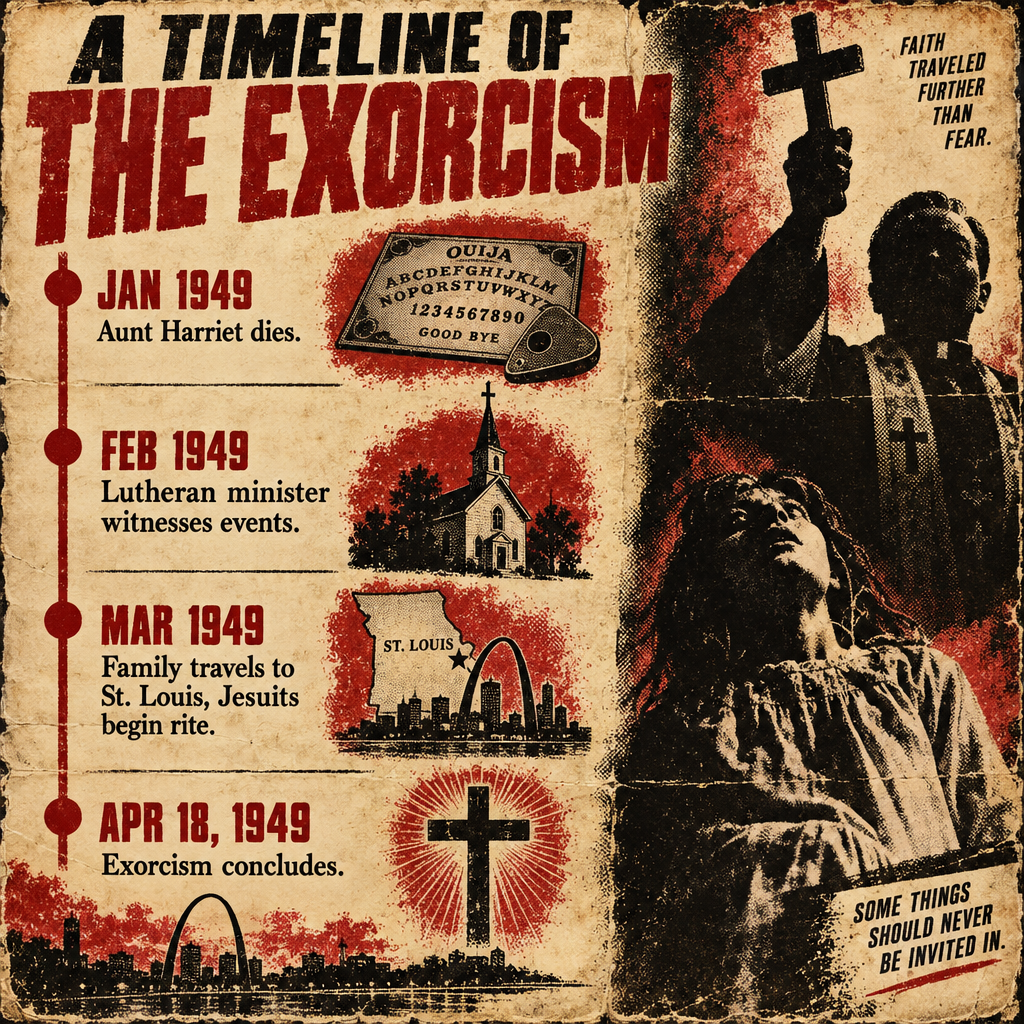
In early March 1949 the family traveled to St. Louis to stay with relatives. One account holds that the word “Louis” appeared scratched on the boy’s body before the trip. Treat that as legend, since it surfaces in retellings more than in firm documentation.
A cousin attended Saint Louis University, the Jesuit school in the city. That cousin approached Father Raymond Bishop, a Jesuit on the faculty. Bishop visited the relatives’ house in the suburb of Bel-Nor and saw enough to bring in Father William S. Bowdern, pastor of St. Francis Xavier College Church on SLU’s campus.
Bowdern asked Archbishop Joseph Ritter for permission to perform a formal exorcism. Ritter granted it, which tells you the church considered the case serious. Under the Catholic rite in use at the time, a priest needed approval from church authority, in this case the archbishop, before he could proceed.
The exorcism: March 16 to April 18, 1949
Bowdern began reading the Rite of Exorcism around March 16, 1949. He was assisted by Bishop and by Walter Halloran, then a young Jesuit in training who was physically strong and could help restrain the boy.
The sessions continued for about a month. They moved between the relatives’ house, the rectory at College Church and the Alexian Brothers Hospital in south St. Louis, where the boy was held in a psychiatric wing.
Father Bishop kept a detailed diary. According to that diary, the boy:
- Thrashed, spat and cursed at the priests, often at night
- Showed welts and scratches forming words such as “evil” and “hell”
- Reacted violently to holy water and to sacred objects
- Seemed to respond to Latin phrases from the ritual
- Displayed strength beyond what the priests expected from a boy his size
During the ordeal, the boy was received into the Catholic Church. He was baptized and made his First Communion while the exorcism was underway. For the priests, this was part of the spiritual fight. For skeptics, it shows how fully the boy’s world had been absorbed into the ritual.
The struggle for a soul reaches its end
The rite ended on April 18, 1949, Easter Monday, at the Alexian Brothers Hospital. According to the diary, the boy entered a trance and described a vision of St. Michael the Archangel driving out the devil. Witnesses reported a loud noise in the hospital. The boy then woke and reportedly said something to the effect of “He’s gone.”
That is the ending as the believers recorded it. The boy went home to Maryland and, by every account, lived a normal life afterward.
What happened to “Roland Doe” afterward
The church protected his identity for decades, and so did the priests. Bowdern refused to discuss the case publicly. He did correspond briefly with Blatty but declined to share details, saying he wanted to protect the family.
Walter Halloran gave interviews later in life. He said he saw the bed move and saw marks appear on the boy’s skin. He also said the boy once broke his nose. Even so, he stopped short of declaring the case definitely supernatural. He said he simply didn’t know. Halloran died in 2005, the last surviving priest from the case.
As for the boy, published reporting says he grew up, built a career and died in 2020. A name for him circulated in 2021, and you will see it in some of the ranking articles on this topic. We aren’t repeating it. He never spoke publicly about 1949, his family never confirmed it, and he spent seventy years avoiding exactly this kind of attention. You don’t need his name to understand the story.
Fact vs legend: a quick reference
| Claim | Status | Main source |
|---|---|---|
| A boy underwent a Catholic exorcism in St. Louis in 1949 | Documented | Archdiocese approval, Bishop diary, 1949 press |
| Archbishop Ritter authorized it | Documented | Church records, Allen’s Possessed |
| Words appeared scratched on his skin | Reported by witnesses | Bishop diary, Halloran interviews |
| The bed shook violently | Reported by witnesses | Diary, Schulze, Halloran |
| He slashed a priest with a bedspring at Georgetown | Disputed | Allen’s book; challenged by Opsasnick |
| He spoke fluent Latin | Doubtful | Diary notes responses; he heard the rite daily |
| His head spun or he levitated | Fiction | Blatty’s novel and Friedkin’s film |
| A priest died during the exorcism | Fiction | Invented for the novel |
Weighing the sources honestly
You’ll get further with this case if you rank the evidence instead of treating every retelling as equal.
Strongest: Contemporary press and church approval. The Washington Post ran a story on August 20, 1949, reporting that a priest had freed a local boy said to be in the grip of the devil. That confirms an exorcism happened and drew attention at the time.
Strong but partisan: Father Bishop’s diary. It’s a primary record written close to events. It was also written by a believer documenting what he understood as spiritual warfare. Copies resurfaced over the years, and Allen built Possessed around it.
Firsthand but uncertain: Halloran’s later interviews. They are honest and useful precisely because he admitted doubt.
Skeptical investigation: Opsasnick’s 1999 article for Strange Magazine. He tracked down neighbors and childhood acquaintances, who described the boy as a spoiled, sometimes nasty kid capable of pranks. Opsasnick concluded the most likely explanation was a troubled child plus adults primed to see the devil.
Weakest: Internet retellings, ghost tours and “haunted house” listicles. These are where the “Louis” scratch, the cursed hospital room and other embellishments tend to grow.
Our take: something genuinely distressing happened to this family. The documented events fit a frightened, manipulative or mentally unwell adolescent at least as well as they fit a demon. The priests believed, and that belief shaped what they recorded.
How the case became a novel and a film
William Peter Blatty was a junior at Georgetown University in 1949 when he read about the case. It stuck with him for two decades. A devout Catholic, he wanted to write something that treated faith and evidence of the supernatural seriously.
His novel The Exorcist came out in 1971 and became a massive bestseller. Blatty moved the setting to Georgetown and changed the boy to 12-year-old Regan MacNeil, daughter of an actress. He built the story around Father Damien Karras, a Jesuit psychiatrist losing his faith.
Warner Bros. released William Friedkin’s film on December 26, 1973. Linda Blair played Regan, Ellen Burstyn played her mother Chris, Jason Miller played Karras and Max von Sydow played the elderly exorcist, Father Merrin. Mercedes McCambridge voiced the demon. The film earned 10 Academy Award nominations, including Best Picture, a first for a horror movie. It won two: Best Adapted Screenplay for Blatty and Best Sound.
What the film changed
- The victim: a girl, not a boy, and a nonreligious family rather than a Lutheran one.
- The setting: Georgetown, which gave us the famous steps off M Street.
- The priests: Karras and Merrin are composites. Neither is Bowdern, Bishop or Halloran.
- The ending: Merrin dies, and Karras takes the demon into himself and throws himself from the window. The real case ended with a recovered boy and no deaths.
- The gore: almost every shock image is invented.
Friedkin stayed fascinated with exorcism long after the film. In 2016 he filmed an exorcism performed by Father Gabriele Amorth in Italy, released as the 2017 documentary The Devil and Father Amorth.
The scares here are slow, cumulative and deeply uncomfortable rather than sudden. Expect bodily horror, profanity from a child and a notorious self-harm scene with religious imagery. If you can’t handle seeing kids in distress, this one will hit hard. Pick the 1973 theatrical cut for your first watch. The 2000 extended version, “The Version You’ve Never Seen,” adds the spider-walk and a few scenes. Some fans love it, while others find it undercuts the original’s restraint.
Haunted St. Louis: the places today
The case left a footprint across St. Louis, and it has become part of local Halloween lore. College Church still stands on SLU’s campus. The Alexian Brothers Hospital wing where the rite ended was demolished in the 1970s. Local legend says workers found a copy of the diary during demolition, but treat that as a story rather than a record.
The Bel-Nor house and the Maryland home are private residences. People live there. Please don’t treat them as attractions, and skip any tour that encourages you to knock on doors. The Exorcist steps in Georgetown are a public spot and a much better pilgrimage.
Watching the franchise this Halloween
Streaming rights for the 1973 film move between services, so check a streaming tracker before you plan your night. The film is widely available to buy or rent digitally and on 4K disc.
The later entries vary wildly in quality. Exorcist II: The Heretic (1977) is a famous misfire. The Exorcist III (1990), written and directed by Blatty from his novel Legion, is the underrated gem and contains one of cinema’s best jump scares. Two prequels followed: Renny Harlin’s Exorcist: The Beginning (2004) and Paul Schrader’s Dominion: Prequel to the Exorcist (2005). Fox’s The Exorcist series ran for two seasons from 2016, and David Gordon Green’s The Exorcist: Believer arrived in 2023.
If real-case horror is your thing, the 1949 story pairs naturally with the Perron family haunting. Our “conjuring true story” piece covers that one, and the “annabelle doll” article picks apart the Warrens’ most famous artifact. The Warrens’ cases draw on the same mid-century Catholic framework, and so does the debate over who was really doing what.
If you liked this
The Exorcist III (1990): Blatty’s own sequel, smarter and stranger than its reputation.
Possessed (2000): Showtime’s TV movie drawn directly from Allen’s book on the 1949 case.
The Devil and Father Amorth (2017): Friedkin’s documentary, for anyone wanting a real exorcism on film.
FAQ
Is The Exorcist based on a true story?
Yes, loosely. Blatty’s novel and Friedkin’s film were inspired by a documented 1949 exorcism of a Maryland boy, carried out by Jesuits in St. Louis. Most of the film’s events are fictional.
Who was Roland Doe?
“Roland Doe” is the pseudonym used for the boy, who was about 13 at the time. Published reporting says he lived a private life afterward and died in 2020. He never discussed the case publicly.
Where did the real exorcism happen?
It started in Maryland and moved to St. Louis. The main locations were a relatives’ home in Bel-Nor, College Church at Saint Louis University and the Alexian Brothers Hospital, where it ended on April 18, 1949.
Did a priest die during the real exorcism?
No. Nobody died. Father Bowdern lived until 1983, and Walter Halloran lived until 2005. The deaths of Merrin and Karras were invented for the novel.
Was the boy really possessed?
The priests who performed the rite believed so, though Halloran later admitted he wasn’t certain. Skeptical researchers point to a troubled adolescent and adults primed by faith to interpret his behavior as demonic. The documented record supports the skeptical reading at least as well as the supernatural one.
Is The Exorcist too scary for a first-time horror viewer?
It’s intense rather than jumpy. If disturbing imagery involving a child or religious content bothers you, build up to it. Older viewers who’ve only seen modern horror often find it slower than expected, then can’t shake it afterward.