

The Amityville Horror true story has two halves. The first is a documented crime: on November 13, 1974, Ronald DeFeo Jr. shot and killed six members of his family at 112 Ocean Avenue in Amityville, New York. The second is the haunting George and Kathy Lutz said drove them out of that same house after 28 days. That half has been disputed in court, in print and by the people who lived there afterwards, and most of the evidence points to a story that was inflated well beyond anything provable.
Spoiler warning
This piece spoils the real case and the plots of The Amityville Horror (1979), its 2005 remake and Amityville II: The Possession.
The short answer: what’s real and what isn’t
You can split the Amityville legend into three layers, and each one deserves a different level of trust.
The murders are real. They are public record, backed by a confession, a jury trial, a conviction and decades of prison filings. Six people died, and none of that is in question.
The Lutz family’s move-in and move-out are real. George and Kathy Lutz bought the house in December 1975, moved in with Kathy’s three children and left in mid-January 1976. Property records and the family’s own consistent account cover those basics.
The haunting is where it falls apart. Bleeding walls, a pig-eyed creature called Jodie, a priest driven off by a voice, green slime oozing down the stairs: these come from the Lutzes and from Jay Anson’s 1977 book. They were never independently confirmed. DeFeo’s own defense lawyer later said he helped invent the story, a federal judge described the book as largely fiction, and the family who bought the house next said they never saw anything strange.
Our position is simple. Treat the DeFeo case as a tragedy that really happened to real people, and treat the haunting as one of the most successful pieces of horror storytelling of the 1970s, built on top of that tragedy.
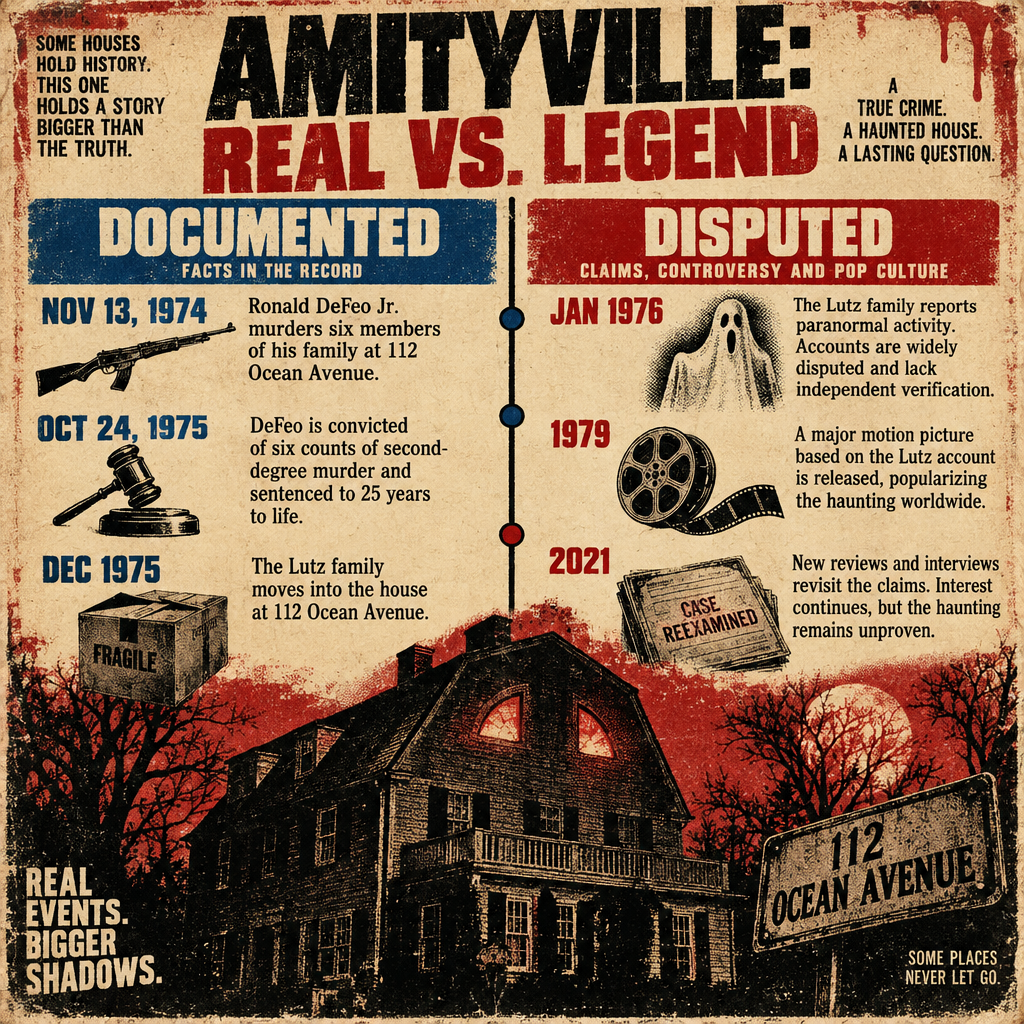
Amityville timeline at a glance
| Date | What happened | How solid is it? |
|---|---|---|
| Nov 13, 1974 | Ronald DeFeo Jr. kills his parents and four siblings at 112 Ocean Avenue | Public record |
| Nov 1975 | DeFeo convicted of six counts of second-degree murder | Court record |
| Dec 1975 | DeFeo sentenced to six concurrent terms of 25 years to life | Court record |
| Dec 18, 1975 | George and Kathy Lutz move in with their three children | Consistent across all accounts |
| Jan 14, 1976 | The Lutzes leave, saying they were driven out | Departure date undisputed; the reason is disputed |
| Mar 1976 | Ed and Lorraine Warren hold a televised séance in the house | Event happened; findings contested |
| Sept 1977 | Jay Anson’s The Amityville Horror: A True Story published by Prentice Hall | Publication fact |
| 1977 | Jim and Barbara Cromarty buy the house and report nothing unusual | Their own public statements |
| 1979 | Defense lawyer William Weber tells People magazine the story was a hoax | On-record quote |
| 1979 | Federal judge dismisses the Lutzes’ lawsuit against Weber and others | Court record |
| July 1979 | The Amityville Horror film released by American International Pictures | Release fact |
| 2004 / 2006 | Kathy Lutz dies (2004), then George Lutz (2006) | Public record |
| Mar 12, 2021 | Ronald DeFeo Jr. dies in state custody, aged 69 | Public record |
November 13, 1974: the DeFeo murders
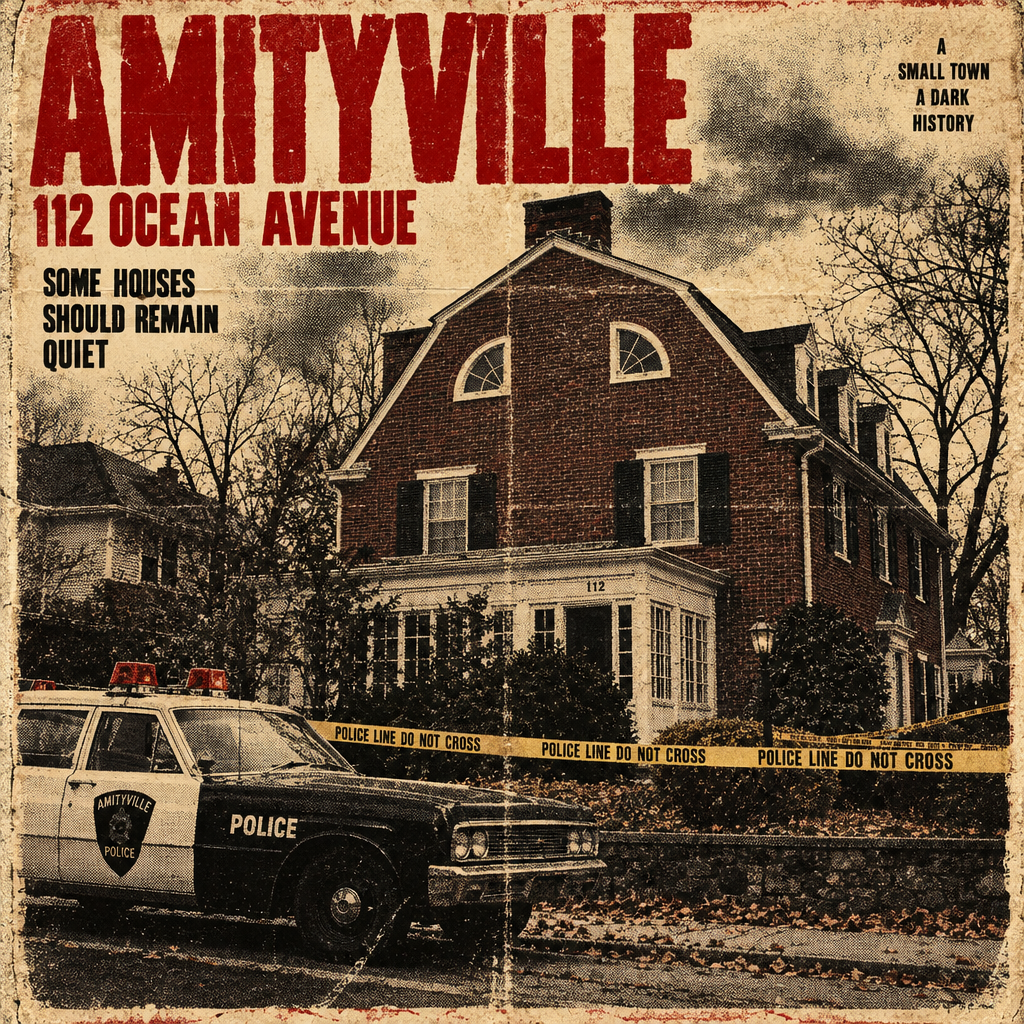
This is the part of the story that deserves the most care. Real people died here, and their names tend to get lost under the ghost stories.
The family at 112 Ocean Avenue
The DeFeos lived in a large 1920s Dutch Colonial on Ocean Avenue, a quiet waterfront street in Amityville on Long Island’s South Shore. The house had a boathouse, a pool and those famous quarter-circle attic windows that later became the “eyes” on every movie poster.
Ronald DeFeo Sr. worked at his father-in-law’s Buick dealership in Brooklyn. His wife, Louise, ran the household. They had five children: Ronald Jr., known as “Butch,” who was 23; Dawn, 18; Allison, 13; Marc, 12; and John Matthew, 9.
Published reporting and trial testimony describe a home under heavy strain. Ronald Sr. was described as volatile and controlling, and his eldest son had serious problems with drugs and alcohol. Butch also worked at the dealership. In the weeks before the killings, a deposit of dealership money he was supposed to bank was reported stolen in what investigators suspected was a staged robbery, and the episode caused open conflict with his father.
The night of the killings
In the early hours of November 13, 1974, Ronald DeFeo Jr. shot his parents and his four siblings with a .35 caliber Marlin rifle. Investigators estimated the deaths happened around 3 a.m. All six victims were found lying face down in their beds.
That evening, DeFeo ran into Henry’s Bar, a local hangout, and told people his mother and father had been shot. A group went back with him to the house and found the bodies, and police were called.
At first DeFeo told detectives that a mob hitman named Louis Falini had committed the murders. That story collapsed quickly because Falini had an alibi. Within about a day, DeFeo confessed. His statement to police, as widely reported, included the line that once he started he couldn’t stop.
The confession and the trial
The trial began in October 1975 in Suffolk County. DeFeo’s attorney, William Weber, pursued an insanity defense. DeFeo testified that he had heard voices and that he believed his family was plotting against him. A defense psychiatrist supported the claim that he could not tell right from wrong.
The prosecution’s psychiatrist, Dr. Harold Zolan, argued that DeFeo had antisocial personality disorder and knew exactly what he was doing. The jury agreed with the prosecution. On November 21, 1975, DeFeo was convicted of six counts of second-degree murder, and on December 4 he was sentenced to six concurrent terms of 25 years to life.
Keep that “voices” testimony in mind. It comes from a defense strategy at a murder trial, months before anyone ever claimed the house itself was haunted, and it became one of the foundation stones of the later legend.
The questions that never went away
The DeFeo case has a few genuinely odd details, and they explain why the haunting story found such fertile ground.
- Nobody woke up. Six people were shot with a high-powered rifle and none of them appear to have stirred or fled. Neighbors did not report hearing gunshots that night.
- No clear evidence of drugging. An obvious explanation would be sedation, but the autopsy findings as publicly reported did not establish that the family had been drugged.
- DeFeo’s shifting stories. Over his decades in prison he gave several conflicting accounts, at times claiming others were involved, including his sister Dawn. Courts rejected his appeals, and his later claims were never corroborated.
Researchers have offered mundane explanations for the silence: the house’s layout, a cold November night with windows shut, and the fact that people do not always wake to sounds in the way we assume. Ric Osuna’s 2002 book The Night the DeFeos Died dug into the case and leaned heavily on DeFeo’s later accounts, which makes it interesting reading but not a neutral source.
What you should take away is this: the mysteries of the crime are real, ordinary true-crime puzzles. None of them require a demon. They simply left a gap that a ghost story could step into, the same way the real crimes behind “ed gein netflix” coverage got reshaped into decades of horror fiction.
December 1975: the Lutz family moves in
About thirteen months after the murders, the house went on the market. George Lutz, a land surveyor who ran his own business, and his wife Kathy, who had three children from her first marriage (Daniel, Christopher and Melissa, known as Missy), went to see it.
They knew about the murders. The price was low for a house of that size on the water: a reported $80,000, with much of the DeFeo family’s furniture included. They moved in on December 18, 1975.
They left on January 14, 1976, taking little more than a change of clothes, according to their account. They never spent another night there.
What the Lutzes said happened in 28 days
The Lutzes’ claims, as told in interviews and in Anson’s book, are what the films adapt. The most famous include:
- Swarms of flies in a second-floor room in the middle of winter.
- Cold spots and a smell of excrement and perfume with no source.
- George waking at 3:15 a.m. night after night, roughly the hour the DeFeos were killed.
- A hidden “red room” behind a basement wall, painted red, which the family said gave them a sense of dread.
- Green slime oozing from walls and a keyhole, and black stains on the toilets.
- Jodie, a pig-like creature with glowing red eyes that Missy described as her friend, and which George and Kathy said they saw at a window.
- Cloven-hoofed footprints in the snow outside.
- Kathy levitating in her sleep and showing marks on her body.
- A crucifix that spun upside down on the wall.
- The sound of a marching band tramping through the house.
- A front door torn from its hinges.
- George changing, growing cold and irritable and, by his own later account, beginning to resemble Ronald DeFeo Jr. physically.
That last claim is the darkest part of the narrative and the one the 1979 film leans into hardest: a father slowly turning into a threat to his own family. It’s dramatically powerful, and it’s also unverifiable.
Father Ralph Pecoraro and “Get out!”
The single most quoted moment is a priest blessing the house and hearing a masculine voice order him out. In the book he appears under the pseudonym Father Frank Mancuso. In the 1979 film, Rod Steiger plays him as Father Delaney, and the line became the film’s tagline.
The real priest was Father Ralph Pecoraro, a Catholic priest and family friend of the Lutzes. His own accounts did not line up neatly. He did visit the house to bless it, and he reportedly told some interviewers he heard something. On other occasions, including in connection with the later litigation, his statements were far more limited than the book suggests. He never became the eager witness that the film version implies, and the book’s scenes of him suffering mysterious illnesses and blisters were not independently backed up.
If you’ve read our “exorcist true story” piece, the pattern will look familiar: a reluctant priest at the center, a dramatic confrontation that grows with every retelling, and very little the clergy themselves would sign their names to.
From kitchen table to bestseller: Jay Anson’s book
After they left, the Lutzes recorded around 45 hours of audio describing what they said they had experienced. Those tapes went to Jay Anson, a writer and producer with a background in television, through the publisher Prentice Hall.
Anson never met the Lutzes for extensive interviews in the house, never spent time there investigating, and never claimed to. He wrote the book from the tapes. The Amityville Horror: A True Story came out in September 1977 and became a massive bestseller, selling millions of copies.
The subtitle did a lot of work. “A True Story” put the book on a different shelf in readers’ minds from a novel, and it is the reason we are still arguing about this house nearly fifty years later.
Researchers who later compared the book with the Lutzes’ own statements found inconsistencies between them. That fits Anson’s role: a skilled writer shaping recorded testimony into a page-turner, smoothing over gaps, ordering events for maximum dread and adding atmosphere. It’s craft, and it’s very good craft. It is not reporting.
The Warrens, the séance and the “demon boy” photo
In March 1976, about two months after the Lutzes left, paranormal investigators Ed and Lorraine Warren went into the house with a news crew from New York’s WNEW Channel 5, plus psychics and other investigators. They held a séance there.
Lorraine Warren said she sensed a powerful, demonic presence. During the investigation, photographer Gene Campbell set up a camera that was later said to have captured a pale, glowing-eyed child peering from a bedroom doorway. That image, usually called the “demon boy” photo, was publicized a few years later and still circulates on social media and in YouTube documentaries.
How much weight should you give the Warrens? They are paranormal investigators who built a large part of their public profile on this case, which makes them interested parties rather than neutral witnesses. Skeptics have argued the “demon boy” is simply one of the investigators caught in the frame, and the Warrens never produced verifiable physical evidence of anything supernatural. They believed the Lutzes until the end, and Lorraine defended the case for the rest of her life.
If the Warrens are why you’re here, our “conjuring true story” piece covers their best-known case with the Perron family, and our “annabelle doll” article covers the most famous object in their museum. The Conjuring 2 (2016) opens with a fictionalized Amityville séance, which is a big reason a new generation connects the Warrens with this house.
Cracks in the story
The Amityville Horror’s credibility did not erode slowly. It took several hard hits within about two years of the book’s release.
William Weber and “many bottles of wine”
The most damaging blow came from a source with direct knowledge: William Weber, Ronald DeFeo Jr.’s defense attorney. In a 1979 interview with People magazine, Weber said he knew the book was a hoax and that he and the Lutzes had created the horror story “over many bottles of wine.”
Weber had an obvious angle. He was hoping a haunting narrative might help DeFeo win a new trial by bolstering the idea that something in the house, or in DeFeo’s mind, drove him to kill. He also wanted a share of the money once the book took off, which is why there was a legal fight in the first place.
So grade him accordingly: a named, on-record source who was in the room, but with financial and legal motives of his own. His claim matters because it fits the timeline. The Lutzes did meet with Weber after leaving the house, and his trial strategy and the haunting narrative share striking details.
The court case
The Lutzes sued Weber, writer Paul Hoffman (who had written magazine pieces about the case) and others for invasion of privacy and related claims. Weber countersued for breach of contract, arguing he had been cut out of a book deal.
In 1979, Judge Jack B. Weinstein of the U.S. District Court for the Eastern District of New York dismissed the Lutzes’ claims. From the bench, he said that based on what he had heard, the book appeared to be largely a work of fiction that relied in large part on Weber’s suggestions.
That isn’t a ruling that the Lutzes lied about every single thing. It is a federal judge, after hearing evidence, concluding that the “true story” looked mostly made up. For a case that marketed itself on being real, that’s about as official a verdict as you’re going to get.
Weather records, doors and the details that didn’t check out
Investigators Rick Moran and Peter Jordan looked into specific claims from the book and reported that several did not match the record:
- The snow. Weather records for the night the book describes cloven footprints in fresh snow showed no snowfall.
- The door. The front door and its hardware, supposedly ripped from the hinges, were reported to be original and undamaged.
- The police. The book describes local police involvement, and researchers reported that Amityville police had no record of the calls described.
Stephen Kaplan, who ran a group called the Parapsychology Institute of America, called the case a hoax from very early on and later co-wrote The Amityville Horror Conspiracy (1995) with his wife Roxanne Salch Kaplan. Kaplan said the Lutzes invited him in and then backed out once he made clear he would investigate skeptically. He’s a useful source for documented inconsistencies, but he was also a publicity-minded figure with his own stake in debunking, so read him as an advocate rather than a referee.
The family who came next
The quietest evidence might be the strongest. In 1977, Jim and Barbara Cromarty bought the house. They lived there for about a decade and said repeatedly that nothing supernatural ever happened.
What did plague them was tourists. Crowds came to stare, trespass and photograph the house, and the Cromartys sued the Lutzes, Anson and the publisher over the disruption. The suit was settled out of court. Every owner since has said essentially the same thing: the only thing haunting 112 Ocean Avenue is the attention.
Why the Lutz story still has defenders
You’d be forgiven for asking why anyone still believes the Lutzes. There are a few real reasons, and they’re worth stating fairly.
George and Kathy never recanted. They maintained to the end of their lives that they experienced something terrifying in that house. Kathy died in 2004 and George in 2006, and neither ever admitted to a hoax. George sued over the 2005 remake partly because he felt it misrepresented him.
They took polygraph tests. In June 1979, George and Kathy took and reportedly passed a polygraph test. Polygraphs are notoriously unreliable and not accepted as proof of truth in most courts, so this counts for very little scientifically. It does show the couple was willing to be tested.
The children’s accounts. In the 2012 documentary My Amityville Horror, directed by Eric Walter, Daniel Lutz, by then an adult, insists that something real and frightening happened. He also describes his stepfather George as harsh and abusive and says George was interested in the occult. It’s a fascinating, uncomfortable film, because it suggests that whatever happened in that house, the fear and family turmoil were real for at least one child, regardless of whether anything supernatural was involved.
They left everything behind. Abandoning a house and its contents is a strange way to start a hoax. Skeptics answer that the Lutzes were reportedly under severe financial pressure and had taken on a mortgage they struggled with, which gives them a motive to leave and a motive to sell a story.
Our verdict on the Amityville Horror true story
Here’s where we land after going through the record.
| Claim | Verdict | Why |
|---|---|---|
| Six DeFeo family members were murdered in the house | True | Confession, conviction, court record |
| Ronald DeFeo Jr. claimed he heard voices | True, as trial testimony | Part of an insanity defense the jury rejected |
| The Lutzes lived there for about 28 days | True | Dates consistent across all accounts |
| The Lutzes believed something frightened them | Plausible | Never recanted; Daniel Lutz still says so |
| Slime, Jodie, levitation, the marching band | Unverified, likely embellished | No independent evidence; book dramatized tapes |
| Snow footprints and the wrecked door | Contradicted | Weather records and the original door |
| A priest was ordered out by a demonic voice | Unverified | The real priest’s accounts were inconsistent |
| The house is still haunted | No evidence | Every later owner says nothing happened |
The most honest summary we can give you: a real mass murder, a family who left fast for reasons that were probably a mix of fear, money trouble and stress at home, and a defense lawyer and a talented writer who helped turn that into a supernatural bestseller. The Lutzes may well have convinced themselves of some of it. The book convinced the rest of the world.
The house today
The house still stands on Ocean Avenue, and it is a private residence. Two changes were made to discourage sightseers. The address was changed from 112 to 108 Ocean Avenue, and the famous quarter-circle attic windows were replaced with ordinary square ones, so the house no longer looks like the one on the posters.
It has changed hands several times since the Cromartys. The most widely reported recent sale was in 2017, at a reported $605,000. Whoever lives there now is a private person living a normal life, and you should leave them alone. Fans do still drive past every October, and photos get shared on social media every Halloween, but please don’t trespass, knock or film through windows. The original Amityville horror, for every family who has lived there since, has been strangers on the lawn.
Amityville on screen: which films use which story
There are dozens of movies with “Amityville” in the title, because the name itself was never trademarked in a way that stopped low-budget producers from using it. Most of those have no connection to the real case at all. These are the ones that actually draw on the DeFeo murders or the Lutz claims, and the one documentary that adds something.
| Title | Year | Director | Based on | Scare level |
|---|---|---|---|---|
| The Amityville Horror | 1979 | Stuart Rosenberg | Lutz claims via Anson’s book | 3/5 |
| Amityville II: The Possession | 1982 | Damiano Damiani | Loose fictional take on the DeFeo murders | 4/5 |
| My Amityville Horror (documentary) | 2012 | Eric Walter | Daniel Lutz’s account | 1/5 |
| The Amityville Horror (remake) | 2005 | Andrew Douglas | Lutz claims, heavily reinvented | 3/5 |
| The Amityville Murders | 2018 | Daniel Farrands | The DeFeo murders, with supernatural framing | 2/5 |
A note on where to watch: streaming rights for these films move around constantly, and they shuffle even more than usual during October horror programming. Rather than print a service list that could be wrong by the time you read this, we’d suggest searching each title on your own services or a streaming tracker before movie night. The 1979 original is frequently available to rent or buy digitally.
The Amityville Horror (1979)
American International Pictures released this in July 1979 with James Brolin as George, Margot Kidder as Kathy and Rod Steiger chewing every piece of scenery as Father Delaney. It was a huge box-office success and earned Lalo Schifrin an Oscar nomination for his score, which still makes the back of your neck prickle with that eerie children’s-choir motif.
It’s a slow burn, more about a marriage and a mortgage curdling than about shocks. The flies, the bleeding walls, the “Get out!” scene and George’s descent into an axe-carrying menace are all here, played completely straight as true events. Watch it for the 1970s dread and the template it set for every haunted-house movie after. It’s a good pick for viewers who want classic atmosphere without much gore.
Amityville II: The Possession (1982)
Produced by Dino De Laurentiis and written by Tommy Lee Wallace, this is a prequel that fictionalizes the DeFeo murders. The family is renamed the Montellis, and the eldest son, Sonny, is possessed by a force in the house before killing his family. The screenplay drew on parapsychologist Hans Holzer’s book Murder in Amityville.
It’s nastier and stranger than the original, with an abusive father, an infamous and deeply uncomfortable sibling subplot, and a full-on exorcism finale. It’s a cult favorite for good reason, and it’s genuinely unsettling. It is also the film that most blurs a real crime into demon fiction, so go in remembering that six real people died and that their story did not involve possession. Skip it if you’re sensitive to abuse themes.
My Amityville Horror (2012)
This is the one we’d recommend most if you came here for the truth rather than the scares. Eric Walter’s documentary sits with Daniel Lutz as he talks, often angrily, about what he says he experienced and about his relationship with George. Lorraine Warren appears too.
It doesn’t settle anything, and that’s its strength. You come away less sure about ghosts and more sure that the house held a very real family crisis. It’s essential viewing for anyone fascinated by how a “true story” ages inside the people who lived it.
The Amityville Horror (2005)
Platinum Dunes remade the story with Ryan Reynolds as George, Melissa George as Kathy and Philip Baker Hall as the priest. It’s slicker, louder and built around jump scares, and it was marketed on the “based on a true story” hook all over again.
It also invents a lot. Jodie becomes the ghost of one of the DeFeo children, and the film adds a backstory about a sadistic preacher torturing Native Americans in the cellar, neither of which appears in the Lutzes’ account. George Lutz objected to the film’s portrayal of him. As a popcorn movie with a group it’s a fun scare; as a guide to the true story it’s the least reliable of the bunch.
The Amityville Murders (2018)
Daniel Farrands’ film returns to the DeFeo family under their real names, with John Robinson as Butch and Diane Franklin (who played the daughter in Amityville II) as Louise DeFeo. It focuses on the family dynamics and the night of the killings while adding supernatural suggestion around Butch’s state of mind.
It’s a low-budget film with uneven results, but it’s notable as the one feature that tries to put the actual victims at the center. If you want the crime on screen rather than the haunting, this is the closest you’ll get, with the caveat that the demonic framing is invention.
Also worth knowing: MGM+ released a four-part docuseries, Amityville: An Origin Story, in 2023, which digs into the DeFeo case and the creation of the legend. And of the many unrelated sequels, Amityville 3-D (1983, directed by Richard Fleischer) is the one fans tend to remember, mostly for its gimmick.
If you liked this
The Conjuring 2 (2016): opens with a stylized take on the Warrens’ Amityville séance before moving to the Enfield case.
The Changeling (1980): a grief-soaked haunted-house film with a mystery that feels genuinely adult.
Hereditary (2018): a family coming apart under something inherited, with far more craft and much heavier scares.
Why Amityville still works on us
Strip away the fakery and you can see why this story has lasted. It taps into fears that have nothing to do with ghosts: buying a house you can’t really afford, moving into a place where something awful happened, and watching a parent turn into someone you don’t recognize.
The 1970s also gave it perfect conditions. The Exorcist (1973) had primed audiences to take demonic possession seriously, true-crime was booming, and nobody had a smartphone to check the weather records. A “true story” label on a paperback carried real authority.
Today the same instinct shows up in every YouTube haunted-location video and every viral “real ghost” clip. Amityville is the blueprint: a real tragedy, a family willing to talk, a skilled storyteller and a market hungry for proof. Knowing how it was built makes it more interesting to us, rather than less.
FAQ
Is The Amityville Horror based on a true story?
Partly. The DeFeo murders that came before it are fully real and on the public record. The Lutz family’s haunting claims, which the 1979 film and 2005 remake are based on, were never verified, and a federal judge described the book they inspired as largely fiction.
How long did the Lutz family live in the Amityville house?
They moved in on December 18, 1975, and left on January 14, 1976, which is where the famous “28 days” figure comes from. They never returned to live there.
Did Ronald DeFeo Jr. say the house made him do it?
No. At his 1975 trial he testified that he heard voices, as part of an insanity defense the jury rejected. The idea that the house itself was evil came later, through the Lutzes and his lawyer William Weber. DeFeo died in state custody in March 2021.
Who was Jodie in The Amityville Horror?
Jodie was a pig-like creature with red eyes that young Missy Lutz described as an imaginary friend, according to the Lutz account. The 2005 remake reinvented Jodie as the ghost of a DeFeo child, which has no basis in the original claims or the real family.
Was the Amityville Horror a hoax?
Most of the evidence says the supernatural parts were invented or heavily embellished. DeFeo’s lawyer said on record that he helped create the story, the following owners reported nothing unusual, and specific details like the snow footprints were contradicted by records. The Lutzes themselves never admitted to a hoax.
Is the Amityville house still standing, and can you visit?
It still stands, but the address is now 108 Ocean Avenue and the iconic windows have been replaced. It’s a private home with people living in it, so you can’t tour it, and you should respect the owners by not trespassing or filming.
Which Amityville movie is the most accurate?
None of the features are accurate about the haunting, because the haunting itself is unverified. For the real crime, The Amityville Murders (2018) uses the DeFeo family’s real names. For the Lutz side, the documentary My Amityville Horror (2012) gets you closest to someone who was actually there.