

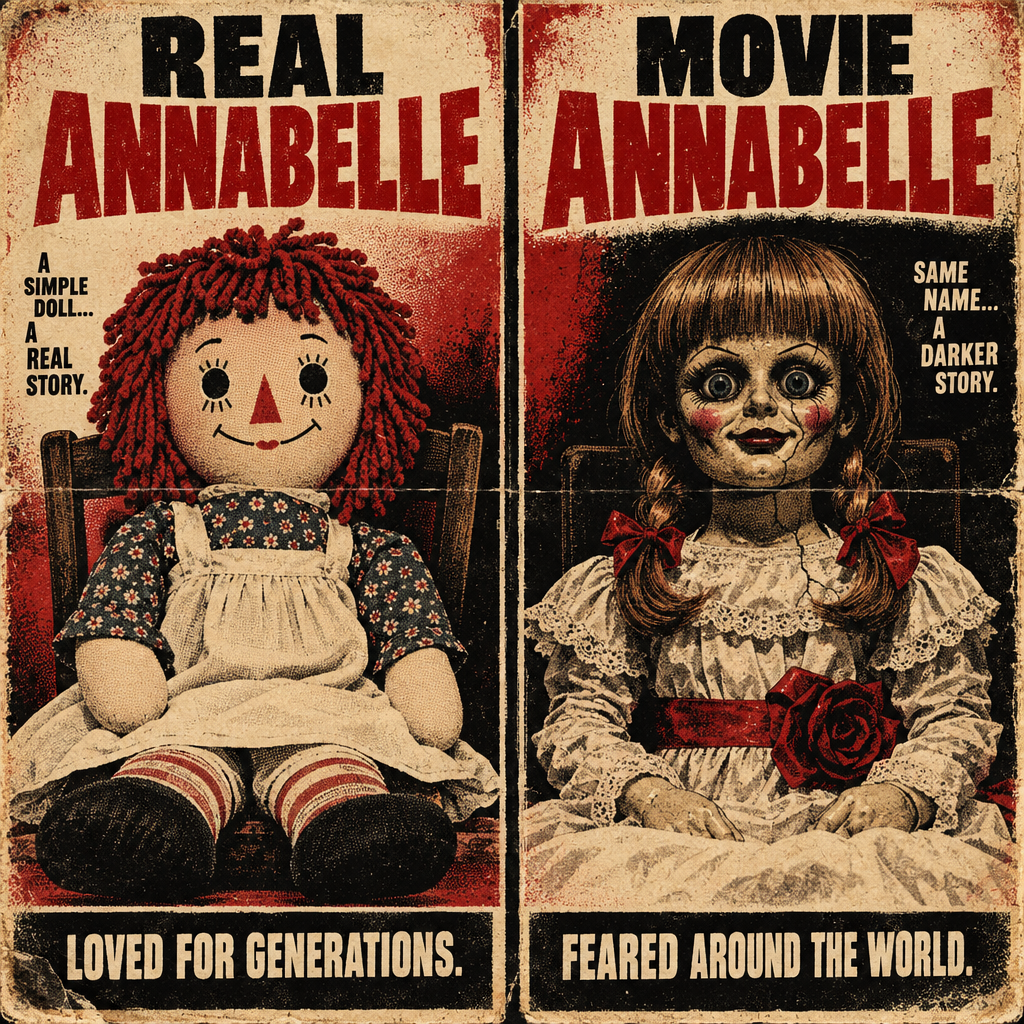
The real Annabelle doll is a cloth Raggedy Ann, not the cracked porcelain thing from the films, and it sits locked in a glass case at the Warrens’ Occult Museum in Monroe, Connecticut. The story attached to it comes almost entirely from Ed and Lorraine Warren and the nursing student who owned it in 1970. I’ve spent years comparing the case files, the books and the movies, so here is what the doll actually looks like, what supposedly happened, and how much of it survived the trip to the screen.
Is Annabelle a real doll?
Yes. There is a physical doll, and it has been in the Warren family’s possession since around 1970. That part is not in dispute.
What is in dispute is everything else. Nobody outside the Warrens’ circle has ever documented the doll moving, writing notes or hurting anyone. The accounts come from Ed and Lorraine Warren’s lectures, their 1980 book with Gerald Brittle, “The Demonologist”, and the museum’s own telling. I treat the Annabelle story the way I treat the Amityville story: a real object with an oral history built around it.
So when people search “is the Annabelle doll real”, the honest two-part answer is: the doll is real, the haunting is unverified.
What does the real Annabelle doll look like?
This is the question that surprises most first-time museum visitors, and it surprised me too.
The real Annabelle is a standard Raggedy Ann. Red yarn hair, a soft cloth body, a triangle nose, button-style eyes and a printed heart on the chest, the same mass-produced toy millions of American kids had on their beds. The Warrens’ doll is large for the type, roughly three feet tall, and the decades have left it faded and a little slumped.
She sits in a wooden case with a glass front, a crucifix mounted inside, and a hand-lettered sign that reads “WARNING: POSITIVELY DO NOT OPEN”. Tony Spera, the Warrens’ son-in-law, has said the case is blessed regularly and that the doll is never handled casually.
Here is how the real doll stacks up against the movie version.
| Feature | Real Annabelle (Warren museum) | Movie Annabelle (The Conjuring films) |
|---|---|---|
| Doll type | Raggedy Ann rag doll | Original porcelain-style prop built for the film |
| Material | Cloth body, yarn hair | Hard sculpted face, fabric body, painted cracks |
| Face | Smiling, friendly, printed features | Wide glassy eyes, rouged cheeks, cracked finish |
| Size | About 3 feet | Roughly life-size for a large child’s doll |
| Clothing | Classic Raggedy Ann dress and pinafore | White dress with red bows and lace |
| First owner in the story | Donna, a nursing student, 1970 | Mia Form, 1960s Santa Monica (2014 film) |
| Where it lives now | Warrens’ Occult Museum, Monroe, CT | Warner Bros. prop archive and licensed replicas |
Why the swap? James Wan has said a smiling Raggedy Ann does not read as scary on camera, and Raggedy Ann is a trademarked character owned by another company. So the production designed its own doll for The Conjuring in 2013. That design has since become the face of the whole franchise.
The true story of the Annabelle doll
The case has a surprisingly tight timeline. All of these dates come from the Warrens’ version of events.
| Year | Event in the Warren account |
|---|---|
| 1970 | Donna’s mother buys the Raggedy Ann from a hobby shop as a birthday gift |
| 1970 | Donna and roommate Angie notice the doll changing position and rooms |
| 1970 | Parchment notes reading “Help us” and “Help Lou” appear in the apartment |
| 1970 | A medium holds a seance and names a spirit, Annabelle Higgins, age seven |
| 1970 | Friend Lou reports a choking nightmare, then claw marks on his chest |
| 1970 | An Episcopal priest refers the case to Ed and Lorraine Warren |
| 1970 | The Warrens take the doll home; Ed has a case built for it |
| 1980 | “The Demonologist” by Gerald Brittle publishes the story in full |
| 2013 | The Conjuring opens with a fictionalised version of the case |
| 2019 | Lorraine Warren dies; the museum closes to walk-in visitors |
A birthday gift for a nursing student
Donna was a 28-year-old nursing student living in a small apartment with her roommate Angie. Her mother gave her the doll for her birthday in 1970. Donna put it on her bed and thought nothing more of it.
Within days, according to the Warrens, the doll was not where she had left it. At first the changes were small. Arms crossed when they had been straight, legs folded when they had been standing. Then the doll turned up in other rooms with the apartment door locked, sometimes sitting upright on a chair, sometimes kneeling, a posture a floppy rag doll cannot hold on its own.
Notes, a seance and “Annabelle Higgins”
The notes are the detail that always gets me. Donna and Angie reportedly found scraps of parchment paper around the apartment with “Help us” or “Help Lou” written in what looked like a child’s hand. Neither woman owned parchment paper.
They called in a medium. The medium told them the spirit of a seven-year-old girl named Annabelle Higgins had died on the land the apartment stood on and had attached herself to the doll because she felt safe with the two nurses. Donna, being kind, gave the spirit permission to stay.
Ed Warren later said that permission was the mistake the whole case turned on.
Lou and the claw marks
Lou was a friend of the two women and never liked the doll. In the Warren account he had a nightmare of the doll climbing his body and strangling him. Not long after, while alone in the apartment with Angie, he heard rustling from Donna’s room, went to check, and felt a sudden burning pain. His shirt was soaked with blood from several parallel scratches across his chest.
The marks healed within two days, far faster than normal cuts. That healing speed is one of the recurring “tells” the Warrens used to argue for a demonic presence rather than a ghost.
Enter the Warrens
Donna reached out to an Episcopal priest, who passed the case to another priest, who called Ed and Lorraine Warren. The Warrens ran the New England Society for Psychic Research out of Monroe and had been investigating hauntings since the early 1950s.
Their conclusion flipped the medium’s reading on its head. In Ed’s view, human spirits do not possess objects. Something inhuman had been manipulating the doll to win the women’s sympathy, with the end goal of possessing Donna herself. The Warrens arranged a blessing of the apartment and asked to take the doll away.
The drive home and the case
Ed Warren liked to tell the story of the drive back to Monroe. He avoided the interstate, and he claimed the car’s brakes and steering kept failing on bends until he sprinkled holy water on the doll in the back seat. At home he set the doll on a chair beside his desk. Over the following days he said it moved around the office, and that a visiting priest who dismissed it as “just a rag doll” was in a car accident on the way home.
The most repeated story involves a young man who visited the museum, mocked the doll, tapped on its case and asked it to do something. The Warrens said he died in a motorcycle crash on the way home. I have never found an independent record of that incident, and I’ve looked. That does not make it false. It makes it folklore.
Ed had the glass case built, added the crucifix and the sign, and the doll has stayed put ever since.
The Warrens’ Occult Museum and the doll today
The museum occupied the basement of the Warrens’ house in Monroe, Connecticut, and for decades you could book a tour and stand a couple of feet from the case. I’d describe it as a cramped, over-stuffed room of crucifixes, masks and framed warnings, with Annabelle given pride of place.
Ed died in August 2006. Lorraine died in April 2019, aged 92. That same year the town’s zoning rules caught up with the house, which had never really been permitted to operate as a public attraction, and the museum closed to walk-in visitors. Tony and Judy Spera, the Warrens’ son-in-law and daughter, now steward the collection and have talked about relocating it.
The 2020 “Annabelle escaped” hoax
In August 2020 a rumour spread on Twitter that the doll had escaped the museum. It started as a joke tied to a mistranslated interview and snowballed into trending-topic territory within hours. Tony Spera posted a video from the museum showing the doll still in her case. It was a very 2020 moment, and it told me something: people want this doll to be real badly enough to panic over it.
The 2025 tour and Dan Rivera
The doll started travelling in early May 2025 under NESPR’s “Devils on the Run” tour, with stops that let fans see the case up close for the first time since the museum closed. In May 2025 the tour hit New Orleans, and when the Nottoway Plantation in Louisiana burned down that same week, the internet immediately blamed Annabelle. The timing was coincidence, but it shows how the legend now generates its own news.
Then came the stop in Gettysburg, Pennsylvania. Dan Rivera, NESPR’s lead investigator and the man who had been fronting the tour alongside Spera, died suddenly in his hotel room on 13 July 2025, aged 54. The Adams County coroner reported nothing unusual or suspicious about the death. Social media, predictably, blamed the doll. Spera and NESPR pushed back hard and asked people to let Rivera’s family grieve. I think that is the right line to take, and it’s a reminder that real people live inside this legend.
How the Conjuring films changed the Annabelle story
The movies keep the Warrens, keep the nursing students, keep the case in the museum, and throw out almost everything else. Here is every film the doll appears in, with where I’d point you to watch them in the US at the time of writing. Streaming rights move around, so check the services the month you plan to watch.
| Film | Year | Director | Studio | Scare level | Where to watch (US) |
|---|---|---|---|---|---|
| The Conjuring | 2013 | James Wan | New Line / Warner Bros. | 4/5 | HBO Max, rent on Apple TV and Prime Video |
| Annabelle | 2014 | John R. Leonetti | New Line / Warner Bros. | 3/5 | HBO Max, rent on Apple TV and Prime Video |
| Annabelle: Creation | 2017 | David F. Sandberg | New Line / Warner Bros. | 4/5 | HBO Max, rent on Apple TV and Prime Video |
| Annabelle Comes Home | 2019 | Gary Dauberman | New Line / Warner Bros. | 3/5 | HBO Max, rent on Apple TV and Prime Video |
| The Conjuring: Last Rites | 2025 | Michael Chaves | New Line / Warner Bros. | 3/5 | Theatrical run then HBO Max |
Gary Dauberman wrote all three Annabelle films, which is why they hang together better than most spin-off series.
The Conjuring (2013)
Annabelle only gets the prologue here, a short case-file scene with two nursing students, but it was enough to launch a sub-franchise. The real meat of the film is the Perron family haunting in Rhode Island, which the Warrens investigated in 1971. James Wan’s clap-game scene and the wardrobe sequence are craft lessons in building dread with a camera. It regularly turns up on greatest horror lists for a reason.
The doll’s design, cracked porcelain and all, debuts here. It is the moment the fictional Annabelle replaced the real one in the public imagination.
Annabelle (2014)
John R. Leonetti, Wan’s cinematographer on The Conjuring, directed this origin story about a young couple, Mia and John Form, in late-1960s California. Annabelle Wallis plays Mia, Ward Horton plays John, and Alfre Woodard steals the back half as a bookshop owner who understands what is in the house.
It was made for a reported budget of around $6.5 million and took roughly $257 million worldwide, which is the single biggest reason the Conjuring Universe became a thing. Critics were cool on it, and I understand why. It leans on jump scares and borrows the “Rosemary’s Baby” apartment-block setup wholesale. But the basement elevator scene is one of the better set pieces in the series, and the cult angle gives the doll a backstory the real case never had.
The real-world connection is thin. The nursing student prologue from The Conjuring is reworked as the epilogue, and Annabelle Higgins becomes a murderer rather than a seven-year-old ghost.
Annabelle: Creation (2017)
David F. Sandberg, fresh off Lights Out, made the film most fans consider the best of the three. The setup moves to 1955, where a dollmaker named Samuel Mullins (Anthony LaPaglia) and his wife Esther (Miranda Otto) take in a nun and six orphan girls. Talitha Bateman’s Janice, recovering from polio, becomes the entity’s target.
Sandberg frames scares like a short-film director, which is what he was before Hollywood. The stairlift sequence and the scarecrow in the barn are brilliantly staged, and the orphans feel like actual kids rather than props. If you can only watch one Annabelle film, this is the one.
Nothing here touches the Warren account at all. It is pure invented mythology, and it is better for it.
Annabelle Comes Home (2019)
Dauberman stepped up to direct and made a haunted-house funhouse ride set inside the Warrens’ artifact room. Vera Farmiga and Patrick Wilson bookend the film, but the real leads are Mckenna Grace as young Judy Warren, Madison Iseman as her babysitter and Katie Sarife as the friend who opens the case.
This is the film that comes closest to the real museum. The glass case, the warning sign, the crucifix and the “do not open” rule are all lifted from Monroe. Everything else in the room, the Ferryman, the bride’s dress, the werewolf, is invented. It is the gentlest entry and the one I’d hand to a 13-year-old who wants to say they have watched an Annabelle movie.
The Conjuring: Last Rites (2025)
Michael Chaves’ franchise send-off, released in September 2025, tackles the Smurl family haunting in West Pittston, Pennsylvania, set in 1986. It is more family drama than fright machine, built around Ed’s heart condition and Judy’s adult life. It also became the highest-grossing film in the whole series, passing $400 million worldwide. Annabelle is background furniture here rather than a plot engine, but the museum set is the most detailed recreation of the real basement the films have produced.
What the films got right and wrong
A quick scorecard, because fans argue about this constantly.
Right:
– A Raggedy Ann owned by nursing students in 1970. The Conjuring prologue keeps this, even if the doll looks different.
– The parchment notes and the medium’s reading. Both appear in the prologue dialogue.
– Ed’s position that demons, not ghosts, work through objects.
– The case, the sign and the rule that the doll is never to be touched.
Wrong, or invented:
– The porcelain design. The real doll never looked like that.
– The Higgins murders and the cult. No such crime exists in the case file.
– The orphanage, the dollmaker and 1955. Pure Creation mythology.
– Any suggestion the doll physically attacks people on camera. The real account is about movement, notes and one set of scratches.
If you enjoy pulling apart true-crime-to-screen liberties, the same exercise works well with the “ed gein netflix” material, where a single real person inspired three wildly different fictional killers.
Buying an Annabelle replica
Every October the costume shops push Annabelle hard, and the search results for the doll are now half retail. Spirit Halloween sells a licensed “distressed” Annabelle replica based on the film prop, and Trick or Treat Studios has produced its own screen-accurate version. Both are the porcelain-look movie doll, not the Raggedy Ann.
A few things I’ve learned from owning one and seeing a lot of them on shelves:
- The affordable replicas are moulded plastic, not porcelain, so the crack lines are painted. Check the face in the box for smeared paint before you buy.
- Most are display pieces. The dress is thin, the body is stuffed, and the joints are not built for posing.
- If you want the real-doll look, a vintage 36-inch Raggedy Ann from a thrift store, a little sun-faded, is far creepier on a shelf than any movie replica. Add a glass cabinet and a printed sign and you’ve got the museum version for a fraction of the cost.
- Stock sells out fast in the days before Halloween. Order early in October or you’ll be hunting resale listings.
One honest note: the doll on your shelf is a toy. The number of people who message me convinced their replica moved overnight is higher than you would think. A cat, a draft and a thin plastic base explain all of them so far.
Ghost or demon? What the Warrens actually claimed
I want to be precise here, because the films muddy it.
The medium’s claim was a ghost: a dead child named Annabelle Higgins. The Warrens rejected that. Ed argued the entity was inhuman, meaning a demon in his Catholic-adjacent framework, and that it used the sympathetic story of a lost girl as bait. In his telling, the doll was never “possessed” the way a person can be. It was a conduit, an object being moved and manipulated from outside to build a relationship with Donna.
That distinction matters for the movies. The films treat the doll as the vessel, and the entity as something that wants to escape it. The Warrens would have said the doll was never the point. Donna’s soul was.
Why skeptics don’t buy it
The case rests on testimony. Nobody photographed the doll in a new position, nobody kept the parchment notes, and Lou’s scratches were not examined by a doctor. Skeptical investigators, Joe Nickell among them, have pointed out that the Warrens’ cases consistently lack physical evidence and consistently end with the Warrens taking custody of a dramatic artifact.
Donna and Angie never spoke publicly under their full names, so no journalist has been able to re-interview them. The seance, the notes and the healing scratches all come filtered through Ed and Lorraine’s retellings over three decades of lectures, and the details drift from one version to the next.
I don’t say this to spoil the fun. The Warrens were extraordinary storytellers, and Lorraine in particular came across as completely sincere. But I’d put Annabelle in the same drawer as the Bell Witch and Robert the Doll in Key West: a great haunted-object tale with no case to stand up in court.
Spoilers: how the Annabelle films connect
Spoiler warning
The endings of Annabelle (2014), Annabelle: Creation (2017) and Annabelle Comes Home (2019) are discussed below, including how the three films link together.
Creation ends with Janice fully possessed. She escapes the Mullins farmhouse and is adopted by a couple named Higgins, who rename her Annabelle. An epilogue jumps forward twelve years to the Higgins family’s home in Santa Monica, where the adult Annabelle and her cult boyfriend murder her parents. That scene is the opening of the 2014 film, replayed from inside the house.
Annabelle (2014) ends with Evelyn, the bookshop owner, jumping from the apartment window holding the doll to spare Mia from sacrificing herself. The doll vanishes from the pavement. Months later it reappears in an antique shop, where a mother buys it as a gift for her daughter, a nursing student. That hands the baton straight to The Conjuring’s prologue.
Annabelle Comes Home is the one that returns the doll to the case. After Daniela unlocks it, the spirits in the museum run wild for a night. Judy and the two babysitters trap the doll again, Ed and Lorraine come home to find the chaos, and a priest re-blesses the case. The final shot is the doll sitting behind glass under the familiar sign.
So the story order is Creation (1955), Annabelle (late 1960s), The Conjuring prologue (nursing students), then Comes Home (early 1970s in the Warren house). Release order is 2013, 2014, 2017, 2019. Watch in release order the first time. Story order makes a fun rewatch once you know the ending beats.
If you liked this
Child’s Play (1988), directed by Tom Holland, for the doll-horror blueprint with actual stabbing. Poltergeist (1982) for the clown doll that traumatised a generation. Dead Silence (2007), James Wan’s own ventriloquist dummy movie, for a rougher early draft of his Conjuring style.
FAQ
Is the Annabelle doll real?
The doll is real and has been kept by the Warren family in Monroe, Connecticut, since 1970. The haunting story is unverified and rests entirely on the accounts of Ed and Lorraine Warren and the doll’s original owner.
What did the real Annabelle doll look like?
A large Raggedy Ann rag doll, about three feet tall, with red yarn hair, a cloth body and the printed heart on its chest. It looks nothing like the porcelain doll in the films.
Why does the movie Annabelle look different?
James Wan’s team designed a new doll for The Conjuring in 2013 because a smiling Raggedy Ann is not frightening on screen and the character is trademarked. The cracked porcelain look has been used across the whole franchise since.
Can you visit the real Annabelle doll?
The Warrens’ Occult Museum closed to the public in 2019 after zoning issues. Since early May 2025 the doll has travelled with NESPR’s “Devils on the Run” tour events, so the only way to see it is to catch an announced stop.
Did the Annabelle doll kill anyone?
No documented death has ever been tied to the doll. The motorcycle-crash story and the 2025 death of investigator Dan Rivera are both repeated online, but the first has no independent record and the second was found to have nothing unusual or suspicious about it.
Which Annabelle movie is the scariest?
Annabelle: Creation (2017). David F. Sandberg builds the best set pieces in the series, and it is the entry I’d pick for a lights-off solo watch. Annabelle Comes Home is the easiest for younger or nervous viewers.