

The Conjuring sold itself as “based on the true case files of the Warrens,” and the Perron family it portrays were real people who lived in a real Rhode Island farmhouse. How much of the 2013 movie actually happened is a different question. Below, we lay out what’s documented, what the family claims, and what James Wan’s film invented, side by side.
Spoiler warning
This piece spoils the full plot of The Conjuring (2013), including the ending.
The short answer: is The Conjuring a true story?
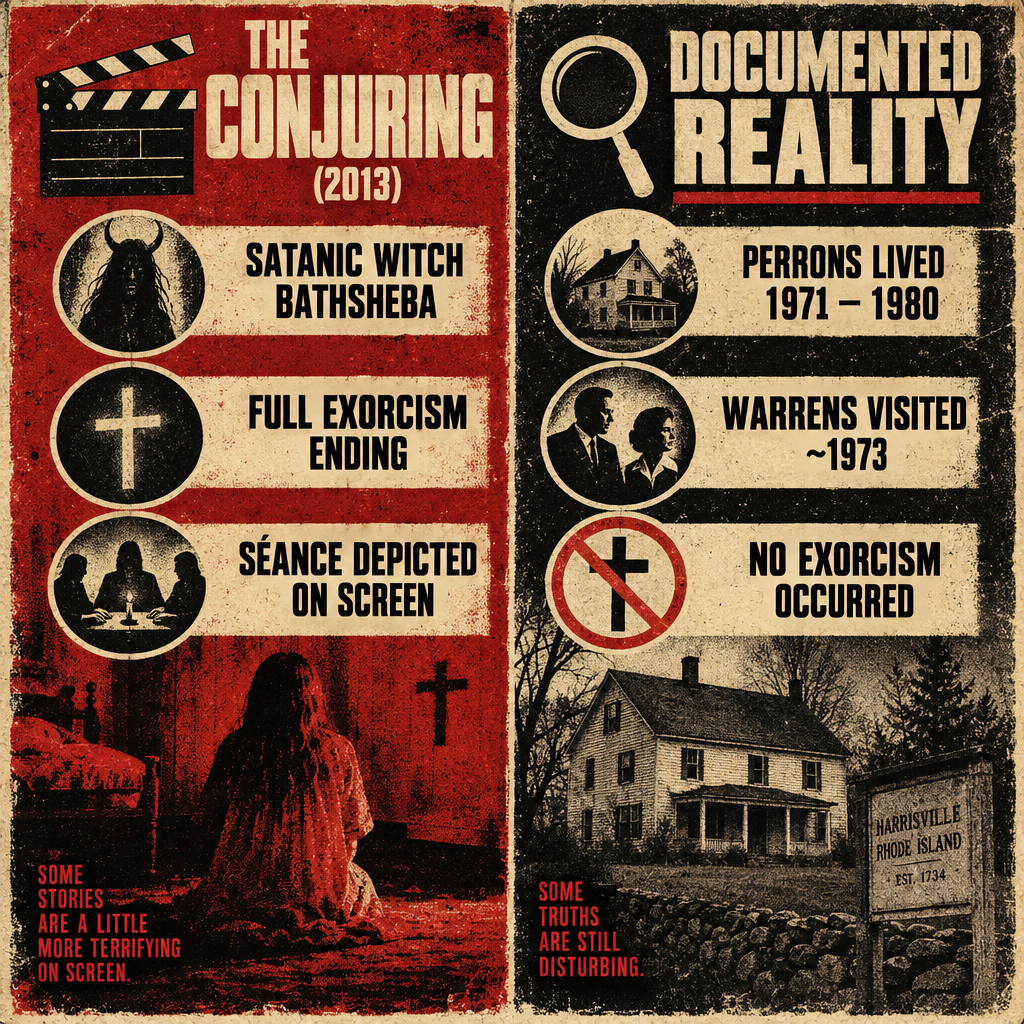
Partly. The Perrons existed, they lived in the farmhouse from 1971 to 1980, and Ed and Lorraine Warren did visit them. Everything supernatural rests on personal testimony, mainly from the eldest daughter, Andrea Perron, and from the Warrens. None of it has been independently verified. The film’s ending, with an exorcism that frees the family, did not happen.
We’ll grade every source as we go. That matters because this story has three distinct layers: public records, first-hand family memoir, and claims from paranormal investigators with a disputed reputation.
The Perron family and the Harrisville farmhouse
These parts are documented. Roger and Carolyn Perron moved their five daughters (Andrea, Nancy, Christine, Cindy and April) into an old farmhouse in Harrisville, a village in Burrillville, Rhode Island. The family has consistently dated the move to January 1971.
The property is often called the Arnold Estate, after the family that held it for generations. It’s a sprawling 18th-century house surrounded by woods and old farmland. It looks almost exactly like a haunted house should, which goes some way to explaining why Hollywood wanted it.
The Perrons stayed until 1980. That’s close to a decade in a house they say was crowded with spirits. The real reason they didn’t leave sooner is plain and very human, and we’ll get to it below.
What the Perrons say happened
Our main source here is Andrea Perron’s trilogy, House of Darkness House of Light. The first volume came out in 2011, two years before the movie. Treat it as first-hand memoir: sincere, detailed, and impossible to check.
According to Andrea, the activity started small and then got worse:
- Subtle signs early on: brooms moving on their own, items going missing, and the smell of rotting flesh drifting through rooms with no source anyone could find.
- Spirits with personalities: some felt harmless or even protective, while others felt hostile.
- Physical events: Andrea has said her own bed levitated, and that beds shook at night.
- A presence aimed at Carolyn: the family believed one spirit had singled out their mother. Andrea has described a puncture wound appearing on Carolyn’s leg, along with periods when her mother seemed drained and changed.
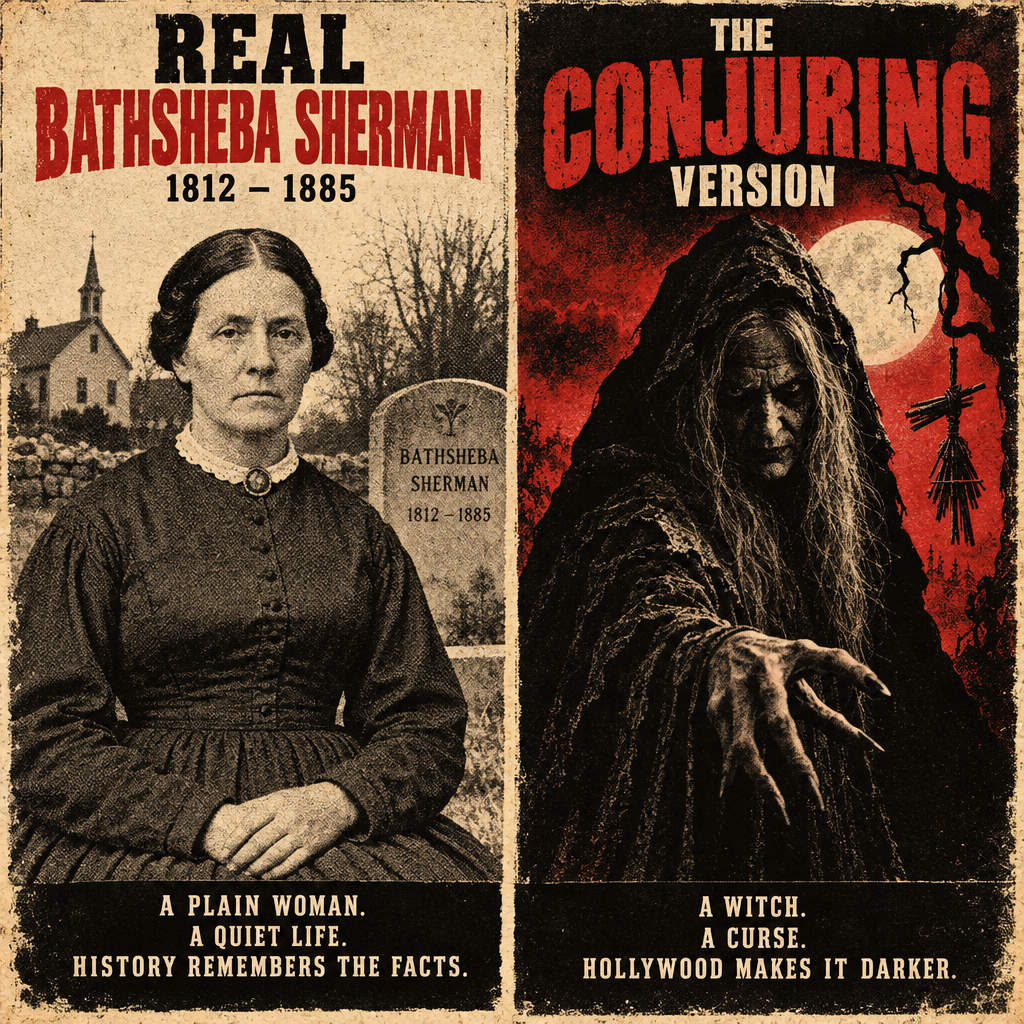
The family linked that hostile presence to a woman named Bathsheba Sherman, who had lived in the area in the 1800s. Andrea has also passed along stories of earlier deaths connected to the property, including suicides and a drowning. We haven’t seen those stories tied to specific records, so they stay firmly in the “claimed” column.
One point in the family’s favor: they haven’t changed their story to cash in on the film. Andrea’s books came first, and the sisters have mostly stood by the same core account in interviews over the years.
Ed and Lorraine Warren, the investigators behind the Perron family haunting
Ed and Lorraine Warren founded the New England Society for Psychic Research in 1952. Ed called himself a demonologist, and Lorraine described herself as a clairvoyant and light-trance medium. They became famous through the Amityville case in the 1970s, and later through books, lectures and their occult museum in Monroe, Connecticut. Ed died in 2006. Lorraine died in 2019.
On reliability, it’s fair to say their record is mixed. Believers saw them as tireless helpers of frightened families. Skeptics, including investigators like Joe Nickell, have argued their cases leaned heavily on dramatic storytelling and couldn’t stand up to scrutiny. The Conjuring films present them as heroes, and Lorraine served as a consultant on the first movie. She even has a brief cameo in the audience of one of Ed and Lorraine’s lectures.
The Warrens reportedly visited the Perron house in the early 1970s, with most accounts placing it around 1973 or 1974. Here the real story turns darker and messier than the movie. Andrea has described a séance during which her mother spoke in a voice that didn’t sound like her own, and a chair rose and Carolyn was thrown across the room. Roger, terrified and furious, reportedly ordered the Warrens out of the house.
Keep in mind that this is the family’s account, filtered through a child’s memory and retold decades later. Some versions of the story differ on details, including the exact year.
Bathsheba Sherman: the real woman vs. the movie witch
This is where the film takes its biggest liberties, and where a real person gets treated unfairly.
What the records support: Bathsheba Sherman was a real Burrillville resident who lived from 1812 to 1885. She married Judson Sherman and is buried in a local cemetery in Harrisville. Local legend says an infant died in her care and that she fell under suspicion. She was never convicted of anything.
What the movie adds: a Satan-worshipping witch descended from Mary Eastey (one of the women executed during the 1692 Salem trials), who sacrifices her baby and hangs herself from a tree on the property after cursing the land. None of that is rooted in any record we know of. The real Bathsheba died in her seventies, not by suicide.
This matters. The Conjuring turned a woman with a sad, rumor-stained life into a demonic villain. Local historians have pushed back on that version for years, and we think fans should know where the line falls.
Movie vs. real life: side-by-side comparison
| Detail | The Conjuring (2013) | Documented record | Perron family account |
|---|---|---|---|
| The family | Roger, Carolyn and five daughters | Real, same names | Same |
| Move-in date | 1971 | Consistent with family dating | January 1971 |
| Length of stay | A few months of story time | Roughly 1971 to 1980 | Nearly a decade |
| Bathsheba Sherman | Witch who sacrificed her baby and cursed the land | Real woman, 1812 to 1885, never convicted | Believed she haunted Carolyn |
| Smell of rotting flesh | Shown | Unverifiable | Reported |
| Levitation | Carolyn levitated during the climax | Unverifiable | Andrea’s bed; a chair at the séance |
| Warrens’ role | Investigate, gather evidence, save the family | Visited, per multiple accounts | Visited; séance went badly; asked to leave |
| Exorcism | Ed performs one, Carolyn freed | No record of an exorcism | Didn’t happen |
| How it ended | The family is rescued | Family moved in 1980 | Left when they could afford to |
How the Perron family haunting ended in real life vs. The Conjuring
In the movie, the Warrens can’t wait for Church approval, so Ed performs the exorcism himself. Carolyn, possessed, nearly kills one of her daughters before the family’s love breaks through. The demon is cast out, and the Perrons are saved. It makes for a great horror climax and a total fiction.
In real life there was no exorcism and no tidy rescue. After the séance, the Warrens were out of the picture. The family has said they stayed for years afterward simply because money was tight and moving a household of seven wasn’t affordable. Roger reportedly took a job that eventually let them relocate, and they left in 1980.
Honestly, we find the real version more horrifying. Living with something you believe wants to hurt your mother, and staying because you can’t pay to leave, is a slow, grinding kind of fear. The movie went for the exorcism because it gives the audience relief. The real family never had that moment.
Who owns the Conjuring house now?
The house has been sold several times since the Perrons left. Norma Sutcliffe and Gerry Helfrich bought it in 1987 and, after the film came out, dealt with a steady stream of trespassers. They filed a lawsuit against Warner Bros. over the attention.
In 2019, Cory and Jennifer Heinzen, both paranormal investigators, bought the house for a reported $439,000 and opened it to overnight stays and investigations. In 2022 it sold again, reportedly for $1.525 million, to Jacqueline Nunez. Ownership and tour arrangements have kept changing, so check the property’s current official channels before planning any trip. Please don’t show up uninvited. People live and work there.
The movie wasn’t shot there, by the way. Production filmed in and around Wilmington, North Carolina, in 2012.
Which version of the story should you choose?
There are three ways to engage with the Perron story, and they offer very different experiences.
The movie: The Conjuring (2013)
Directed by James Wan, written by Chad Hayes and Carey W. Hayes, starring Vera Farmiga and Patrick Wilson as the Warrens, with Lili Taylor and Ron Livingston as Carolyn and Roger. It opened July 19, 2013 and grossed around $319 million worldwide on a roughly $20 million budget. It famously earned an R rating with no gore, sex or language to blame. The ratings board cited “sequences of disturbing violence and terror.”
Pros
– One of the best-crafted haunted house films of the century. The “hide and clap” scene alone is worth it.
– Low gore, so it suits viewers who love dread but hate blood.
– A great entry point to the wider universe, starting with the opening prologue featuring the “annabelle doll“.
Cons
– It plays fast and loose with Bathsheba Sherman and invents the ending.
– It treats the Warrens as unquestioned heroes.
Where to watch: Warner Bros. owns the film, so it usually lives on HBO Max and is widely available to rent or buy digitally. We weren’t able to confirm live availability or rental prices for this Halloween, and licensing deals rotate, so check your service before movie night. The main series wrapped with The Conjuring: Last Rites in September 2025, if you plan to binge all of it.
The books: House of Darkness House of Light
Pros
– The closest thing to a primary source on the haunting, written by someone who lived it.
– Rich in day-to-day detail the movie had no room for.
Cons
– Long. The trilogy is a big commitment.
– Memoir, not evidence. Nothing in it can be independently checked.
The house itself
Pros
– Standing in the real rooms hits differently. You can make up your own mind about the atmosphere.
Cons
– Access, prices and tour formats depend on whoever owns it at the time, and they change.
– It’s expensive and far for most fans, and a tour can’t show you anything the books haven’t described.
Our verdict
Start with the movie for the scares, then read at least the first volume of Andrea Perron’s trilogy for the real story. The film is the better horror experience by a mile. The books are the better window into what the family believes happened. Visit the house only if you’re already deep in the lore and can confirm a legitimate, booked visit.
If you liked this
The Conjuring 2 (2016): Wan returns and takes on the Enfield case, with even bigger set pieces.
The Amityville Horror (1979): the other famous “true” haunting the Warrens are tied to, with a very different 1970s feel.
The Haunting (1963): Robert Wise proves a house can terrify you without showing a single ghost.
FAQ
Is The Conjuring based on a real family?
Yes. Roger and Carolyn Perron and their five daughters lived in the Harrisville, Rhode Island farmhouse from 1971 to 1980. The supernatural events come from the family’s and the Warrens’ accounts and can’t be verified.
Was Bathsheba Sherman really a witch?
No evidence supports that. She was a real local woman who lived from 1812 to 1885. Legend says she fell under suspicion over an infant’s death, but she was never convicted. The witch backstory and the Salem lineage were created for the movie.
Did Ed Warren perform an exorcism on Carolyn Perron?
No. There’s no record of an exorcism. By the family’s account, a séance went badly and Roger asked the Warrens to leave.
Did anyone die in the real Perron haunting?
No member of the Perron family died because of the haunting. Stories about earlier deaths on the property come from local lore and the family’s research, not from records we could tie to specific events.
Can you visit the Conjuring house?
At times, yes. Recent owners have offered tours and overnight investigations, but access depends on the current owner. Only visit through an official booking, and never trespass.