

Resident Evil 2 is Capcom’s 1998 survival horror sequel for the original PlayStation, directed by Hideki Kamiya and produced by Shinji Mikami. It scares you through scarcity and blindness: tank controls, fixed camera angles that hide what is around the corner, a police station where things keep coming through the windows, and a giant stalker who ignores the door you just slammed. My verdict up front: play the original at least once, even if the 2019 remake is the Resident Evil 2 you grew up with.
Story and setting
It is late September 1998 in Raccoon City, a Midwestern American town owned in all but name by the Umbrella Corporation. Two months have passed since the S.T.A.R.S. disaster at the Spencer mansion in the first game. Something has gone very wrong in the city since then.
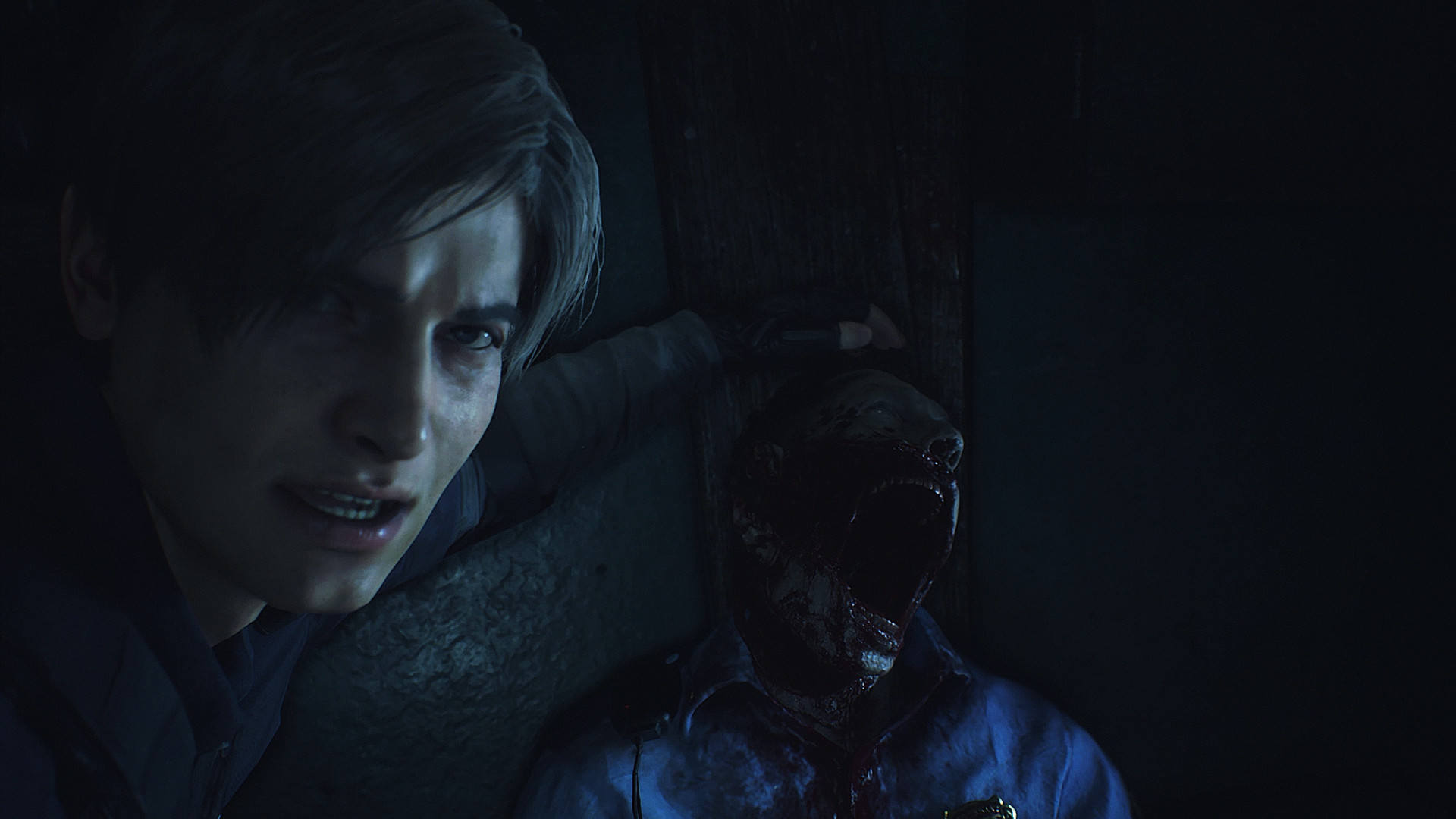
You play as one of two people who arrive on the same bad night. Leon S. Kennedy is a rookie cop reporting for his first day with the Raccoon Police Department. Claire Redfield is a college student riding into town on her motorcycle to look for her brother Chris, one of the survivors from the first game. They meet in the street, get separated almost immediately, and each heads for the one place that should be safe: the police station.
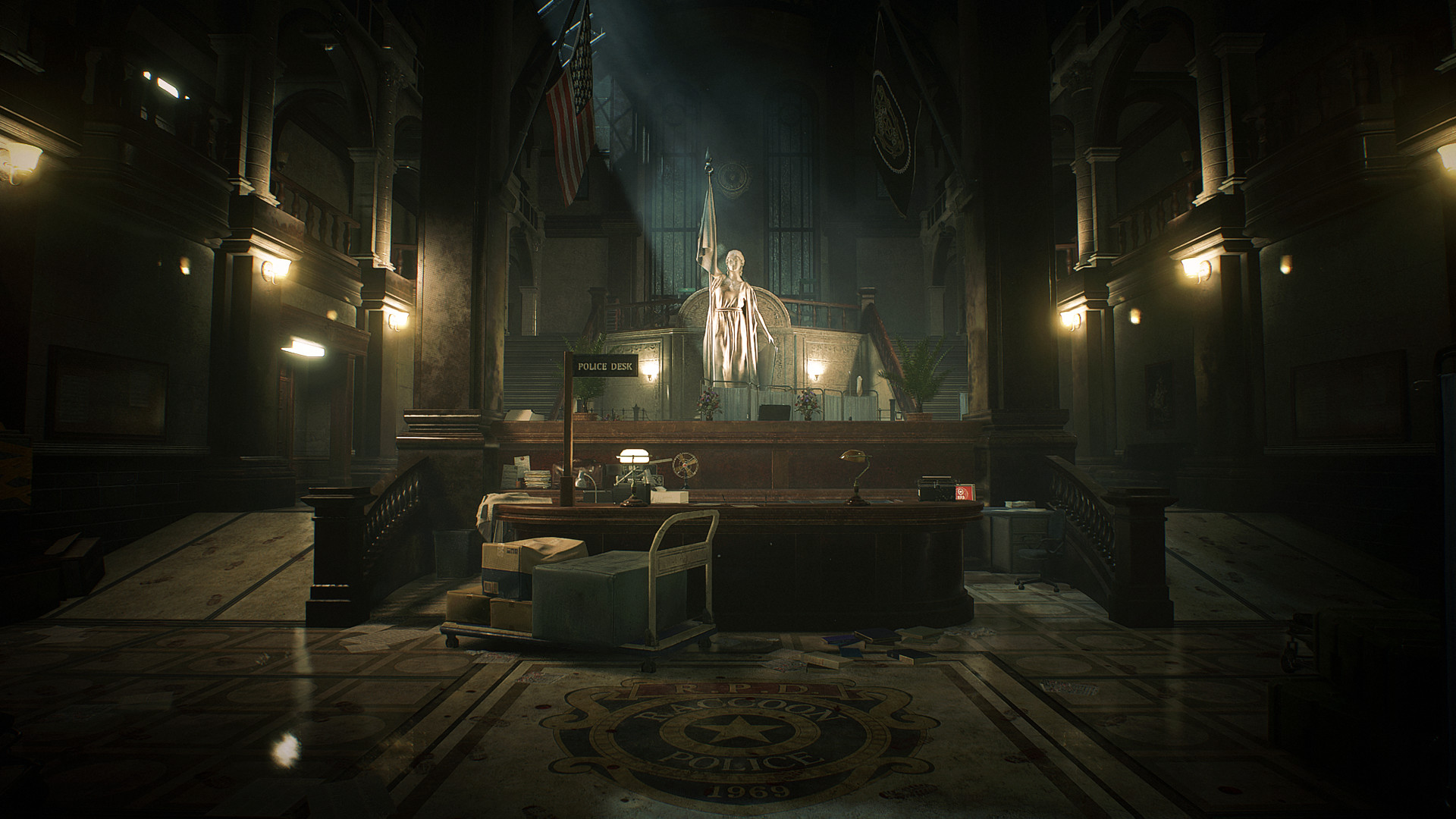
It is not safe. The RPD building is a converted art museum, full of statues, hidden switches and puzzle locks that make no sense for a police station and perfect sense for a Resident Evil game. From there the story drops you into the sewers and then deeper, into places Umbrella never wanted anyone to see.
Along the way you meet a small cast of survivors. Leon crosses paths with a mysterious woman named Ada Wong and a jailed reporter. Claire finds a frightened little girl named Sherry and the station’s deeply strange police chief. I won’t say more than that here. The voice acting is classic late-90s Capcom, which means a little stiff but far better than the first game. Leon is voiced by Paul Haddad, who died in 2017, and Claire by Alyson Court, who returned for the next Claire game.
The big structural trick is the “zapping system.” You pick Leon or Claire for your first run (the A scenario), then play the other character’s B scenario afterwards. The B run happens in parallel with the A run, and choices in the first one change what you find in the second. One pair tells the full story. Two pairs tell it from both angles.
How it scares you
I first played this on a borrowed PlayStation with the lights off, and what I remember most is not a monster. It is the sound of my own footsteps on the RPD tile floor, and the dread of knowing a door was about to load. That mix of quiet and anticipation is the engine of the whole game.
Enemies that keep escalating
Zombies are slow, but they come in groups, and they take more bullets than you want to spend. The game keeps adding to them. Crows, giant spiders, mutated dogs and plant creatures all show up, plus a sewer alligator for one memorable set piece.
The new monster everyone remembers is the Licker. Your first hint is a shape crawling past a window. When you finally meet one, it has an exposed brain, a long tongue and claws, and it hits hard enough to put you into the “Danger” health state fast. Lickers are blind and hunt by sound, so they also teach you to move more carefully.
Then there are the bosses. William Birkin keeps coming back throughout the game, each form more grotesque than the last. Every fight with him feels like a resource check you might fail.
Ink ribbons and the item box
You save at typewriters, and every save costs an ink ribbon. Ribbons are limited, so every save is a decision. Did I just burn a ribbon after two rooms, or do I push on with low health and a door I haven’t opened yet?
Inventory is tiny, and anything extra goes in magic item boxes in safe rooms. You cannot carry everything. You will leave a shotgun behind and then meet a Licker in a hallway, holding a handgun and a crank.
Those safe rooms are the emotional anchor. The save room music in RE2 is one of the most calming pieces in horror gaming. It works because everything outside those rooms is the opposite.
The camera is lying to you
Resident Evil 2 uses pre-rendered backgrounds with fixed camera angles. The camera often frames a hallway so you can hear a zombie groaning but cannot see it. You walk forward because you have to, and the shot cuts right as something lunges.
Tank controls make it worse, in a good way. Turning around takes time. Running and shooting at once is off the table. Combined with the camera, each corner becomes a small gamble.
Door transitions add another beat of tension. Those creaking door animations were there to hide load times, but in practice they work like a held breath.
Sound design
Sound carries more of the horror than the graphics now. Zombies groan off screen. Glass shatters before arms come through boarded windows. Licker claws click on the floor. The soundtrack by Masami Ueda, Shusaku Uchiyama and Syun Nishigaki moves between eerie ambience and alarm-bell boss themes.
Wear headphones. A lot of the game’s best scares start as a noise you cannot place.
Mr. X and the scripted chase
In the B scenario, a towering Umbrella bioweapon in a trench coat starts hunting you. Fans call him Mr. X. In the original game his appearances are scripted rather than free-roaming like the 2019 remake. He bursts through walls at set points and follows you between rooms. He hits hard and does not stay down.
It is less systemic than modern stalker horror, but it changes how you play. You stop clearing every room and start asking whether this trip is worth it. That shift from explorer to prey is what makes the B run the scarier half.
What holds up and what doesn’t
Pros
– The RPD is still one of horror gaming’s best-designed buildings
– Zapping system rewards a second run with new routes, bosses and story
– Ink ribbon saves make every decision feel heavy
– Sound and music do a ton with very little
– Short enough to replay, which the game wants you to do
Cons
– Tank controls and fixed angles take an hour to accept
– Some puzzles are pure video-game logic (chess plugs in a police station)
– Scripted stalker moments are predictable on replay
– The second scenario reuses a lot of the first one’s map
Lore and ending
Spoiler warning
Major spoilers for both scenarios, the true ending, Ada, Sherry, Birkin and HUNK below.
The short version: Umbrella researcher William Birkin created the G-virus. Umbrella’s own special forces came to steal it and shot him. Birkin injected himself with the G-virus to survive, mutated, and killed the squad. The T-virus spilled into the sewers when they did, and rats carried it into Raccoon City. That is the outbreak you walk into.
The true ending comes at the end of the B scenario. You fight the Tyrant’s final mutated form, then Birkin’s last monstrous form aboard the underground escape train. Leon, Claire and Sherry escape as the lab self-destructs, and the three of them walk off together as the sun comes up. It feels like a happy ending, but Raccoon City is still doomed.
How the scenario pairs differ
| Run order | First run | Second run | What the pair emphasises |
|---|---|---|---|
| Leon first | Leon A | Claire B | Leon’s arc with Ada, then Claire’s rescue of Sherry with Mr. X hunting her |
| Claire first | Claire A | Leon B | Claire’s bond with Sherry, then Leon’s final stretch with Ada and the Tyrant |
Neither pair is fully canon. Each pair contradicts the other in small ways, such as who fights which boss form.
Ada Wong
Ada claims to be looking for her boyfriend, an Umbrella researcher. She is really a spy after a G-virus sample. She and Leon build trust through the game, and she seems to die in the lab. In Leon’s B scenario, a figure throws Leon a rocket launcher for the final Tyrant fight, heavily implying she survived. Later games confirm it, and Ada becomes one of the series’ most important recurring characters. Our profile of Ada Wong across every Resident Evil game follows her from here forward.
Sherry, Annette and the vaccine
Sherry is the Birkins’ daughter. Her mutated father implants her with a G-embryo, his attempt to produce offspring. Her mother, Annette Birkin, tells Claire how to make a vaccine called DEVIL before she dies. Claire saves Sherry with it. Sherry’s story does not end here. The series returns to her years later.
Leon’s arc
This is the game that makes Leon. He goes from a rookie with no idea what he walked into to a survivor who has seen Umbrella’s secrets up close. Everything he becomes later, from government agent in Resident Evil 4 onward, starts in this game. Our piece on Leon S. Kennedy across the Resident Evil series covers that whole journey.
The 4th Survivor and Resident Evil 1.5
HUNK is the Umbrella commando who survives Birkin’s attack on his squad. His bonus mode, The 4th Survivor, has you racing from the sewers to the RPD roof with the G-virus sample and a fixed inventory. It is brutally hard and a great piece of lore.
There is also an even older version of this game. Capcom scrapped an earlier, mostly built version of Resident Evil 2, now nicknamed Resident Evil 1.5, because the team was unhappy with it. It had a different heroine named Elza Walker, a more modern police station and a darker tone. The cancelled build tells you how much the team changed before the 1998 game we know.
Where it fits in the series
Resident Evil 2 is the second main entry and the point where the series’ story gets bigger than one mansion. It was also enormous commercially. Capcom’s Platinum Titles list has long put the PlayStation version at around 4.96 million copies sold, making it one of the best-selling games on the system.
Release order vs story order
| Release order | Year | Story order | When it takes place |
|---|---|---|---|
| Resident Evil | 1996 | Resident Evil 0 | July 1998 |
| Resident Evil 2 | 1998 | Resident Evil | July 1998 |
| Resident Evil 3: Nemesis | 1999 | Resident Evil 3: Nemesis (opening) | Late September 1998 |
| Resident Evil Code: Veronica | 2000 | Resident Evil 2 | Late September 1998 |
| Resident Evil 0 | 2002 | Resident Evil 3: Nemesis (ending) | Early October 1998 |
| Resident Evil (2002 remake) | 2002 | Resident Evil Code: Veronica | December 1998 |
Resident Evil 3 is the tricky one. Jill’s story starts before Leon and Claire arrive and finishes after they escape, so the two games overlap.
Spin-off fans can also see these same streets in Operation Raccoon City (2012), a squad shooter that puts you on Umbrella’s side during this outbreak. It is not canon, but it plays around with RE2’s characters. The direct follow-up for Claire is Resident Evil Code: Veronica, where she continues her search for Chris. Our RE Code Veronica guide picks up there.
Versions and remakes
| Version | Year | Platform | What’s different |
|---|---|---|---|
| Original | 1998 | PlayStation | Two-disc release, the baseline |
| Dual Shock Ver. | 1998 | PlayStation | Analog and rumble support, easier Rookie mode, Extreme Battle mode |
| PC | 1999 | Windows | Higher resolution, extras from the Dual Shock Ver. |
| Nintendo 64 | 1999 | N64 | Squeezed onto a single cartridge, adds Ex Files, gore and difficulty options |
| Dreamcast | 1999-2000 | Dreamcast | Crisper visuals, extra modes |
| GameCube | 2003 | GameCube | Straight port with Dual Shock Ver. extras |
| Resident Evil 2 (remake) | 2019 | PS4, Xbox One, PC and later platforms | Full RE Engine rebuild, over-the-shoulder camera, free-roaming Mr. X |
The N64 port by Angel Studios fit a two-CD game onto one cartridge, and people still talk about it as a technical miracle. The 2019 remake is a separate game rather than a remaster, with a reworked story, map and boss fights. If you want the same comparison for the first game, our RE 1 remake versus the original piece breaks that one down.
Which version should you play first?
For most new players, I would start with the 2019 remake. It is scarier in a modern way, easier to control and the best on-ramp. Then play the 1998 original to see where the ideas came from.
If you love retro horror, tank controls or pre-rendered backgrounds, go straight to the original. It is short, smart and only gets better on a second run. The Dual Shock Ver. or a PC version is the best way to play today because of the extras.
Where to play
The original is harder to buy legally than the remake. Here is the situation as of October 2026.
| Platform or service | Original 1998 game available? | Notes |
|---|---|---|
| GOG (PC) | Yes | DRM-free release based on the classic PC version, updated for modern Windows and controllers |
| Steam | No | Only the 2019 remake is sold there |
| PlayStation Store | Limited | It was sold as a PSone Classic in the PS3, PSP and Vita era, and availability varied by region |
| PS Plus Premium | No | Not in the classics catalog as far as I can confirm |
| Xbox Game Pass | No | The original has never been on Game Pass |
| Nintendo Switch Online | No | The N64 port isn’t in the Expansion Pack library |
| Original hardware | Yes | PS1, N64, Dreamcast and GameCube copies sell secondhand |
Steam Deck users get no official rating, since the original is not on Steam. The GOG version is a Windows build, so running it on Deck means desktop mode and a Proton-compatible launcher. I’d call that tinkerer territory, not plug and play.
If you are buying a disc, expect the PS1 original to be the cheapest physical route. The N64 cartridge and GameCube disc usually cost more. If you would rather play the remake, the RE remakes on Switch 2 arrive October 16, though early review copies showed mixed performance.
If you liked this
Resident Evil 3: Nemesis (1999): same city, same nightmare week, and Nemesis is the free-roaming stalker Mr. X was working toward.
Silent Hill (1999): fixed-camera-era horror with fog, radio static and a far more psychological kind of dread.
Dino Crisis (1999): Shinji Mikami directs this time, swapping zombies for dinosaurs that track you and chase you between rooms.
FAQ
Is the Resident Evil 2 remake a horror game?
Yes. The 2019 remake is survival horror through and through. It keeps the original’s limited saves and resources and adds a free-roaming Mr. X who stalks you through the police station. On my own scale, it scores a notch higher than the 1998 original for most modern players, since the over-the-shoulder camera puts monsters right in your face.
How do I unlock HUNK in Resident Evil 2?
In the 1998 original, you unlock The 4th Survivor by earning an A rank on both halves of a scenario pair, such as Leon A followed by Claire B. The ranking mostly rewards a fast clear time and few saves, so plan your route and stay away from typewriters. The remake has its own HUNK mode, unlocked by completing the second run.
Is Claire or Leon canon in RE2?
Both of them. Leon and Claire both survive the outbreak and appear in later games. The scenario pairs contradict each other on details, such as who fights which boss form, so neither pairing is canon in full. Capcom’s later games treat the events as a blend of both.
Is Resident Evil 2 longer than 1?
A single RE2 scenario is shorter than a full run of the first game. Most players finish one in about two to three hours. You need both scenarios to see the full story, though, and one A and B pair runs roughly five to seven hours. As a complete package with four scenarios and bonus modes, Resident Evil 2 offers more to play than the original Resident Evil.
Which scenario should I play first in the original?
Start with Leon A, then Claire B. Leon’s story with Ada gives you the best overview of the plot, and Claire’s B run gets the scarier Mr. X sections and the true ending. Save Claire A and Leon B for your second pair, after you know the map.