

Eternal Darkness: Sanity’s Requiem is a 2002 psychological horror adventure from Silicon Knights, published by Nintendo for the GameCube. It spans two thousand years of cosmic horror across a dozen playable characters. Its real weapon is the sanity meter, which lets the game lie to you, the player sitting on the couch, as well as to the character on screen.
Story and setting
In 2000, Alexandra Roivas, a student living in Washington, D.C., is called to her family’s mansion in Rhode Island. Her grandfather, Edward Roivas, has been found brutally murdered, and the police have no answers. Alex decides to search the house herself. She finds a hidden study and a book bound in human skin and bone: the Tome of Eternal Darkness.
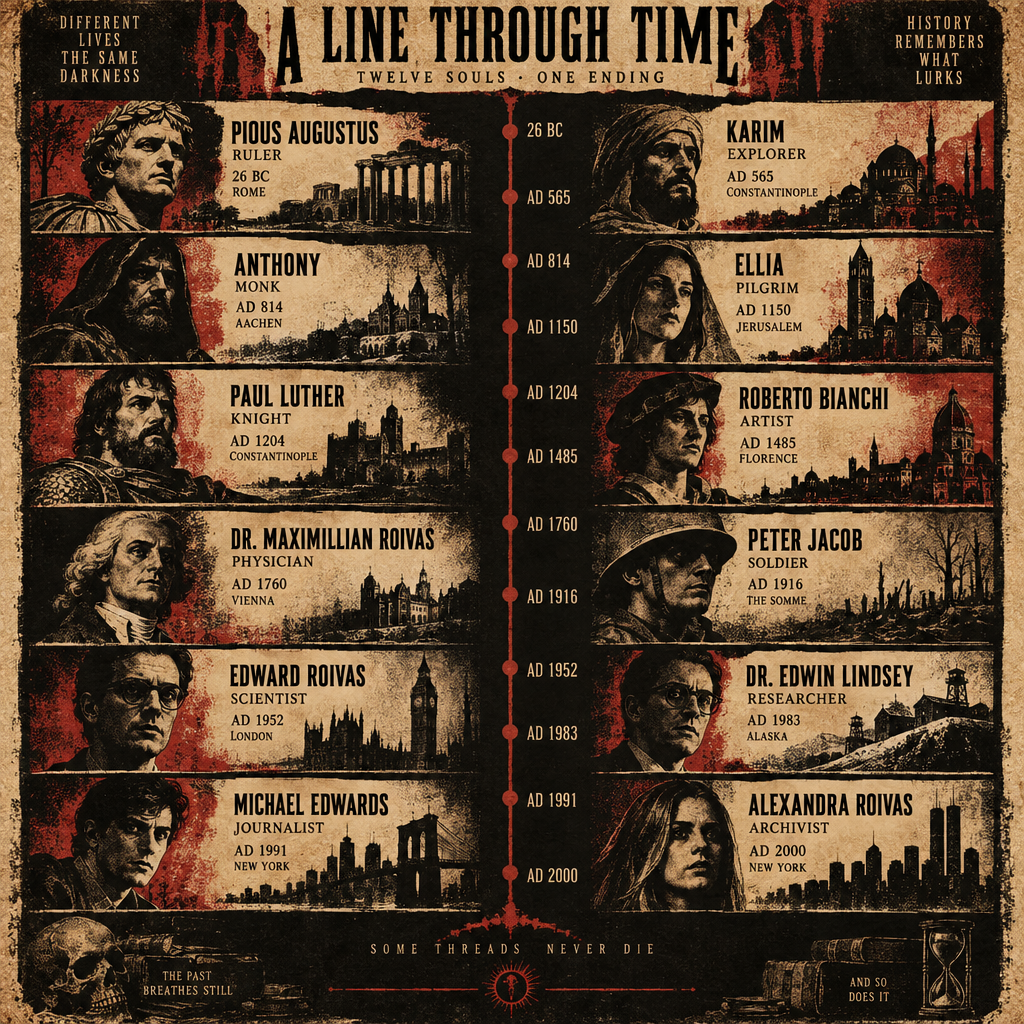
Each chapter of the tome puts you in someone else’s shoes. Everyone who touched the book over the centuries left a record behind, and you play those records out. The story opens with Pious Augustus, a Roman centurion, in 26 BC. From there it jumps to a medieval French cathedral, a Cambodian temple, a colonial-era mansion and a Gulf War battlefield. Between chapters you return to Alex, who explores more of the house as she learns.
The cast is the hook. Alex is voiced by Jennifer Hale, and the game cycles through twelve playable characters in total. Here they are in the order you play them:
| Chapter | Character | Year | Location |
|---|---|---|---|
| 1 | Pious Augustus, Roman centurion | 26 BC | Forbidden City, Persia |
| 2 | Anthony, messenger to Charlemagne | AD 814 | Oublié Cathedral, France |
| 3 | Karim, Persian swordsman | AD 565 | Forbidden City, Persia |
| 4 | Dr. Maximillian Roivas | AD 1760 | Roivas Estate, Rhode Island |
| 5 | Dr. Edwin Lindsey, archaeologist | AD 1983 | Angkor Thom, Cambodia |
| 6 | Ellia, temple dancer | AD 1150 | Angkor Thom, Cambodia |
| 7 | Roberto Bianchi, Italian architect | AD 1485 | Forbidden City, Persia |
| 8 | Paul Luther, Franciscan monk | AD 1204 | Oublié Cathedral, France |
| 9 | Michael Edwards, firefighter | AD 1991 | Forbidden City, Iraq |
| 10 | Peter Jacob, war correspondent | AD 1916 | Oublié Cathedral, France |
| 11 | Edward Roivas, clinical psychologist | AD 1952 | Roivas Estate, Rhode Island |
| 12 | Alexandra Roivas | AD 2000 | Roivas Estate, Rhode Island |
You keep coming back to the same few locations, and they change across the centuries. Seeing the cathedral you crept through as a ninth-century messenger turned into a World War I field hospital is one of the best feelings in GameCube-era horror.
How it scares you
Most survival horror of the era threatens you with low ammo and tank controls. Eternal Darkness threatens your trust in the game itself.
Three meters, three colours
You manage three bars at once. Health is red, magick is blue and sanity is green. Sanity drops every time an enemy spots you. As it falls, the game starts playing tricks on you, and they get stronger the lower the bar goes:
- The camera tilts and blood runs down the edges of the screen
- Statue heads turn to follow you down hallways
- A mute icon appears, as if your TV volume just dropped
- A fake “controller disconnected” message freezes the action
- The game pretends to delete your save files
- Your character dies horribly, then it turns out it never happened
- Insects swarm across the screen, apparently on the glass
On a big CRT in 2002, several of these got real people to stand up and check their hardware. Nintendo patented the sanity system, and that patent is a big reason nobody openly copied it for years.
Enemies and combat
The enemies are servants of the Ancients: zombies, teleporting Trappers, hulking Horrors and Bonethieves, which wear human bodies like coats. You can target heads, arms or torsos. Decapitate a zombie and it flails around blindly, which is somehow worse than when it could see you.
Magick
Spells are built from runes and codices you find in the world, arranged on circles of power with 3, 5 or 7 points. Early on you’ll learn Reveal Invisible, which exposes hidden enemies, doors and text, and Enchant Item, which powers up your weapon. Bigger circles mean stronger spells and longer casting times. That makes you vulnerable at exactly the wrong moment.
Pacing
The game rarely chases you. It lets you explore, then punishes inattention. Rooms are quiet except for whispers, distant crying and footsteps that may not be real. It’s a slow-burn haunted house, closer to a psychological thriller in tone than to the shotgun action of later Resident Evil games.
Common mistakes on a first run
- Skipping finishing moves. Hit a downed enemy with the finishing attack. It restores a chunk of sanity, and new players forget this all the time.
- Letting sanity bottom out. Below zero, sanity damage starts eating your health. It stops being a fun hallucination and starts killing you.
- Ignoring the colour triangle. Shields and attacks matched to the right Ancient make fights much shorter (see the table below).
- Hoarding magick. The blue bar regenerates as you walk. Cast freely.
- Missing hidden text. If a room seems empty, cast Reveal Invisible before you leave.
Lore and ending
Spoiler warning
This section spoils the artifact choice, the three endings and the true ending.
In Chapter 1, Pious Augustus enters a temple in the Forbidden City and must choose one of three artifacts. The one you pick decides which Ancient he serves for the rest of that playthrough. Pious becomes an undead Liche and spends the next two millennia trying to summon his god into our world. Every chapter after that is a mortal tripping over his plans.
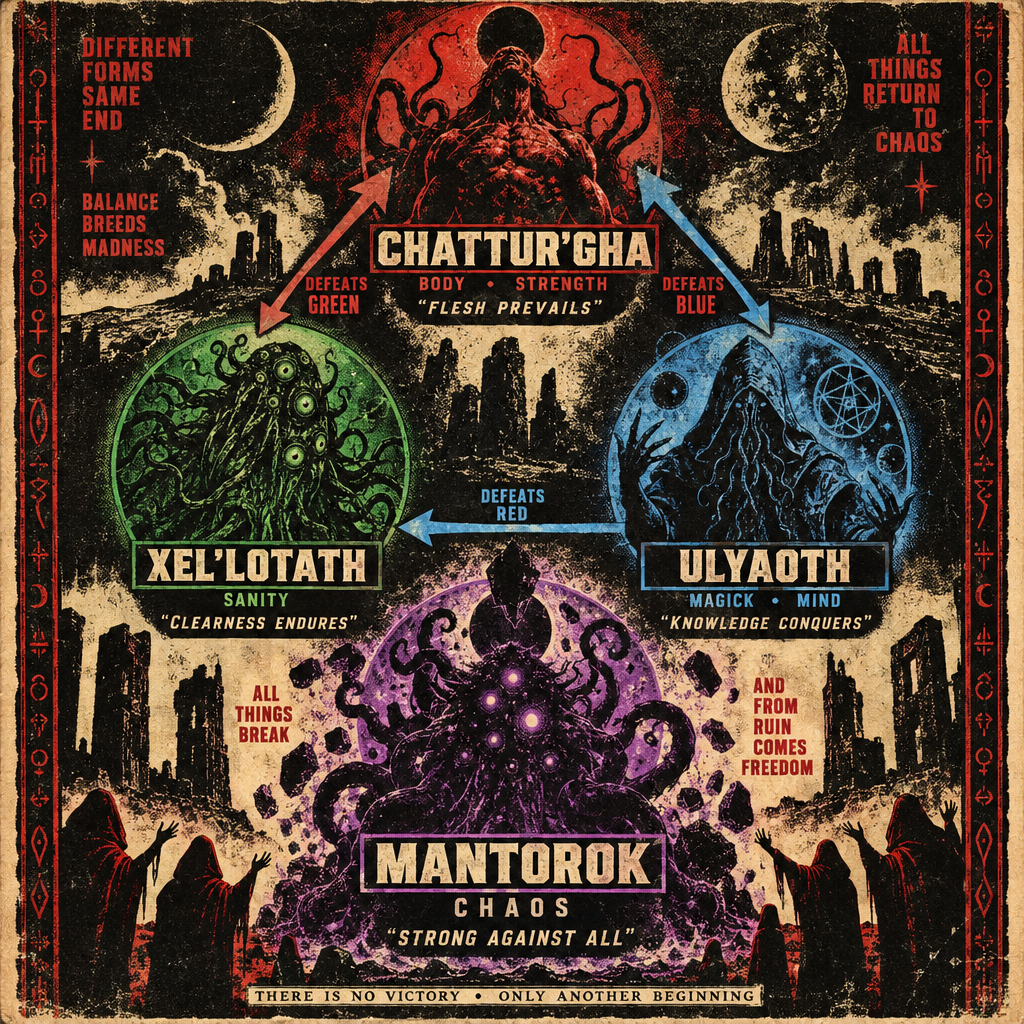
The Ancients follow a rock-paper-scissors rule, and the game expects you to learn it:
| Ancient | Colour | Governs | Strong against | Weak against |
|---|---|---|---|---|
| Chattur’gha | Red | Body and strength | Xel’lotath | Ulyaoth |
| Ulyaoth | Blue | Magick and mind | Chattur’gha | Xel’lotath |
| Xel’lotath | Green | Sanity | Ulyaoth | Chattur’gha |
| Mantorok | Purple | Chaos, the corpse god | All three | None |
Mantorok is the fourth god, a dying Ancient imprisoned beneath the Forbidden City. In each run, Pious’s chosen god nearly breaks through in 2000. Alex, helped by the spirits of everyone who held the tome, uses its Mantorok and opposing-colour magick to summon a rival Ancient, which destroys Pious’s god.
How to unlock the true ending
- Finish the game choosing the red artifact (Chattur’gha) at Pious’s pedestal.
- Start a new game on the same memory card and pick the blue artifact (Ulyaoth).
- Repeat a third time with the green artifact (Xel’lotath).
- Watch through the final chapter of your third run.
Expected result: an extra ending plays. It reveals that all three playthroughs happen at once, in three parallel realities. In each reality a different Ancient is destroyed, and together they wipe out all three. That was Mantorok’s plan from the beginning, which means the “corpse god” was guiding the Roivas family and the tome’s other keepers. Edward’s ghost speaks with Alex in the final scenes, and the game treats balance as its last word.
Where to play
Eternal Darkness has never been re-released. There’s no remaster, no remake and no PC version. You won’t find it on lists of PC horror games, and Steam Deck isn’t an option without an official port. As of October 2026, we are not aware of Eternal Darkness on Nintendo’s GameCube Classics service for Switch 2, so check Nintendo’s current library before you buy anything for it.
| Platform | Status as of October 2026 | Notes |
|---|---|---|
| Nintendo GameCube | Original release | Disc and memory card required |
| Original Wii (RVL-001) | Backward compatible | Needs GameCube controller and memory card |
| Wii Family Edition / Wii Mini | Not compatible | No GameCube ports |
| Wii U, Switch, Switch 2 | No official release | Not in Nintendo’s classics service |
| PlayStation, Xbox, PC | Never released | No Game Pass or PS Plus option |
Here’s the release timeline by region:
| Region | Release date |
|---|---|
| North America | June 24, 2002 |
| Japan | October 25, 2002 |
| Europe | November 1, 2002 |
What you need to play it today
- A GameCube, or an original launch-model Wii with GameCube ports
- A legitimate disc copy (check the disc surface, because secondhand copies get scuffed)
- A GameCube memory card, which you need for saves and for unlocking the true ending
- A GameCube controller
Setting up
- On a Wii, plug the GameCube controller into port 1 on top of the console and the memory card into slot A.
- Insert the disc and launch it from the Wii disc channel.
- Make sure you have at least a few free blocks on the memory card before your first save.
- Use the same card for all three playthroughs so the game can track your artifact choices.
Troubleshooting: If the game won’t detect your save, reseat the card in slot A. If a Wii won’t read the disc, clean it with a soft cloth wiped from the centre outward. And if a “deleting save data” screen appears mid-game, don’t panic. That’s a sanity effect, not your hardware.
If you liked this
Silent Hill 2 (2001): the same slow, unnerving psychological dread, with a town that reflects the protagonist’s guilt.
Amnesia: The Dark Descent (2010): a sanity meter that punishes you for looking at the monsters, built for players who want the mechanic pushed further.
Call of Cthulhu: Dark Corners of the Earth (2005): Lovecraftian cosmic horror with brutal sanity effects and a terrifying Innsmouth escape.
FAQ
Is Eternal Darkness on Nintendo Switch?
No. As of October 2026, there’s no official Switch or Switch 2 version. It also hasn’t appeared in Nintendo’s GameCube Classics lineup. The only official ways to play are the original GameCube disc on a GameCube or a backward-compatible Wii.
Does Eternal Darkness actually delete your save?
No. The save-deletion screen is one of its sanity effects. It plays out convincingly, then snaps back to normal gameplay. Your memory card is safe.
How many endings are there?
Three standard endings, one for each artifact Pious can choose, plus a true ending. You unlock the true ending by completing all three paths on the same memory card. Later runs go faster because you already know the puzzles.
Is there a sequel?
No official one. Director Denis Dyack tried to fund a spiritual successor called Shadow of the Eternals on Kickstarter in 2013, but it never got made. Silicon Knights closed after losing a legal battle with Epic Games.
Is it a good first horror game?
Yes, if you can handle tension more than gore. Combat is forgiving, saves are generous and the scares are psychological rather than gross-out. It’s one of the best horror games for players who want to be unnerved rather than splattered.