

Kitchen is a short virtual reality horror demo by Capcom, first shown on Sony’s Project Morpheus prototype (the headset that became PlayStation VR) at E3 2015. It is a first-person, captive-in-a-chair experience that lasts only a few minutes. It frightens you because you cannot run, fight or look away: you sit there while something comes for you. If you searched “kitchen re”, this is the one. A year after its debut, Capcom confirmed it was an early glimpse of Resident Evil 7: Biohazard.
Story and setting
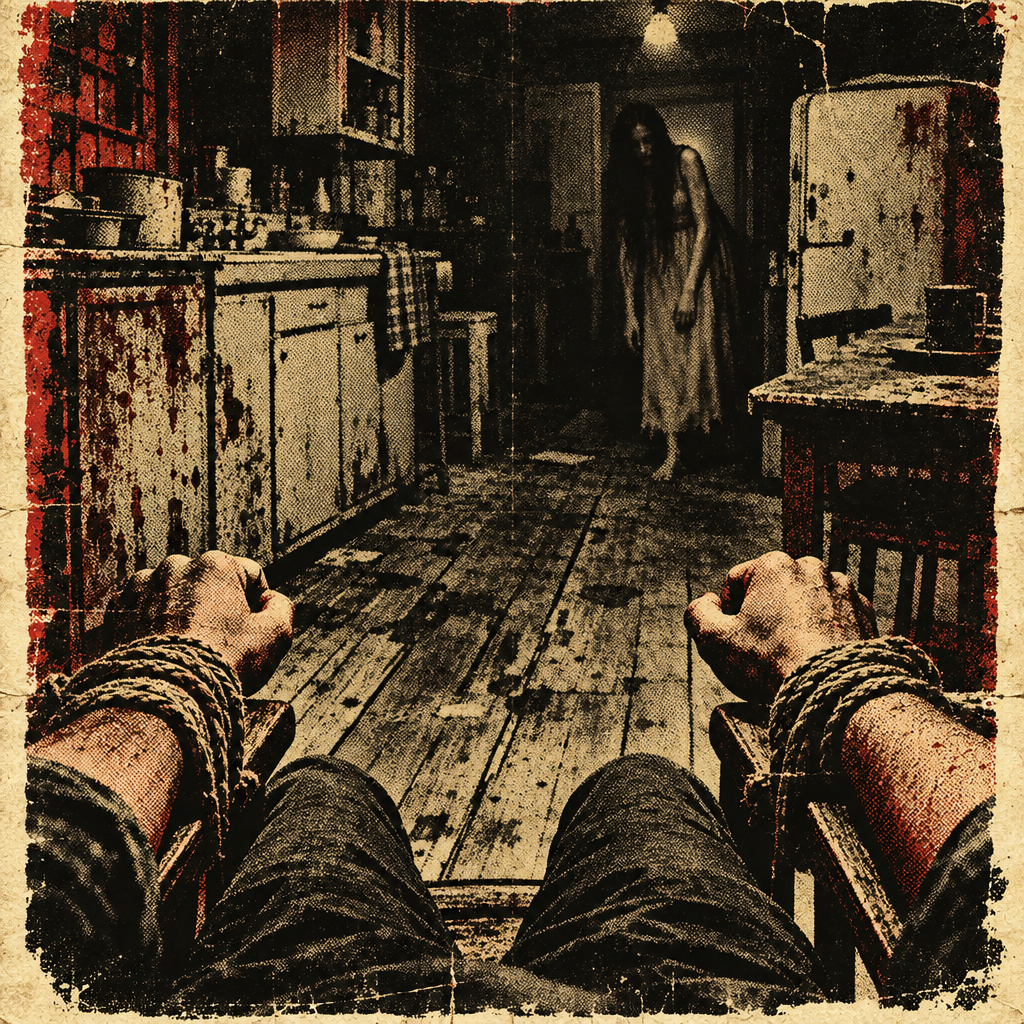
You wake up as an unnamed man, bound to a chair in the kitchen of a filthy, rotting house somewhere in the American backwoods. Nobody tells you how you got there. A frightened man in the room with you is trying to get you both out, and for a moment it feels like rescue is coming.
That’s the whole premise, and the demo keeps it that bare on purpose. The room does the storytelling: grime on every countertop, a dim light that barely reaches the corners, cabinet doors hanging open, and a doorway into darkness you keep glancing at because you can’t stop yourself. You learn about the house the way you would if you really were tied up in it, by turning your head and taking in whatever detail you can.
Capcom first presented Kitchen as a standalone VR horror experiment, with no Resident Evil branding. Looking back, the warning signs are obvious. You’re in a decaying Southern-style home, you’re helpless, and there’s a family-shaped presence nearby. When Resident Evil 7 was revealed at E3 2016, the connection became official, and the demo was later rebranded with the game’s numeral worked into the name as KI7CHEN.
How it scares you
Kitchen uses almost none of the tools horror games usually rely on, and that is why it works. There are no enemies to shoot, no ammo to count and no inventory to manage. You can’t walk. You can’t use your hands. The only input that matters is your head, because the PlayStation VR headset tracks where you look, so the demo’s entire design is built around what you see and what you are afraid to see.
The chair is the mechanic
Most horror games give you some way out, even if it’s only a closet to hide in or a corridor to sprint down. Kitchen takes every option away. Being strapped down turns you into an audience member who can’t leave the room, and the demo exploits this by putting threats at the edge of your view and behind you. You will spin your head around in a real chair in your real living room, which is something no flat-screen game can make you do.
Sound does the heavy lifting
Positional audio is the second half of the trick. Footsteps, scraping and breathing come from specific directions, and with headphones on your brain treats them as physically present. A noise behind your left shoulder makes you turn left. The demo knows you’ll do this and stages its beats so that turning toward a sound is sometimes exactly the wrong move.
Pacing in miniature
Because it’s so short, Kitchen works like a single drawn-out horror movie scene. There’s a quiet setup, a glimmer of hope, a sudden reversal, and then a slow, close approach that ends in one violent payoff. The big scare isn’t a cheap noise in an empty room. It’s earned by everything before it, and the moment the threat gets inside your personal space is far more uncomfortable in VR than any monster jumping at a TV screen.
The proximity problem
The detail people still bring up from Kitchen is distance. In VR, a face leaning in close actually feels close. The demo uses this better than most full games do: a character crouching inches from you, staring, is more frightening than any chase. Full horror games still lean on this trick, and Resident Evil 7’s own VR mode leaned on it heavily.
If you get motion sick, you’ll be happy to know Kitchen is one of the gentler VR horror experiences. You never move artificially, so there’s no locomotion to make you queasy. The discomfort it causes is purely psychological.
Lore and ending
Spoiler warning
Everything below spoils the full Kitchen demo and touches on key scenes from Resident Evil 7: Biohazard.
Kitchen doesn’t have multiple endings. It has one outcome, and you can’t change it. The man trying to free you is attacked and dragged out of sight by someone you can’t see properly. His screams stop. Then a pale, long-haired woman comes into the kitchen and creeps up to you, closer and closer, until she drives a knife into your leg. The screen cuts out there. You never escape, and you never find out who she is or what happens next.
What the ending means
The best way to read Kitchen’s ending is as a statement of intent from Capcom. In 2015, the studio was testing whether VR could make players feel completely helpless, and the stabbing is the punchline to that test. In story terms, the message is simple: in this house, you are the prey, and help won’t arrive.
The bigger meaning only came into focus once Resident Evil 7 launched on January 24, 2017. Kitchen set the tone for the whole game. It shared the same team and technology, a rotting family home in the American South, a first-person camera and a hero who spends long stretches tied up, hurt and at the mercy of the people living there.
The Resident Evil 7 connections
You can find several clear echoes of Kitchen in the full game:
- The chair. Resident Evil 7’s infamous dinner scene ties Ethan Winters to a chair at the Baker family table while Marguerite serves him a plate of something unspeakable. It plays like Kitchen’s premise blown up to feature length.
- The house. The squalid kitchen, the sticky surfaces and the junk-filled rooms in the demo look a lot like the Baker estate in Dulvey, Louisiana, with the same art direction and the same sense that nobody has cleaned anything in years.
- The woman. Her stringy hair, pale skin and way of moving lead many fans to read her as Marguerite Baker, or as an early version of the character. Capcom has never confirmed this, so treat it as a popular community theory rather than canon.
- Body horror against the player. Kitchen’s knife to the leg looks ahead to Ethan’s long list of injuries in the full game, starting with the brutal fight with Mia in the guest house.
Is Kitchen canon?
Capcom has never officially placed Kitchen in Resident Evil 7’s timeline, and its layout doesn’t match the Baker property room for room. It is best read as a concept sketch that fed into the final game, not a lost chapter. If you want playable prequel material that does fit the canon, look at the found-footage tapes inside Resident Evil 7 and the Banned Footage DLC, like “Daughters,” which shows the night the Baker family’s life fell apart.
Where it fits in the series
Kitchen is the very first public piece of Resident Evil 7, released before the game even had a name. Here is how it fits with what came after, in release order:
| Release | Year | What it is | VR |
|---|---|---|---|
| Kitchen | 2015 (E3), 2016 (PS VR demo) | VR tech demo, captive-in-a-chair scene | Yes, VR only |
| Resident Evil 7 Teaser: Beginning Hour | 2016 | Free non-VR teaser set in a derelict house | No |
| Resident Evil 7: Biohazard | 2017 | The full game, Ethan Winters at the Baker estate | Fully playable in PS VR |
| Banned Footage Vol. 1 and Vol. 2 | 2017 | DLC tapes and side scenarios | Yes, on PS VR |
| Not a Hero and End of Zoe | 2017 | Story DLC wrapping up the Baker saga | No |
| Resident Evil Village | 2021 | Direct sequel continuing Ethan’s story | VR mode added on PS VR2 in 2023 |
Kitchen didn’t get a remake or a remaster, and it never came out as a separate paid release. Its successor is effectively Resident Evil 7 itself, which you can play start to finish in VR on the original PlayStation VR.
What to play first
Kitchen is a ten-minute appetizer, and it spoils nothing important, so play it before Resident Evil 7 if you can get to it. It gives you a quick sample of what the full game’s VR mode feels like, and the dinner scene will hit harder once you’ve already been tied to one chair in this world. If you can’t get Kitchen running, don’t worry about it. You aren’t missing story you need, and the main game does everything Kitchen does at greater length and with more polish.
If you are newer to the series, Resident Evil 7 is a strong starting point in its own right. It’s a soft reboot of the franchise’s tone, and you can follow Ethan’s story without having played the earlier entries. Our guide to the best “horror games” you can play right now has more places to start if you want options beyond Capcom.
Where to play
Kitchen is a PlayStation VR exclusive, and getting to it in 2026 takes some effort.
- Original release: The consumer version was included on the PlayStation VR demo disc that shipped with the headset in October 2016. It was also listed as a free download on the PlayStation Store. If you own that disc or downloaded the demo back then, check your PS4 or PS5 game library first.
- Hardware you need: A PS4 or PS5, the original PlayStation VR headset and a PlayStation Camera. On PS5, you’ll also need Sony’s camera adapter to connect the older PS4 camera.
- PS VR2: Not supported. The PS VR2 can’t run original PS VR software, and as of October 2026 Capcom has not released a PS VR2 version of Kitchen.
- PC, Xbox, Switch: Not available as of October 2026. Kitchen has never come out on any other platform, and there’s no Steam release, so there’s no Steam Deck status to report.
- Subscriptions: Kitchen isn’t sold or offered through Game Pass or PS Plus as of October 2026, which makes sense for a free demo.
Store listings for old free demos come and go, so check the PlayStation Store on your own account before you buy older hardware just for Kitchen. If your main goal is the same scares, buying Resident Evil 7 for PS4 and playing it in PS VR gets you the full version of what Kitchen promised. If you don’t have a headset, you can play the flat-screen game on PS4, PS5, Xbox One, Xbox Series X|S, PC and other platforms. For more of that sort of thing on a desktop, see our list of the best “pc horror games” to play tonight.
If you liked this
Resident Evil 7: Biohazard (2017), because it’s the full game Kitchen was teasing, and it is fully playable on the original PS VR.
Until Dawn: Rush of Blood (2016), because it’s another early PS VR horror showcase that uses the headset to put threats right in your face.
The Exorcist: Legion VR (2018), because it’s a short, episodic VR horror experience built on slow dread and close encounters instead of combat.
FAQ
Is Kitchen a Resident Evil game?
Yes and no. It came out in 2015 without Resident Evil branding, but Capcom confirmed at E3 2016 that it was an early look at Resident Evil 7: Biohazard, created by the same team. It is best treated as a prototype that led into Resident Evil 7, not as a canon chapter.
Can you play Kitchen without VR?
No. Kitchen was designed around head tracking and positional audio, and it only exists as a PlayStation VR experience. If you want the same atmosphere on a regular screen, play Resident Evil 7. For a flat-screen teaser, try Beginning Hour.
Who is the woman in Kitchen?
Capcom has never named her. Many fans think she is Marguerite Baker from Resident Evil 7, or an early concept of Marguerite, because of her appearance and the Baker-style house. That reading makes sense, but it’s still unconfirmed.
How long is Kitchen?
Most players finish it in about five to ten minutes. You can’t fail or make choices, so one playthrough shows you everything. Most people go back only to show it to a friend and watch them squirm.
Does Kitchen work on PS5 or PS VR2?
It works on PS5 through backward compatibility if you use the original PlayStation VR headset, a PlayStation Camera and Sony’s camera adapter. It doesn’t work on PS VR2, which can’t run original PS VR games.