
Scott Cawthon built this 2014 point-and-click survival horror game on his own in Clickteam Fusion, and it quietly rewrote the rules for indie scares. You sit in one chair for the whole game, with two doors, a power meter and four animatronic mascots that want to stuff you into a suit. The fear comes from helplessness: you cannot run, you cannot fight, and every tool you have to feel safe is also what gets you killed.
Story and setting
You play Mike Schmidt, a new night security guard at Freddy Fazbear’s Pizza, a family restaurant that is clearly a few health code violations away from closing for good. The game takes place in 1993, which you only learn from the date on your paycheck. Your shift runs from midnight to 6 AM, five nights in a row, for a total of $120. That works out to four dollars an hour, which tells you most of what you need to know about this employer.
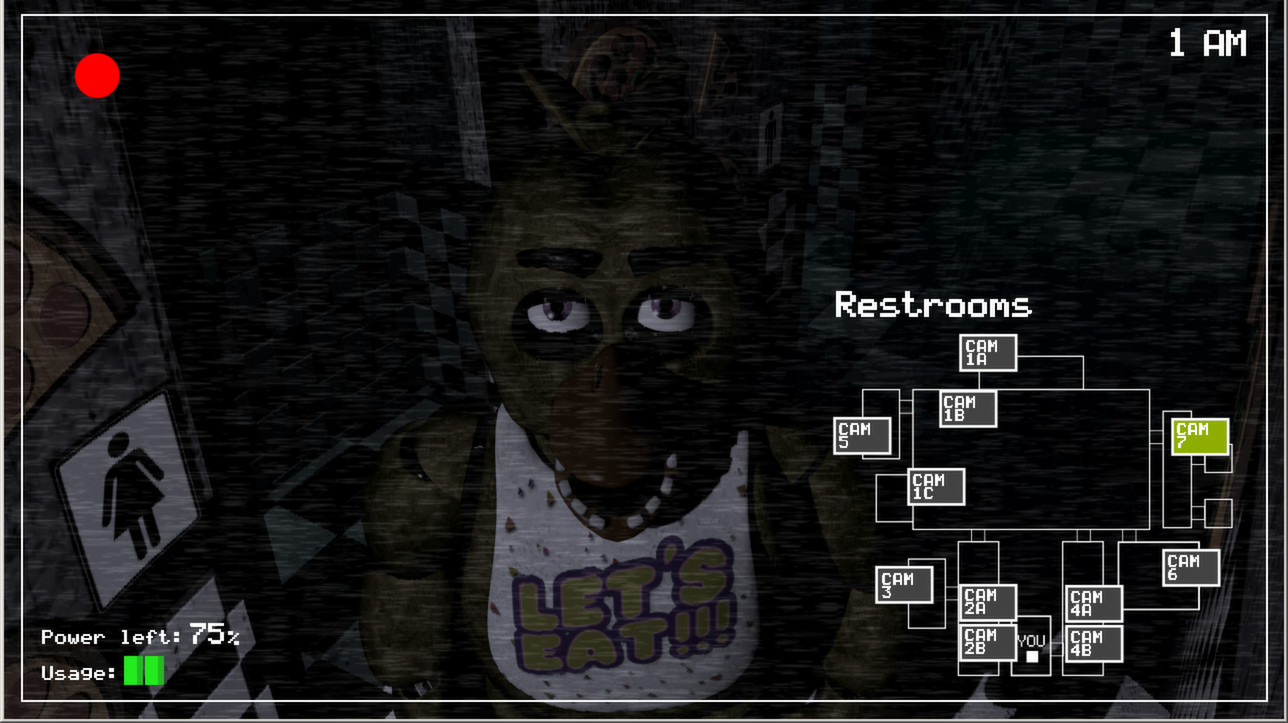
The restaurant’s star attractions are Freddy Fazbear, Bonnie the bunny, Chica the chicken and Foxy the pirate fox. By day they sing for children. By night, as a recorded message from your predecessor (fans call him Phone Guy) explains, they are left in a free roaming mode so their servos do not lock up. The catch is that if one of them spots you, it will assume you are a bare metal endoskeleton that has wandered off without its costume, and it will correct that mistake.
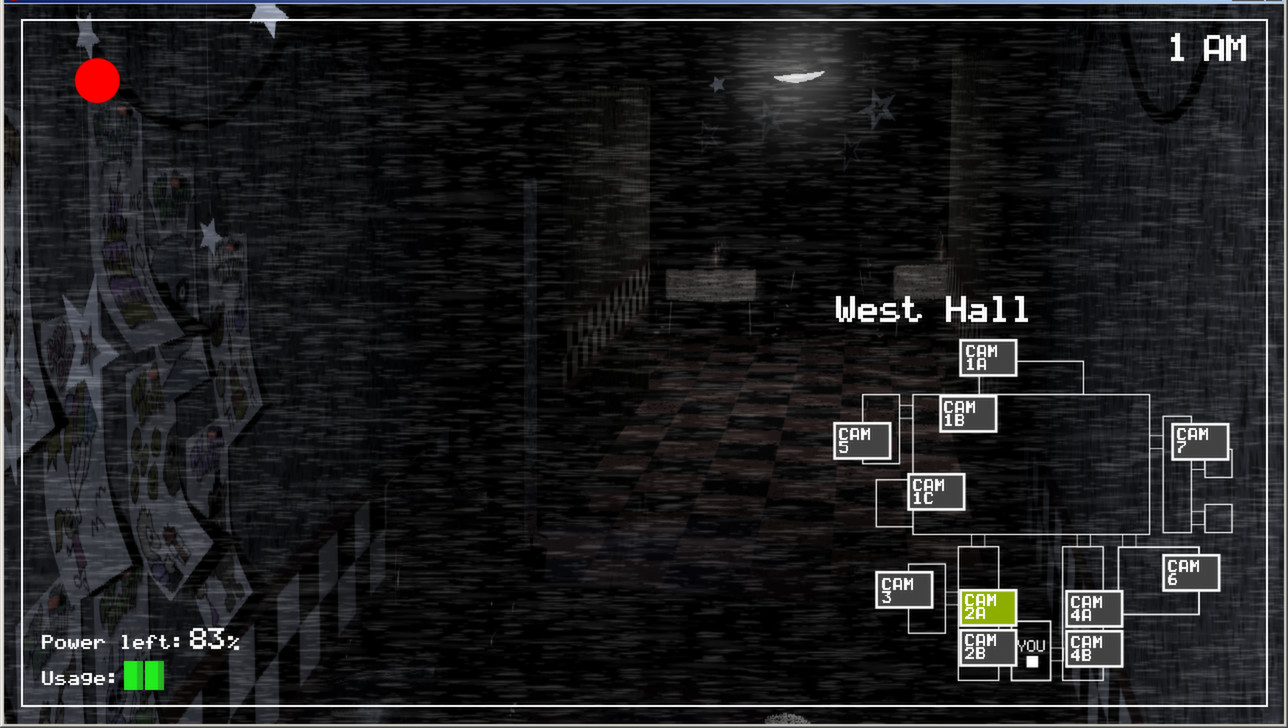
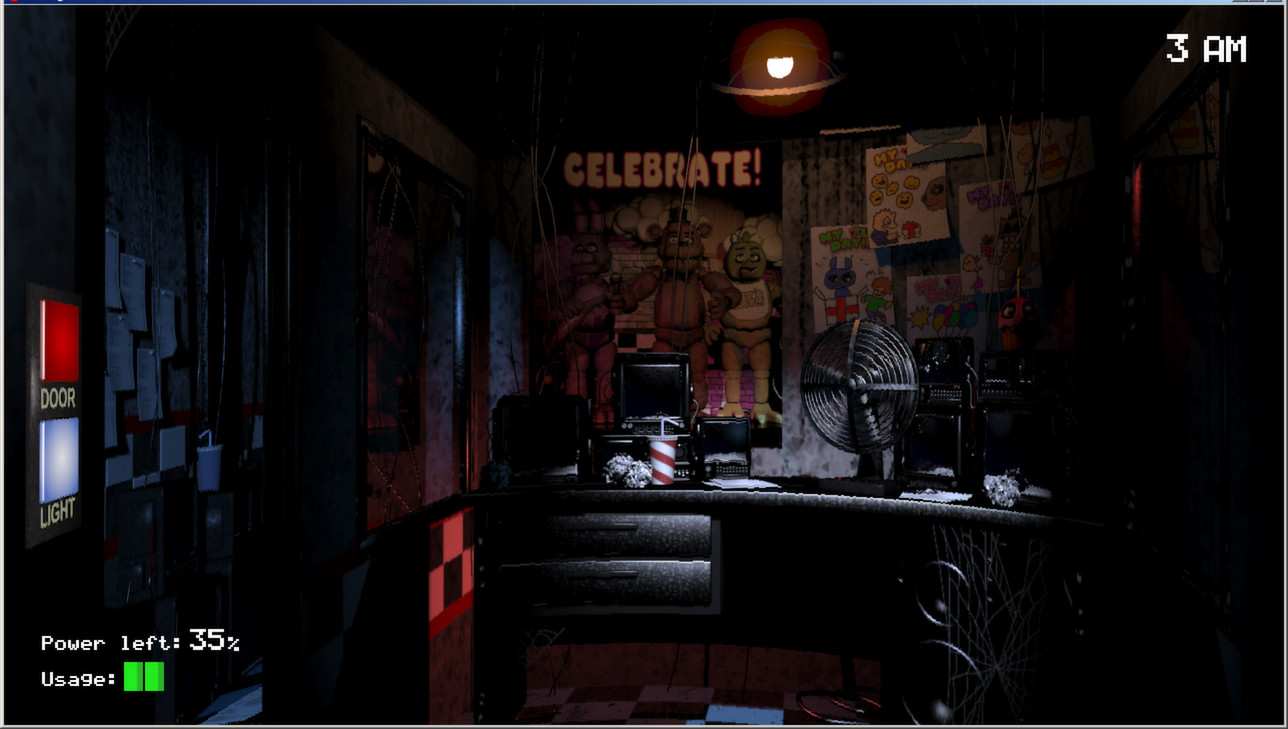
Your entire world is a cramped office with a desk fan, a few posters and a cupcake. On either side is a hallway door you can seal with a steel shutter, and a light switch that lets you peek into the dark just outside. A tablet gives you access to the building’s security cameras. That is the whole game. No inventory, no walking, no map screen.
How it scares you
The genius of Five Nights at Freddy’s is the power meter in the bottom left of the screen. Every door you close, every light you flick on, every second the camera feed is open drains your battery. Run it to zero and the office goes black, Freddy’s face lights up in the doorway, and a tinny music box rendition of the Toreador March plays while you wait to die. The game never tells you how much power a night needs. You learn it by dying.
Each animatronic has its own behaviour, and part of the terror on early nights is not knowing the rules yet. Bonnie favours the left hallway. Chica takes the right, usually after a detour through the kitchen, where you can hear her clattering through pots and pans on a camera that shows nothing but audio. Freddy hangs back on the show stage for a few nights, then starts moving only when you are not watching him, announcing himself with a low chuckle that tells you he has changed rooms. Foxy stays behind a curtain in Pirate Cove and gets restless if you ignore him for too long. When he goes, he sprints down the west hall in a few frames of pure adrenaline, and only a closed door stops him.
That design creates a constant tug of war. Checking the cameras costs power and leaves you blind to what is standing right outside. Not checking them means Foxy is coming. Closing a door is safe but expensive. Opening it to save power is cheap but risky. By Night 4 and Night 5 you are rationing fractions of a percent and making split-second calls based entirely on sound.
Sound does most of the heavy lifting. Footsteps in the hall, a wet breathing noise at the door, the hum of the fan dropping out when the power dies. Cawthon pulled from stock sound libraries and layered them so well that fans still recognise half the effects in other games. The camera feed crackles with static that occasionally resolves into a face that should not be there. Then, when something finally gets you, it arrives as a full-screen screaming animatronic and a noise that has launched roughly a million reaction videos.
A single in-game night lasts just under nine minutes on PC. That brevity is the point. You can stomach one more attempt, then one more, and before you know it you have been tense for two hours. Nobody plays this game relaxed. It is not a game you share a couch for either, which is worth remembering if you came here from our list of cooperative survival horror games. This one is strictly you, alone, in the dark.
Lore and ending
Spoiler warning
The Night 5, Night 6 and Night 7 endings, the newspaper clippings, the Phone Guy calls and where the series later took them are all discussed below.
There is no cinematic ending. Survive Night 5 and you get your paycheck for $120, dated 12 November 1993, with a “Good job, sport!” style pat on the back. Survive the unlockable Night 6 and you get an overtime check for $120.50. Finish Night 7, the Custom Night where you set each animatronic’s aggression from 0 to 20, and you get a pink slip: fired for tampering with the animatronics, general unprofessionalism and, memorably, odour. Beat Custom Night on 4/20 mode, every enemy maxed out, and the title screen earns a third star. That is the whole reward structure.
The actual story is hidden in the margins. Flip to the East Hall corner camera and the poster occasionally changes to a set of newspaper clippings. They describe five children lured into the back room by a man wearing a mascot costume, a suspect arrested, bodies never found. Later clippings report that the restaurant is closing after customers complained about the animatronics smelling of rot and leaking something around the eyes and mouths. Fans call this the Missing Children Incident, and it is the spine of the whole franchise.
Phone Guy fills in the rest. He mentions a previous location, and on Night 1 he drops the Bite of ’87, an incident where an animatronic bit someone hard enough that the restaurant now bans the characters from walking around during the day. On Night 4 his call is interrupted by banging on his door, then the Toreador March, then a groan and silence. He does not call again. The game is telling you that your job has already killed at least one person.
Put the clippings, the smell and the suits together and the implication is grim. The murdered children’s bodies were hidden inside the animatronics. The Game Over screen, which shows a Freddy mask with a human eyeball and teeth bulging out of the sockets, is what happens when the restaurant stuffs you in a suit too. The animatronics being haunted by those children was only strongly implied in this game. Five Nights at Freddy’s 2 (2014) and 3 (2015) confirmed it through 8-bit minigames, and the killer was eventually named as William Afton, first in the 2015 novel The Silver Eyes and then in Sister Location (2016).
Then there is Golden Freddy. Very rarely, a poster in the west hall corner changes to a yellow Freddy, and when you lower the camera a slumped golden suit sits in your office, the words “IT’S ME” flashing. Look at him too long and the game crashes to desktop. He is the first hint that there is a fifth child, a fifth suit, and a much older story underneath this one.
Where it fits in the series
Five Nights at Freddy’s is both the first game released and the middle of the timeline. Here is how the mainline entries line up.
| Release order | Year | Developer | Timeline placement |
|---|---|---|---|
| Five Nights at Freddy’s | 2014 | Scott Cawthon | 1993 |
| Five Nights at Freddy’s 2 | 2014 | Scott Cawthon | 1987, prequel |
| Five Nights at Freddy’s 3 | 2015 | Scott Cawthon | About 30 years after the first game |
| Five Nights at Freddy’s 4 | 2015 | Scott Cawthon | 1983 |
| Sister Location | 2016 | Scott Cawthon | Between 4 and 2 |
| Freddy Fazbear’s Pizzeria Simulator | 2017 | Scott Cawthon | After 3 |
| Ultimate Custom Night | 2018 | Scott Cawthon | Non-canon-ish afterlife |
| Help Wanted | 2019 | Steel Wool Studios | Later, framed as a VR game |
| Security Breach | 2021 | Steel Wool Studios | 2020s era mall |
| Help Wanted 2 | 2023 | Steel Wool Studios | After Help Wanted |
| Into the Pit | 2024 | Mega Cat Studios | Based on the Fazbear Frights book |
| Secret of the Mimic | 2025 | Steel Wool Studios | 1979 |
If you want chronological story order, the rough fan consensus runs Secret of the Mimic, FNAF 4, Sister Location, FNAF 2, FNAF 1, FNAF 3, Pizzeria Simulator, then the Steel Wool era. Do not start there. Play in release order. The original game is the cleanest version of the formula, and every sequel assumes you already understand what a power meter and a door light mean.
There is no remake or remaster of the first game. The 2019 console ports and the 2019 mobile update added higher resolution assets and a few quality of life changes, but the game is the same. Blumhouse’s 2023 film adaptation, directed by Emma Tammi with Josh Hutcherson as Mike, is a loose retelling of this game’s premise and gets its own entry in our movie archive.
Where to play
As of October 2026, the Steam version is the one to buy. It costs $4.99 on Windows, and the game is also available on PlayStation 4, PlayStation 5, Xbox One, Xbox Series X/S, Nintendo Switch, iOS and Android. It is a single-player game with no co-op or multiplayer of any kind. The whole thing is a couple of hundred megabytes, so it installs in the time it takes to make a coffee.
The 2019 remastered mobile version is on the App Store and Google Play. It is a solid way to play, though touch controls make the camera flipping a little clumsier on hard nights. Nintendo Switch, PlayStation 4 and Xbox One ports arrived in November 2019, and those digital versions carry forward to current consoles. If you want a physical copy, the Five Nights at Freddy’s: Core Collection (2021) bundles the first five games on Switch, PS4 and Xbox One.
The game has never been part of Game Pass or PlayStation Plus. You buy it outright, which at five dollars is hardly a sacrifice. On Steam Deck it runs without fuss in our experience: the Clickteam executable is light, the controller mapping works, and the Deck’s screen is small enough that the office feels even more claustrophobic. Check the compatibility badge on the store page for the current official status.
If you liked this
Outlast (2013): same no-weapons, camera-dependent panic, but you get to run.
Alien: Isolation (2014): one unkillable hunter you track by sound and motion tracker, stretched over a full campaign.
Amnesia: The Dark Descent (2010): the resource that keeps you alive is also the thing that draws the monster.
FAQ
How scary is Five Nights at Freddy’s really?
We give it a 4 out of 5, and almost all of that comes from tension and jump scares rather than disturbing imagery. If loud screaming faces are your weak point, this is one of the most terrifying games you can buy for five dollars. If jump scares bounce off you, it drops to a tense puzzle about power management with some great sound design.
Is it suitable for kids?
The Steam page lists no age requirement, and there is no blood or swearing on screen. The subject matter, child murder hidden in newspaper clippings, is dark once you understand it, but most kids never find those screens. The jump scares are the real issue. Plenty of ten-year-olds love it. Plenty of adults cannot finish Night 2.
How many nights are there?
Five in the main game, plus a harder Night 6 unlocked after Night 5, and Night 7, which is the Custom Night with adjustable AI levels. Beating Night 5 earns one star on the title screen, Night 6 a second, and 4/20 mode a third.
Do I need to play the games in order to understand the lore?
Yes. The first game poses the mystery. FNAF 2 is a prequel that answers some of it, FNAF 3 answers more, and FNAF 4 and Sister Location reach back to the beginning. Watching a lore video is faster, but you will miss how Cawthon hid everything in posters and 8-bit minigames, which is half the fun.
What is the Bite of ’87?
An incident Phone Guy mentions on Night 1 where an animatronic bit a person badly enough to damage their frontal lobe, after which the characters were banned from roaming during the day. The first game never says which animatronic did it. Five Nights at Freddy’s 2, set in 1987, is where you go for that answer.