
Pennywise the Dancing Clown is the face of Stephen King’s It, but the clown is a costume worn by something far older than Derry, Maine. This profile walks you through what It actually is, why it picks a clown, every form it takes across the novel and the films, and the exact sequence the Losers’ Club uses to kill it.
Spoiler warning
This explainer spoils the 1986 novel, the 1990 miniseries, It (2017), It Chapter Two (2019) and the premise of It: Welcome to Derry, including how the creature dies.
The short answer: what It the clown Pennywise really is
Pennywise is not a clown, a ghost or a demon in any traditional sense. It is a cosmic predator that fell to Earth in the deep past, long before people arrived, and it has been feeding on the children of Derry in roughly 27-year cycles ever since the town was settled.
The clown is a lure. King’s creature reads the fears of its victims and wears whatever shape will make them run, and because it hunts kids it defaults to a shape that kids trust on sight, then corrupts it. Every other form, from the werewolf to the giant spider, works the same way.
The name “Pennywise” belongs to the persona It built around a human identity, Mr. Bob Gray, which the novel suggests It borrowed from a real circus performer. The creature itself has no name that humans can pronounce, which is why King’s characters just call it It.
Where It came from: the Macroverse, the Turtle and the Deadlights
King places It’s origin outside our universe in a void he calls the Macroverse. Two beings dominate that space in the novel: It, a thing of pure appetite, and Maturin, an ancient turtle who vomited our universe into existence after a stomach ache and who later shows up in the Dark Tower books as a guardian of the Beams.
It came to Earth in an impact event, crashing into the land that would become Derry millions of years ago. It slept until the first humans built on top of it, and then it woke up hungry.
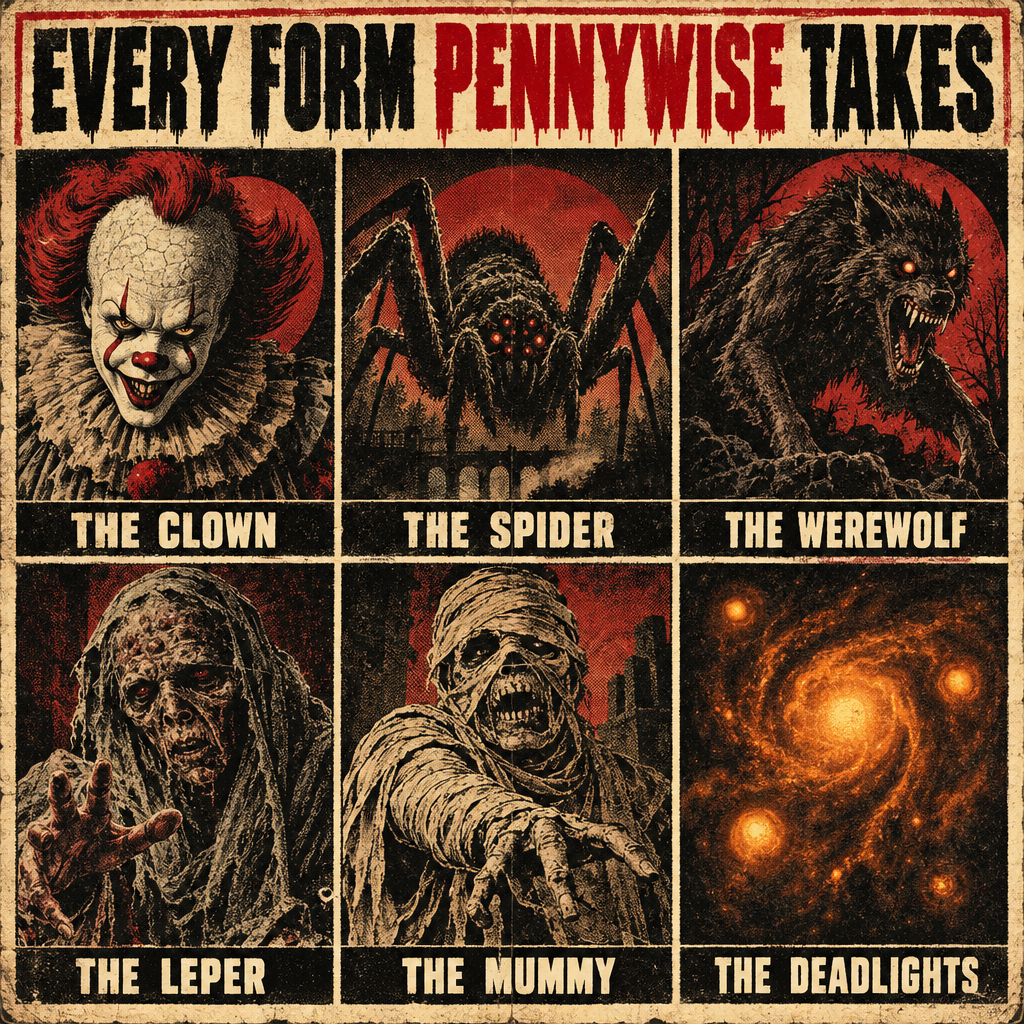
The creature’s true nature is a set of writhing orange lights the novel calls the Deadlights. Any human who looks directly at them goes mad or catatonic, which is what happens to Bill’s wife Audra in the book and the 1990 miniseries, and to Beverly in the 2017 film before Ben’s kiss pulls her back.
Because the Deadlights cannot be processed by a human mind, It needs a physical shape to interact with our world. The closest shape our brains can hold is a giant spider, which is why the spider shows up as the final form in the novel, the miniseries and It Chapter Two.
Why Stephen King chose a clown
King has told the story of It’s birth many times, and the details stay consistent. In 1978 he walked across a wooden bridge in Boulder, Colorado, thought of the troll from Three Billy Goats Gruff, and asked himself what might live under a bridge in a modern town.
The second question he asked was what scares children more than anything else, and his answer was clowns. The friendly circus clown, the kids’ TV clown and the fast-food mascot all share the same painted smile, and King realised that smile only has to tilt a few degrees to become horrifying.
The novel was published by Viking on September 15, 1986, at 1,138 pages in the US hardcover, and it was one of the best-selling novels in America that year. King had been writing it since 1981, and the book’s two-timeline structure, children in 1957 to 1958 and adults in 1984 to 1985, became the template every adaptation follows.
The 27-year cycle and Derry’s silent consent
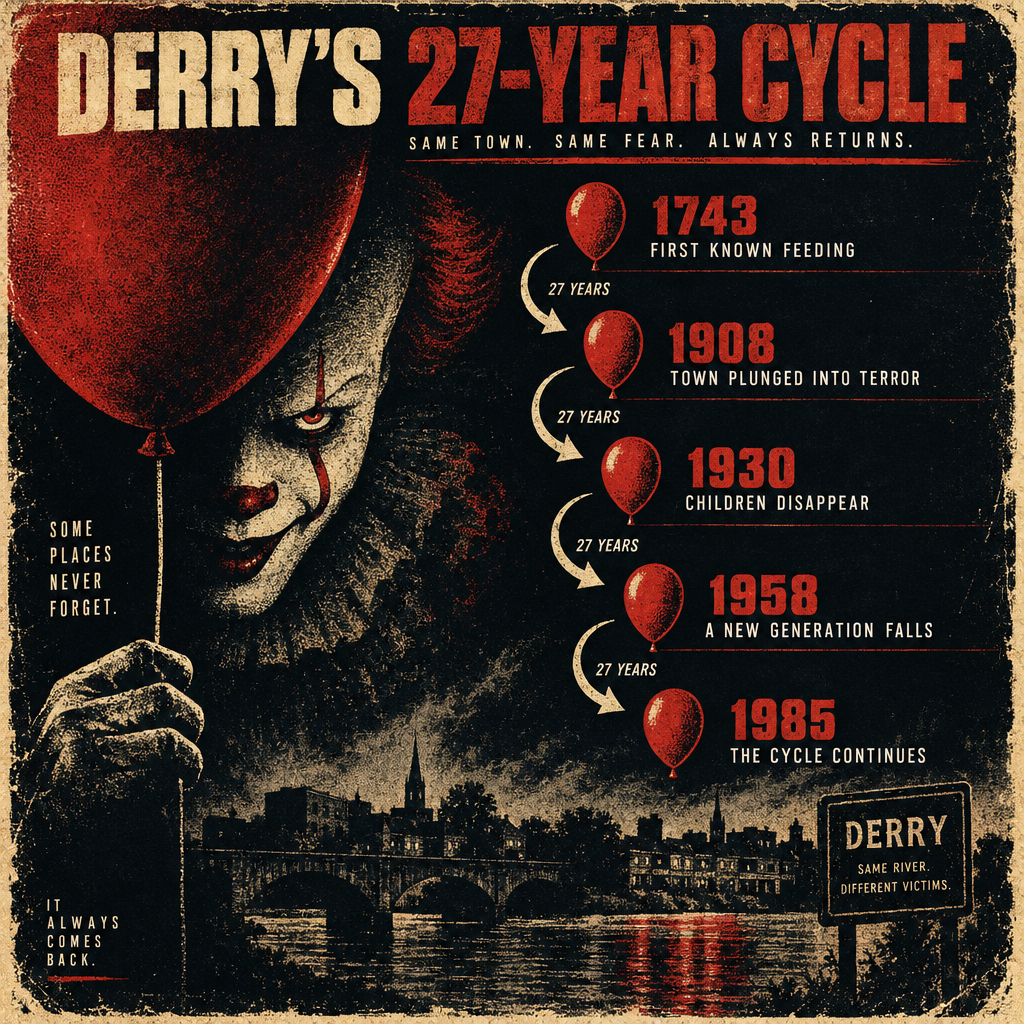
It feeds in cycles of roughly 27 years, each lasting a year to 18 months. A cycle opens with a spate of child disappearances and closes with a large-scale act of violence that It helps arrange, after which the creature returns to hibernation beneath the town.
| Cycle in the novel | Marker event | Who records it |
|---|---|---|
| 1740 to 1743 | The original Derry settlement, around 340 people, vanishes | Mike Hanlon’s research |
| 1908 | Kitchener Ironworks explosion during an Easter egg hunt | Derry library archives |
| 1929 to 1930 | The Bradley Gang shootout, then the Black Spot fire | Mike’s father, Will Hanlon |
| 1957 to 1958 | Georgie Denbrough’s death, the Losers’ first fight | The Losers’ Club |
| 1984 to 1985 | Adrian Mellon’s murder, the Losers’ return | Mike Hanlon’s phone calls |
The films shift every date forward by about 30 years. Georgie dies in October 1988 in It (2017), the kids fight Pennywise in the summer of 1989, and the adults return in 2016 in It Chapter Two. It: Welcome to Derry rewinds the cycle to 1962, with later seasons planned for 1935 and 1908.
The cycle matters because the town is part of the creature. Derry’s adults look away from bleeding children, ignore screams from the Barrens and forget the dead within weeks, and the novel is explicit that this silent consent is It’s most important power. A predator that hunts in the open needs a town willing to pretend nothing is happening.
Every major form Pennywise takes
It picks the shape from inside the victim’s head, so the forms double as a map of the Losers’ fears. The table below tracks the big ones across versions.
| Form | Whose fear | Novel (1986) | Miniseries (1990) | Films (2017, 2019) |
|---|---|---|---|---|
| Pennywise the Dancing Clown | Everyone, Georgie first | Yes | Yes, Tim Curry | Yes, Bill Skarsgård |
| Georgie Denbrough | Bill | Yes | Yes | Yes, and the flooded basement |
| The Leper | Eddie | Yes, at 29 Neibolt Street | Yes, brief | Yes, expanded |
| The Werewolf | Richie (and Bill) | Yes, from I Was a Teenage Werewolf | Yes | No, replaced by the Paul Bunyan statue in Chapter Two |
| The Mummy | Ben | Yes | Yes | Replaced by a headless burning boy |
| Blood from the bathroom sink | Beverly | Yes | Yes | Yes |
| Giant bird | Mike | Yes | No | No, replaced by the burning Black Spot hands |
| The drowned boys | Stan | Yes, at the Standpipe | Yes | Replaced by the Modigliani-style painting woman |
| Mrs. Kersh | Beverly as an adult | Yes | Yes | Yes, with the naked giant reveal |
| The Giant Spider | The Losers’ final confrontation | Yes, with eggs | Yes, stop-motion | Yes, a spider-clown hybrid |
The 2017 film also adds Pennywise forms with no book equivalent, like the headless boy chasing Ben through the library and the chaotic projector sequence in Bill’s garage. Andy Muschietti said he wanted scares the kids in the audience could not predict from the novel, and those scenes are the ones Twitter and TikTok still clip every October.
One rule holds across every form: It inherits the weaknesses of whatever it becomes. A werewolf can be hurt by silver, a mummy can be burned and a leper can be struck in the throat with a water gun full of “battery acid,” so long as the attacker believes the weapon will work.
Pennywise’s powers, ranked by how much they matter
You can find long lists of It’s abilities online, but most of them are variations on four core powers. Here they are in the order the story actually uses them.
- Shapeshifting and illusion. It can become anything a victim fears, down to the texture of a werewolf’s fur or the smell of a leper’s breath. Illusions can be solid enough to kill, as the werewolf’s claws prove on Bill’s cheek in the novel.
- Psychic reading and influence. It knows what you are afraid of before you do, and it can nudge the thoughts of adults so that they fail to notice a missing child. Henry Bowers is the clearest example, pushed from bully to murderer by voices from the moon in the novel and from a floating balloon in Chapter Two.
- Control of Derry. The town is It’s web. It can make sewer grates speak, cause the Standpipe to flood, send storms through downtown and keep every outsider from feeling welcome, which is why none of the Losers can remember Derry once they leave.
- The Deadlights. Exposure drives people mad, and It uses this as both weapon and feeding tool. Victims lifted into the Deadlights are the ones who “float,” suspended in the cistern beneath the Neibolt house.
A fifth, quieter power deserves mention. It prefers to frighten a victim before feeding because fear, in the novel’s phrase, salts the meat, and this preference is what gives the Losers their opening. A creature that could simply kill them would have done so in the Barrens. It plays with its food, and the game is the weakness.
How the Losers kill It, step by step
Spoiler warning
This section spells out the Ritual of Chüd and the ending of every version of It.
King’s ending is unusual because it is procedural. The Losers do not stumble onto a lucky weapon; they follow a sequence, get it half right as kids and finish the job as adults. Here is the method as the novel and films present it.
What you need before you go down
- Seven people who formed a bond in childhood. The novel is specific that seven is the number, and that the circle breaks when Stan dies, which is why the adults nearly fail.
- A weapon everyone believes in. For the kids it is Beverly’s slingshot, Bullseye, loaded with silver slugs Ben poured from a pair of his mother’s silver dollars.
- A map of the sewers. Ben draws the route in the novel, and the group enters through the pumping station in the Barrens, not the Neibolt house, which the films use as a shortcut.
- A memory of being afraid. The adults in Chapter Two have to retrieve “tokens” from their childhoods, and the point is the fear inside the token, not the object itself.
- Mike Hanlon’s research. Mike stays in Derry, keeps the archive and makes the phone calls that bring everyone back. Without his information, the others never remember the promise.
The steps
- Agree on the belief first. The kids spend a day arguing about whether silver will work, and the argument matters more than the metal. Belief is the only thing It cannot fake, and shared belief is stronger than individual belief.
- Enter the sewers together. Every version punishes anyone who separates. Stan is grabbed at the Standpipe in the novel when he wanders off, and in Chapter Two the Losers are picked apart one by one inside the Neibolt house until they regroup.
- Hit It with the weapon while It is in a vulnerable shape. Beverly shoots the werewolf in the head with a silver slug in 1958. The wound is real because It is bound by the rules of the shape, and the creature flees into the deeper tunnels.
- Follow It to the Deadlights’ chamber. Beneath Derry sits a cistern full of floating bodies and children’s belongings. In the novel, this is where Bill sees the spider for the first time and realises the spider is not It’s true form either, only the nearest edge.
- Perform the Ritual of Chüd. In the novel this is a psychic duel: Bill bites down on It’s tongue in his mind, and the two trade riddles and jokes while Bill is dragged toward the Deadlights. The Turtle advises Bill, and the tongue-twister his mother taught him, “He thrusts his fists against the posts and still insists he sees the ghosts,” becomes the anchor that keeps his mind whole.
- Wound the heart. Bill and Richie push into the Deadlights together in 1985, Eddie sprays his inhaler into the spider’s eye and loses his arm, and Bill finally reaches inside the spider’s body and crushes its heart. Ben smashes the eggs It laid so that nothing hatches later.
- Get out before Derry collapses. The creature’s death triggers a storm that floods downtown, drops the Standpipe and tears open the main street. The Losers climb out as the town literally caves in on the thing that fed on it.
The films change step five. Chapter Two’s Ritual of Chüd comes from the Shokopiwah people whom Mike visits, and it fails because the artifact never contained the creature in the first place. What works instead is shrinking It: the Losers insult it, deny its forms and refuse to be afraid until the spider-clown is small enough to pull its heart out by hand.
Common mistakes, in the story and in the fandom
- Assuming silver is the magic bullet. Silver works in 1958 because seven kids decide it will. The adults use silver earrings in the miniseries and nothing of the sort in the films. The weapon is a container for belief.
- Confusing the three endings. The novel ends with a psychic duel and a crushed heart. The 1990 miniseries ends with a stop-motion spider pelted with silver and then ripped open. Chapter Two ends with a shrunken clown whose heart is squeezed to dust. Mixing them up is the most common error in forum “Pennywise explained” threads.
- Thinking Pennywise is dead for good. The novel leaves ambiguity. Audra wakes up, Derry’s memory of the Losers begins to fade, and King never says whether a creature from outside the universe can truly die. Welcome to Derry only exists because the cycle has plenty of history left.
- Forgetting Stan. The adults in every version are six, not seven, and the story treats that as a wound. Stan’s letter in Chapter Two is Muschietti’s way of putting the seventh voice back in the room.
The expected result
If the steps are followed, the Losers lose one of their own, usually Eddie, and the town of Derry suffers a catastrophe that the rest of Maine will blame on weather. The survivors go home, and within months they struggle to remember each other’s names, because the thing that bound them was the thing they killed.
Pennywise on screen: three faces, one creature
There is no “Pennywise film” in the singular, and each screen version makes a different bet on how much of the clown to show. If you want to pick one for a watch night, here is how they compare.
It (1990 miniseries)
ABC aired the two-part miniseries on November 18 and 20, 1990, directed by Tommy Lee Wallace, who had cut and designed the sets for the 1978 John Carpenter Halloween before directing Halloween III. Lawrence D. Cohen, who adapted Carrie, wrote the script, and the cast of adult Losers included Richard Thomas, John Ritter, Annette O’Toole, Harry Anderson, Tim Reid and Dennis Christopher.
The reason it endures is Tim Curry. His Pennywise wears minimal prosthetics by design, so the performance lives in the voice, the eyebrows and the way he switches from carnival barker to snarling animal mid-sentence. The childhood half, set in 1960, still plays like a strong Saturday-matinee creature feature, while the adult half, set in 1990, sags, and the stop-motion spider finale is the part everyone apologises for. In the US it streams on HBO Max; in the UK look for it on NOW or on disc.
It (2017)
Andy Muschietti’s film for New Line and Warner Bros. opened on September 8, 2017, cost about $35 million and grossed roughly $700 million worldwide, which makes it the highest-grossing horror film of all time in unadjusted dollars. The screenplay by Chase Palmer, Cary Fukunaga and Gary Dauberman keeps only the childhood timeline, moved to 1988 and 1989.
Bill Skarsgård was 27 when the film came out, the same number as the creature’s cycle, and his Pennywise is a different animal from Curry’s. He drools, his eyes drift in two directions (a trick Skarsgård can do without effects) and his voice cracks between a child’s giggle and something subsonic. The kids, led by Jaeden Martell, Sophia Lillis and Finn Wolfhard, carry the film’s heart, and the Neibolt house sequence is the best Pennywise set piece ever shot. It streams on HBO Max in the US and NOW in the UK, and rents everywhere else.
It Chapter Two (2019)
Released September 6, 2019, Chapter Two brings back Muschietti and Dauberman and casts James McAvoy, Jessica Chastain, Bill Hader, James Ransone, Jay Ryan, Isaiah Mustafa and Andy Bean as the adult Losers. It earned around $473 million worldwide and runs almost three hours.
The film is bigger and bloodier than the first, with the Mrs. Kersh scene and the Chinese restaurant fortune cookies among the best Pennywise material in any version, but it has a pacing problem that the novel’s structure never solves on screen either. Hader’s Richie and Ransone’s Eddie carry the back half, and the ending’s “make It small” idea is a clever screen translation of the Ritual of Chüd even if book readers grumble. Same streaming homes as the first film.
It: Welcome to Derry (2025 series)
HBO’s prequel series premiered on October 26, 2025, with Muschietti directing the opening episodes and Jason Fuchs and Brad Caleb Kane as showrunners. It is set in 1962, one cycle before the Losers, and follows a new group of Derry kids alongside adults at the local air force base, played by Taylour Paige, Jovan Adepo and Chris Chalk as a young Dick Hallorann from The Shining.
Skarsgård returns as Pennywise, and the show’s job is to fill in the Bob Gray question the films skipped, with Madeleine Stowe playing Ingrid Kersh, an ancestor of the old woman Beverly meets. The first episode’s opening set piece is nastier than anything in the films, so this is not the version to start a squeamish friend on. It streams on HBO Max in the US, with Sky Atlantic and NOW carrying it in the UK, and HBO has renewed it for a second season.
If you liked this
Doctor Sleep (2019) for the same King universe and a Dick Hallorann link. Stand by Me (1986) for the kids-on-bikes friendship without the monster. Hereditary (2018) for a story where the family’s silence is the real horror.
Bob Gray: the human face under the paint
The novel drops a thread that fans pull on constantly. When Georgie meets the clown in the storm drain, It introduces itself as “Mr. Bob Gray, also known as Pennywise the Dancing Clown,” and later Mike’s research turns up a Pennywise who appeared in Derry’s history long before any circus would have reached Maine.
King leaves it open whether Bob Gray was a real clown whose identity It absorbed, or a name It simply likes. The films strip the Gray name down to a single line in the 2017 film, and the Muschiettis built Welcome to Derry around answering it, which is the strongest reason for a book reader to watch the series.
The tangled roots of the name explain another odd detail you may have noticed. Pennywise’s costume shifts across versions, from Curry’s baggy yellow silk to Skarsgård’s Renaissance-era ruff and bells, because the clown is a memory of whatever clowns the town’s children have seen, and Derry’s kids in 1908 saw different clowns from Derry’s kids in 1989.
Pennywise across Stephen King’s other books
Derry is King’s second-most-visited town after Castle Rock, and Pennywise leaks into several books outside It. You do not need any of them to understand the creature, but they add texture.
- The Tommyknockers (1987) sends a character through Derry, where he glimpses a clown with silver-dollar eyes grinning from a storm drain, a scene set after the 1985 ending.
- Insomnia (1994) is set in Derry and ties the town to the Crimson King, the villain of the Dark Tower, which is where the Turtle’s role as a guardian of the Beams gets its wider meaning.
- Dreamcatcher (2001) includes a memorial to the Losers’ Club in Derry and graffiti that reads “Pennywise Lives.”
- 11/22/63 (2011) has Jake Epping visit Derry in 1958, where he meets Beverly Marsh and Richie Tozier mid-story and feels the town’s wrongness without understanding it.
- The Dark Tower series (1982 to 2004) gives Maturin his full role, and the Dandelo creature in the seventh book is clearly a cousin of It, a thing that feeds on emotion.
King also published a short piece called “Derry: An Interlude” structure inside It itself, the five sections of Mike’s notebook, and if you only read one part of the novel for lore, read those. They contain every historical cycle, the Black Spot, the Bradley Gang and the ironworks, which is the material Welcome to Derry is adapting season by season.
Novel Pennywise vs. film Pennywise: the differences that matter
A reader coming from the films will be surprised by how talkative the book’s creature is. Novel Pennywise narrates its own history to the Losers, explains the Deadlights and the Turtle, and even argues philosophy with Bill in the Ritual of Chüd, while Skarsgård’s version barely strings two sentences together.
The novel also makes It female, or at least pregnant. The spider the adults confront in 1985 has laid eggs, which is a detail the 1990 miniseries keeps and both films drop, and it is one reason some readers argue It is not truly dead at the end.
The films pull the horror forward. Georgie’s death in the novel happens on the page in a few restrained paragraphs, while the 2017 film shows the bite, the arm and the body being dragged into the drain, which is the moment that sent kids in cinemas into their parents’ laps. The miniseries, as network television, cuts away entirely.
One scene no adaptation touches is the novel’s sewer sequence between the kids after their first victory, a sexual scene King has defended as a symbol of leaving childhood but which the films replace with the blood-oath in the field. If you look up the novel today, that scene is the first thing people argue about, and it is worth knowing it exists before you hand the book to a teenager.
Is Pennywise in any horror games?
Surprisingly, no. Despite constant rumours of Pennywise joining Dead by Daylight, no licensed Pennywise game has ever shipped beyond a 2017 virtual reality promo called It: Float, which was a short tie-in experience rather than a game. The clown is one of the biggest horror brands on the planet in merchandise terms, with Funko figures, NECA statues and Halloween masks sold by every retailer, and still no console appearance.
If you want the Losers’ Club experience with a controller, the nearest substitutes are cooperative survival horror games where a small group has to trust each other in the dark, because the whole point of It is that nobody survives Derry alone. Skarsgård did lend his face to a Pennywise costume in a few mobile titles, but none of them involve the Neibolt house or the sewers.
Why Pennywise outlasts other horror icons
Freddy Krueger needs you asleep, Jason needs you at a lake and Michael Myers needs Haddonfield. Pennywise only needs you to be a child who is afraid of something, which is everyone who ever lived.
King’s deeper trick is that the creature is also the town. Adults in Derry are not possessed; they simply choose not to see, and anyone who grew up somewhere that buried its scandals recognises that choice. The clown gets the posters, but the sign that you are in Derry is a grown-up looking at a bleeding kid and walking past.
That is why the character thrives in every format. Curry’s version is a monster for a 1990 living room, Skarsgård’s is built for an IMAX scream, and the Welcome to Derry version is a serialised history lesson in how a town learns to look away, and all three are the same creature because the fear underneath has not changed in 39 years of books, TV and film.
FAQ
Is Pennywise a clown or a spider?
Neither. Pennywise is the clown persona of a shapeshifting creature from outside our universe, and the spider is simply the closest shape a human mind can perceive of its true form. Its real nature is the Deadlights, a mass of orange lights that drive anyone who sees them mad.
Why does It come back every 27 years?
The novel never gives a biological reason, only a pattern Mike Hanlon finds in Derry’s records: a year or so of feeding, then a mass tragedy, then hibernation beneath the town. Bill Skarsgård being 27 when It (2017) opened is a coincidence fans love to point out.
Who played Pennywise?
Tim Curry played him in the 1990 ABC miniseries directed by Tommy Lee Wallace. Bill Skarsgård played him in It (2017), It Chapter Two (2019) and the HBO series It: Welcome to Derry (2025), all overseen by Andy Muschietti.
What is Pennywise afraid of?
Belief, courage and groups. It is bound by the rules of whatever shape it takes, so a werewolf can be shot with silver if the shooter believes it, and it feeds on fear, so a child who refuses to be afraid starves it. The novel adds the Turtle, which It hates and fears as the one older being in the Macroverse.
Does Pennywise die at the end of It Chapter Two?
Yes, on screen. The Losers shrink the creature by refusing its fear until it is small enough to tear its heart out, and the Neibolt house collapses into the cistern. The novel is more ambiguous about whether something from outside the universe can truly die, which is the gap Welcome to Derry plays in.
Where should a newcomer start?
Watch It (2017) first; it is the most frightening and the cleanest entry point. Follow with It Chapter Two, then the novel if you want the full mythology, and treat the 1990 miniseries as a curiosity worth seeing for Tim Curry. Save Welcome to Derry for after the films, since it assumes you know who Pennywise is.