
Kindergarten is an abstract puzzle adventure game from Con Man Games and Sean Young, published by SmashGames on Steam on June 15, 2017. It looks like a cheerful cartoon about a kid’s first day at school. Underneath, it is a time-loop murder puzzle where the adults are dangerous, the other kids hide awful secrets, and one wrong choice gets your child killed in a gory way that is played for laughs.
Story and setting
You play a nameless new kid starting at a new elementary school. Your parents have just moved, and your first day happens to be a Monday. It keeps being Monday. Each school day loops, and you restart the same morning with whatever you learned the last time.
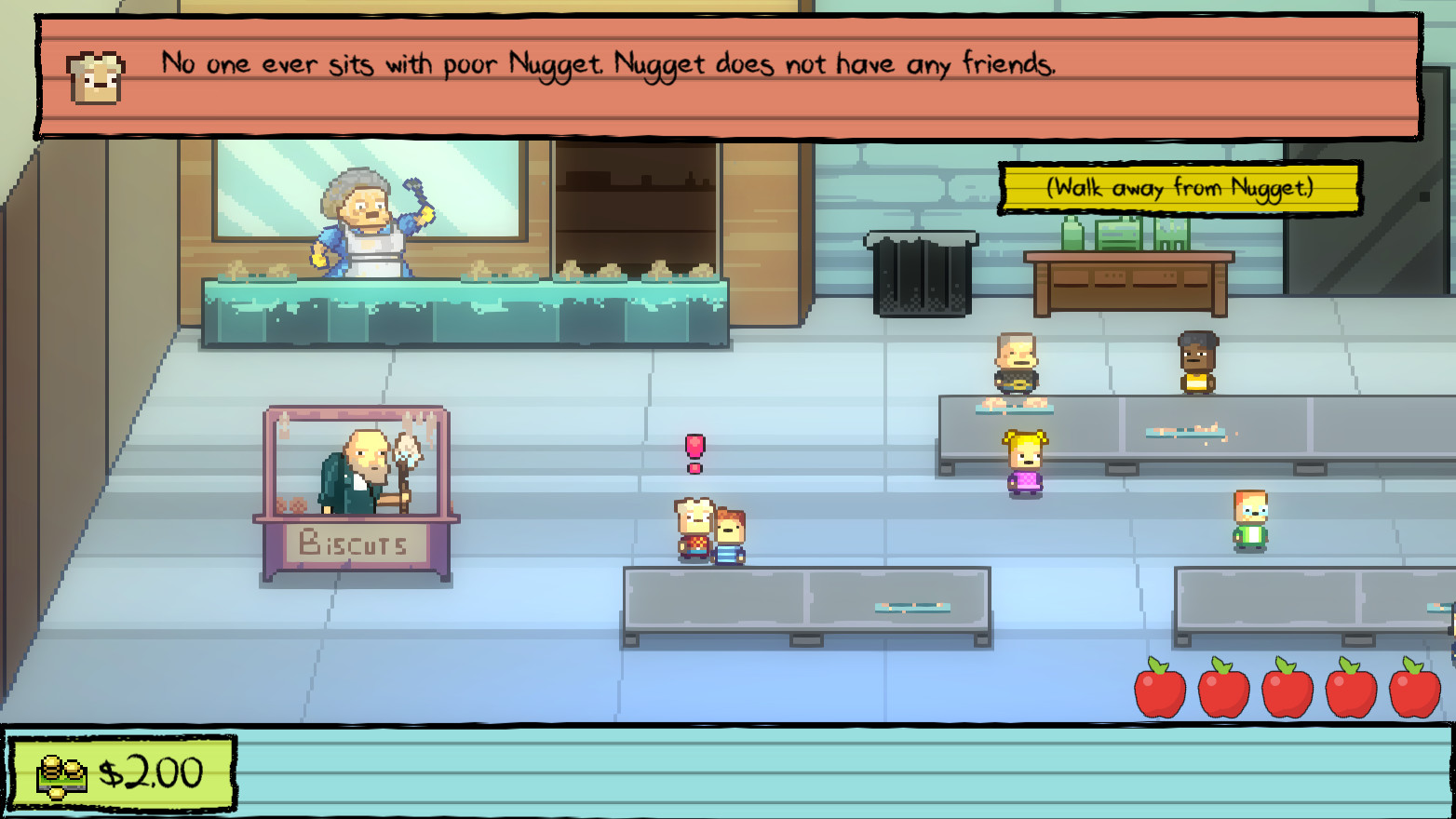
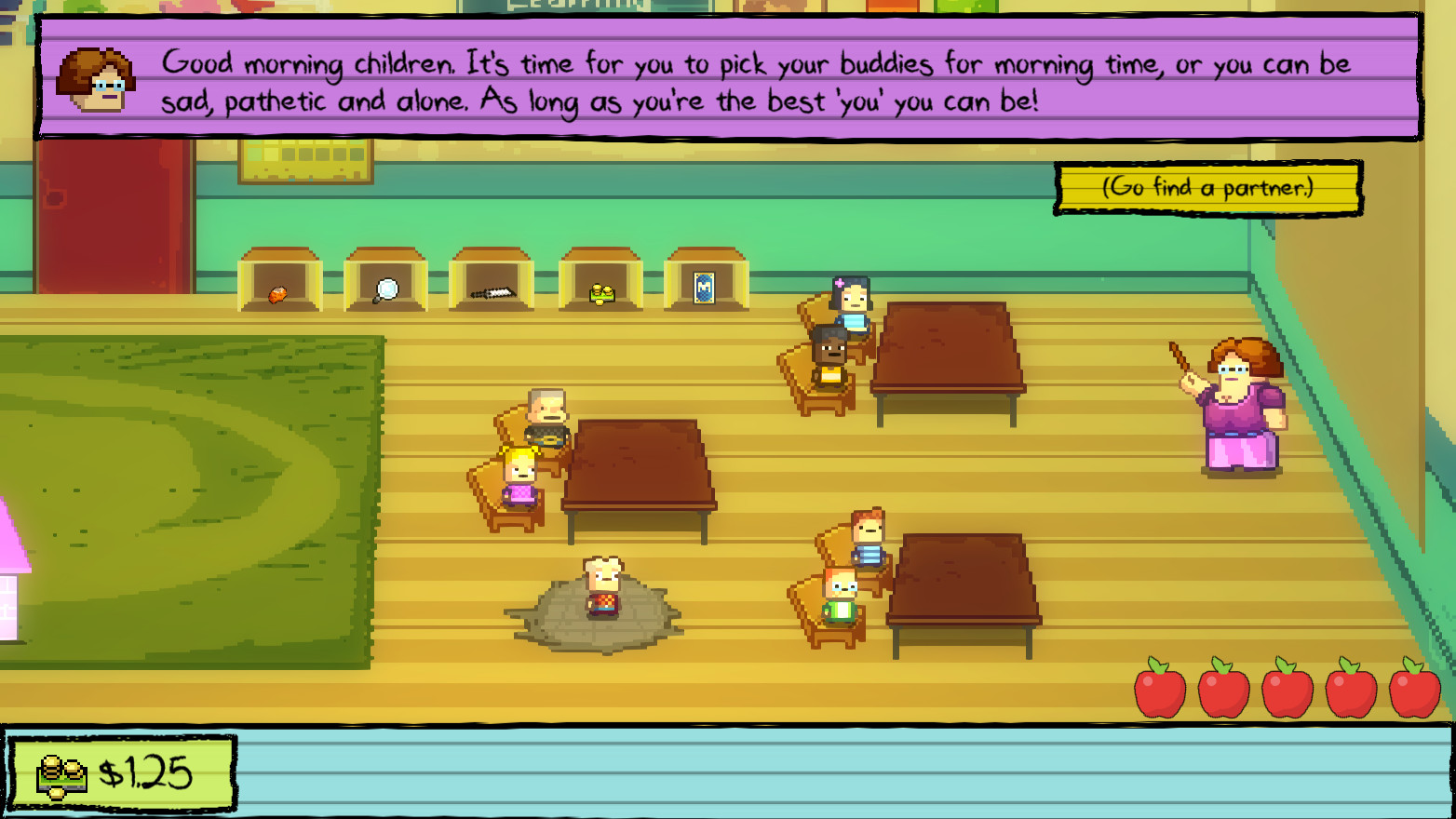
The whole game takes place inside the school building and its playground across a single day. You meet a small class of strange children, a teacher named Ms. Applegate who is far less wholesome than her name suggests, a janitor, a principal and a lunch lady. Every one of them is hiding something.
The tone sits halfway between a Saturday-morning cartoon and a crime scene. The art is bright and chunky, with big heads and simple shapes. The writing is deadpan and often very funny. Then a classmate dies on screen and the game shrugs and moves on. That collision is the whole point.
Without spoiling anything, the central hook is that a child has gone missing from this school, and nobody is acting like that matters. You don’t arrive as a hero. You start by trading for candy money and running errands, and only slowly realise how bad things are.
How it scares you
Kindergarten won’t scare you in the jump-scare sense. There are no monsters chasing you down corridors and almost no stingers. The fear is slower and stranger: dread mixed with discomfort, and the nagging sense that the school itself is rotten.
The loop and the clock
Each day is split into periods: morning, recess, lunch, and the afternoon. You can only take a limited number of actions in each period before the bell rings. Talking to someone, using an item, or walking into the wrong room all cost time.
That limit is the engine of tension. You need to plan a route through the day, and you often won’t have enough actions to do everything. Run out of time in the wrong place, and the day ends badly.
Death as a puzzle mechanic
Your character dies a lot. Kids can get hurt by adults, by other kids, by accidents you set in motion, and sometimes by things you never saw coming. Death resets the day, so it works like a failure state in any puzzle game.
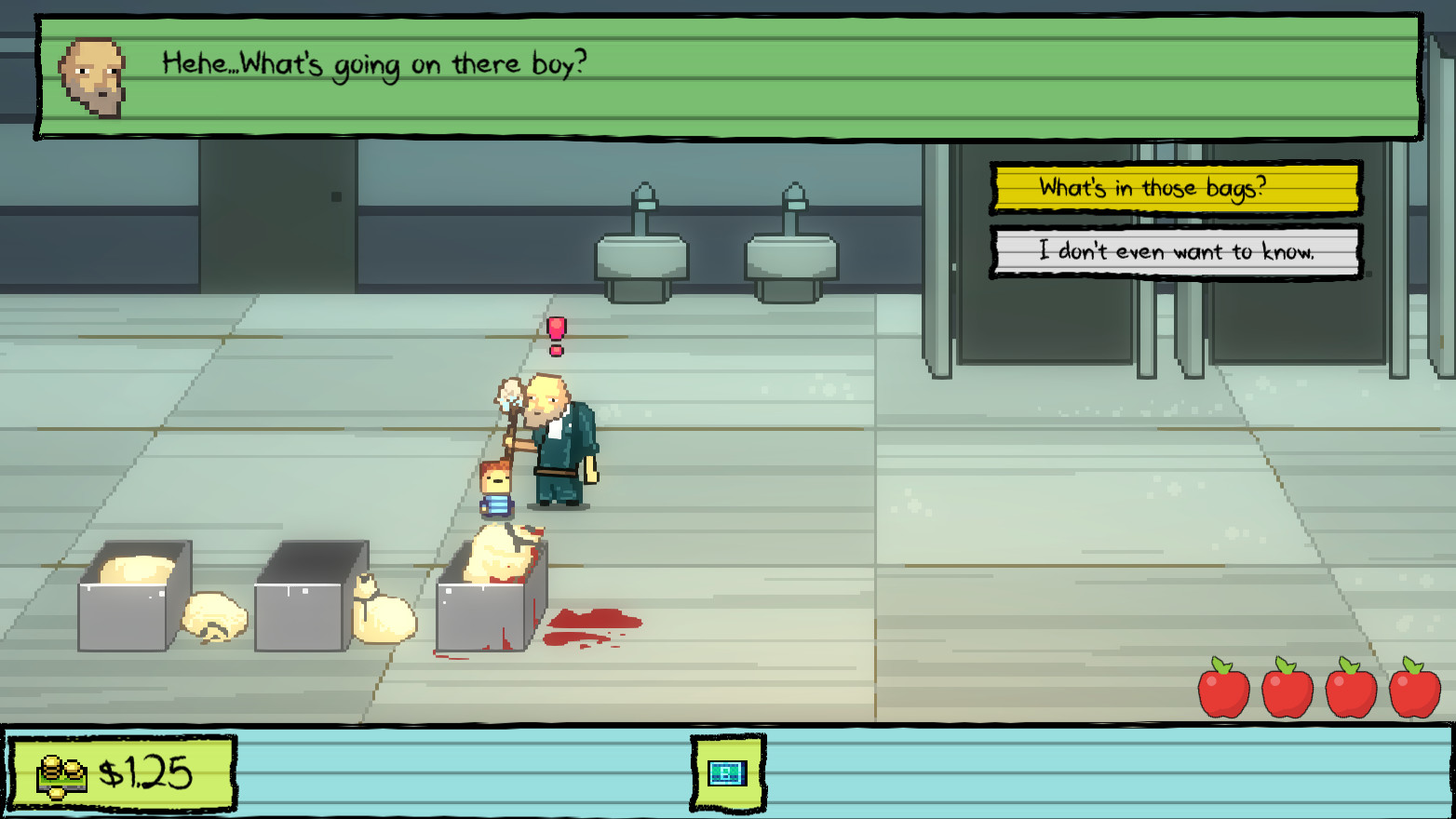
The scenes themselves are where the horror lives. They are brief, cartoon-styled and bloody. A cheerful character model doing something horrible to a six-year-old is more upsetting than any realistic gore would be. If you have a low tolerance for violence involving children, take that seriously before buying.
Missions instead of levels
Progress runs through character missions. Each classmate or adult has a storyline, and completing one usually means doing a precise chain of actions across a single day. You’ll need specific items, specific money amounts and specific timing.
Your resources are small and childish:
- Pocket money for trades and purchases
- Monstermon cards, the game’s in-world collectible card craze
- Items you pick up and swap between characters
- Knowledge carried over from previous loops
That last one matters most. The game rewards you for paying attention. A throwaway line from one kid on Tuesday-that-is-actually-Monday becomes the key to another kid’s mission three loops later.
Sound and camera
You see the school from a fixed, side-on view, room by room. There is no free camera and nowhere to hide from what happens on screen. Music is light and bouncy most of the time, which makes the sour moments land harder. The quiet beats after a death, with a cheerful loop still playing, are some of the creepiest in the game.
Common frustrations
Most players hit the same walls. Knowing them in advance saves a lot of grumbling:
- Wasting actions early. Morning actions are precious. Talking to everyone “just to see” often locks you out of a mission for that loop.
- Missing money. Several missions need a set amount of cash. If you’re short, the run is dead before lunch.
- Doing missions out of order. Some storylines unlock others. If a mission feels impossible, another character probably holds the piece you need.
- Expecting fairness. Some deaths have no warning. Treat the first death in any new situation as research, not failure.
If you get stuck for more than a few loops, there’s no shame in a guide. The game is built for trial and error, and plenty of fans played it with a walkthrough open on a second screen.
Lore and ending
Spoiler warning
This section discusses the overall mystery, the shape of the final mission and how the story connects to the sequel.
Kindergarten has one main ending, reached by completing every character’s mission and then playing a final mission that opens up once the rest are done. Finishing everything is the only way to see what the school is really covering up.
The big reveal is that the horror was never random. The missing child, the violent adults and the bizarre behaviour of your classmates are all tied to something the people running the school are hiding. Each character mission gives you one slice of it. Individually, they play like grim jokes. Together, they show an institution that treats children as disposable.
The time loop is part of that reading. You are the only one who remembers. Every adult resets to the same cruelty each morning, and every child resets to the same fear. You can only change things by understanding all of them, which is a neat way of making the player the investigator nobody else in the school will be.
The game deliberately leaves threads hanging. The fate of the missing child and the larger forces behind the school are not fully explained. Those questions carry straight into Kindergarten 2, which reuses the loop structure and expands the conspiracy. If the ending of the first game feels abrupt, that is because it was built as the opening chapter of a bigger story.
Where it fits in the series
Kindergarten is the first game in a series by Con Man Games.
| Order | Title | Notes |
|---|---|---|
| 1 | Kindergarten (2017) | Introduces the loop, the school and the core mystery |
| 2 | Kindergarten 2 (2019) | Same structure, new characters, deeper conspiracy |
| 3 | Kindergarten 3 | Continues the series with the same puzzle formula |
There are no remakes or remasters of the first game. The sequels build on its setup and assume you know who certain characters are and what happened before.
Play this one first. It is short and cheap, and the reveals in the later games hit far harder when you have already lived through the original’s Mondays. The sequels also polish the mission design, so starting with the roughest entry and moving up feels like a natural progression.
Where to play
As of October 2026, Kindergarten is sold on Steam for $4.99. The store page lists it for:
- Windows
- macOS
- Linux
It’s a single-player game only. There is no co-op and no multiplayer.
The native Linux build is good news for Steam Deck owners, since the game is simple 2D point-and-click puzzle play that suits handheld screens well. Steam Deck verification badges change over time, so check the current rating on the store page before you buy if you plan to play only on Deck.
Kindergarten is not something you need a subscription for. At its normal price it costs less than a month of Game Pass or PS Plus, and Steam sales regularly cut it lower. If you’re building a list of cheap PC horror games to work through, this is an easy one to add.
A note on the age rating: the Steam listing shows no required age, but don’t read that as “kid-friendly.” The violence against child characters is frequent and bloody, even if it’s drawn in a cartoon style. It’s a game for adults who like gallows humour.
If you liked this
Kindergarten 2: the same loop and deadpan humour, with sharper missions and more answers about the school.
Little Misfortune: a cute child protagonist, a cheerful narrator and a story that turns much darker than its art.
Doki Doki Literature Club: another sweet-looking game from 2017 that uses its innocent surface to deliver real horror.
FAQ
Is it spelled kindergarten or kindergarden?
The correct spelling is “kindergarten,” with a “t,” and that’s exactly how the game’s title is written. If you search the store for “kindergarden,” you may miss it, so use the “t” spelling when you look it up.
Is Kindergarten actually scary?
Not in a heart-pounding way. We rate it 2/5 for scares. It’s unsettling rather than terrifying, built on dread, dark jokes and shocking cartoon deaths instead of chases or jump scares. If gore involving children bothers you, it’ll hit harder than that number suggests.
How long does Kindergarten take to beat?
Plan on about five hours to finish every mission and see the ending. Players who go in blind and enjoy experimenting can take longer, while players following a guide can finish faster.
Is Kindergarten suitable for children?
No. Despite the school setting and bright art, it shows child characters being killed in bloody, comic ways. It suits teens and adults who enjoy dark comedy, and it’s a poor fit for younger players.
Do I need to play Kindergarten before Kindergarten 2?
You should. The second game continues the mystery and brings back characters and ideas from the first. You can technically follow the sequel on its own, but the original is short and inexpensive. Playing it first makes the later reveals far more satisfying.