

Monster: The Ed Gein Story is the third season of Ryan Murphy and Ian Brennan’s Netflix anthology, released on October 3, 2025, with Charlie Hunnam as Gein and Laurie Metcalf as his mother Augusta. The real Ed Gein was a Plainfield, Wisconsin handyman who confessed to two murders and years of grave robbing after police searched his farmhouse in November 1957. Here is what actually happened, what Netflix invented, and which horror movies carry his fingerprints.
What you get on Netflix (spoiler-free)
The season runs eight episodes and sits alongside Dahmer – Monster: The Jeffrey Dahmer Story (2022) and Monsters: The Lyle and Erik Menendez Story (2024). Tom Hollander plays Alfred Hitchcock, Olivia Williams plays Alma Reville, Suzanna Son plays Adeline Watkins and Vicky Krieps plays Ilse Koch, which tells you how far the story wanders beyond Plainfield.
Hunnam plays Gein as soft-spoken and childlike, which matches most accounts from people who knew him. Metcalf is the standout. Her Augusta is a sermon on legs, and the first two episodes are mostly a two-hander between them inside a dying farmhouse. If you only want the true crime, you will get restless around episode four, when the show starts cutting to Hollywood and the Texas Chain Saw set. If you want a film-history fever dream, that is where it comes alive.
Critics were split, with many calling it the weakest Monster season for playing loose with facts. Audiences watched anyway. It topped Netflix’s English-language TV chart in its first week.
The real Ed Gein, year by year
| Year | What happened |
|---|---|
| 1906 | Edward Theodore Gein born August 27 in La Crosse, Wisconsin |
| 1914 | Family moves to a 160-acre farm outside Plainfield |
| 1940 | Father George Gein, an alcoholic, dies |
| 1944 | Brother Henry dies during a brush fire on the farm |
| 1945 | Augusta Gein dies December 29 after a second stroke |
| 1947 to 1952 | Gein makes roughly 40 night visits to three local cemeteries |
| 1954 | Tavern owner Mary Hogan disappears December 8 |
| 1957 | Bernice Worden killed November 16; her body found in Gein’s shed |
| 1958 | Farmhouse burns March 20, days before a planned auction |
| 1968 | Tried for Worden’s murder, found guilty, then ruled legally insane |
| 1984 | Dies July 26 at Mendota Mental Health Institute, Madison |
Two murders. That is the confirmed count. Gein admitted to killing Worden and later Hogan, and he was only ever tried for Worden. Everything else in his house came from graves. He told investigators he dug up recently buried middle-aged women who reminded him of his mother, usually within a day or two of the funeral, and often returned to the cemetery in a trance-like state.
Ed Gein’s mother, Augusta
Searches for Ed Gein’s mother spike every time a new adaptation lands, and for good reason. Augusta Wilhelmine Gein, born Lehrke, ran the family grocery in La Crosse before buying the Plainfield farm specifically to get her sons away from the city. She was a devout Lutheran who read her boys Old Testament passages about Jezebel and the wages of sin and told them that women were instruments of the devil.
Henry pushed back as an adult and reportedly criticised Ed’s devotion to her. Ed never did. When Augusta died in 1945, he was 39 and had never had a girlfriend or a job outside odd handyman work and babysitting.
What he did next is the detail that shaped a whole genre. He boarded up her bedroom and the front parlour and kept them exactly as she left them, spotless, while the rest of the house filled with filth and trophies. Investigators in 1957 opened those sealed rooms and found a shrine. Robert Bloch turned that into the Bates house. Laurie Metcalf’s version on Netflix is louder and more theatrical than the historical Augusta, who left behind no recordings and only a handful of family photographs.
What police found in November 1957
Bernice Worden ran the Plainfield hardware store. On the morning of November 16, the first day of deer season, her son Frank, a deputy sheriff, found the store empty with blood on the floor and a receipt for antifreeze in Gein’s name. Waushara County Sheriff Art Schley drove out to the farm that evening.
In the summer kitchen shed he found Worden’s body hanging upside down from the rafters, decapitated and dressed out like a deer. Inside the house were skulls on bedposts, bowls made from skull caps, a chair seat and lampshade made from human skin, a wastebasket of skin, masks made from the faces of nine different women, and a vest and leggings sewn from skin. Mary Hogan’s face was in a paper bag. Worden’s head was in a burlap sack.
Schley reportedly slammed Gein’s head into a wall during questioning, which made the first confession inadmissible. Gein was declared unfit for trial in 1957 and sent to Central State Hospital in Waupun. Eleven years later Judge Robert Gollmar found him guilty of first-degree murder and then not guilty by reason of insanity in the same week. Schley had died of a heart attack before the trial. Locals blamed the case.
Ed Gein pictures: what exists and what does not
Life magazine put the case in its December 2, 1957 issue, and those photographs are the ones you have most likely seen: Gein in a plaid cap being walked to a car by deputies, the cluttered kitchen with its wood stove and boxes, the farmhouse under snow, the shed door. The Wisconsin crime lab’s evidence photos also circulated for decades through true crime magazines and later the internet.
We do not reproduce the crime scene imagery, and you should treat any “leaked” photo of the skin masks or the Worden scene with suspicion. Most that circulate online are mislabelled props from the 2000 and 2007 films or unrelated medical photographs. The authentic set is small, grainy and mostly shows objects, not bodies.
Two other photos matter for collectors. Gein’s 1949 Ford sedan was bought at the 1958 farm auction by sideshow operator Bunny Gibbons and toured county fairs as “Ed Gein’s Ghoul Car” at a quarter a look. And his headstone was stolen from Plainfield Cemetery in 2000, recovered near Seattle in 2001, and is now held by the Waushara County sheriff rather than returned to the grave beside Augusta.
What Netflix invented
Spoiler warning
The next section spoils plot points from all eight episodes of Monster: The Ed Gein Story, including the ending.
The series makes Ed responsible for Henry’s death in the 1944 fire, showing him striking his brother. In reality the death was ruled asphyxiation, and while Henry had bruises on his head, no charge was ever brought and the fire itself was a brush fire the brothers were fighting together. Suspicion exists. Proof does not.
Adeline Watkins, played by Suzanna Son as a true crime obsessive who eggs Ed on, was a real Plainfield woman. In 1957 she told a Minneapolis newspaper she had dated Gein for 20 years and nearly married him. She recanted within days and said they had only gone to the movies a few times. The show’s version of their relationship, including her presence during the crimes, is fiction.
The Evelyn Hartley abduction, shown on screen with Addison Rae in the role, is the murkiest claim. Hartley was a 15-year-old babysitter who vanished from La Crosse in October 1953. Gein was questioned about it in 1957 because he had been in La Crosse that day, but he passed a polygraph and nothing linking him was ever found. The case remains unsolved. Netflix presents it as solved.
Ilse Koch, the “Bitch of Buchenwald” accused of making lampshades from prisoners’ skin, appears as a recurring fantasy figure. Gein did read pulp magazines full of Nazi atrocity stories, and investigators noted them in the house, so the influence is plausible. The scenes of Ed talking to her are pure invention. The same goes for the finale’s framing of Gein as a direct muse who haunts Hitchcock, Tobe Hooper and the FBI profilers. Bloch never met him, Hooper never met him and Thomas Harris never met him. They read about him, like everyone else.
Movies about Ed Gein, directly
Deranged (1974)
Jeff Gillen and Alan Ormsby’s Deranged renames Gein as Ezra Cobb but follows the real case more closely than any film before or since. Roberts Blossom, the scary neighbour from Home Alone, plays Ezra with a gentleness that makes the taxidermy scenes land harder. The mother, Ma Cobb, dies in the opening minutes and keeps talking anyway. Tom Savini did the effects, two years before Dawn of the Dead. It is the one to show a friend who thinks they know the story from Psycho. Blu-ray is the reliable route.
Ed Gein (2000)
Chuck Parello’s film, also released as In the Light of the Moon, is the most literal retelling. Steve Railsback plays Gein and Carrie Snodgress plays Augusta, and the script uses real names, the Worden hardware store and the 1957 timeline. It is a quiet, low-budget drama rather than a horror film. Scares are minimal. The value is accuracy. Free streamers like Tubi carry it regularly, and it rents for a few dollars elsewhere.
Ed Gein: The Butcher of Plainfield (2007)
Michael Feifer’s direct-to-video take casts Jason actor Kane Hodder as Gein, which gives you an idea of the approach. It invents a sheriff’s daughter subplot and a far higher body count. Watch it only if you are collecting every Gein-based movie. Rental only.
The three classics he inspired
| Film | Year | Director | What it borrowed | Scare level | Where to watch |
|---|---|---|---|---|---|
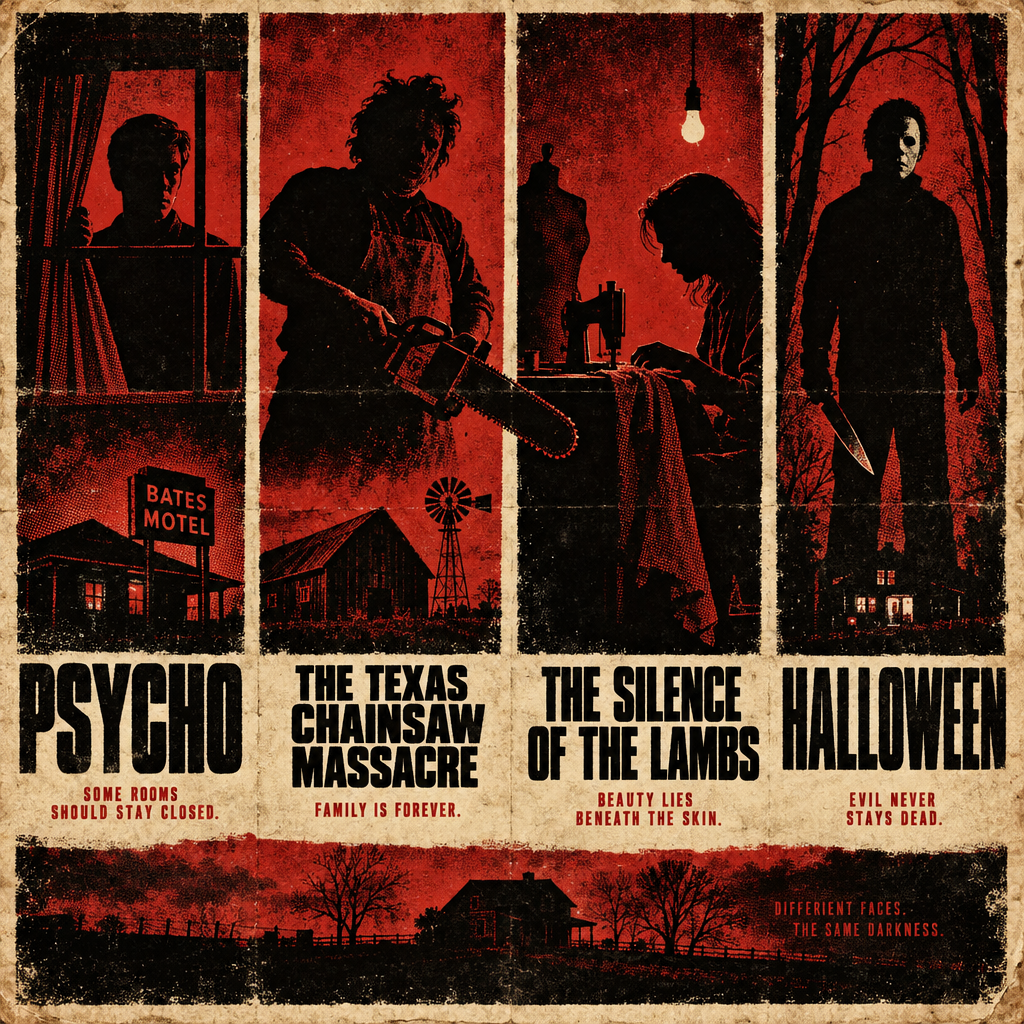
| Psycho | 1960 | Alfred Hitchcock | Mother fixation, preserved shrine, small-town killer | 4/5 | Peacock, digital rental |
| The Texas Chain Saw Massacre | 1974 | Tobe Hooper | Skin masks, bone furniture, farmhouse of trophies | 5/5 | Rotating streamers, rental |
| The Silence of the Lambs | 1991 | Jonathan Demme | The “woman suit” made of skin | 4/5 | Digital rental |
Psycho (1960)
Robert Bloch was living in Weyauwega, Wisconsin, about 35 miles from Plainfield, when the Gein story broke. He wrote the novel in 1959 and later said the detail that gripped him was that a man could do all this in a tiny town and have nobody suspect a thing. Norman Bates got the mother, the taxidermy hobby and the sealed bedroom. He did not get the grave robbing or the masks, which is why Psycho plays as a thriller rather than body horror. The Netflix series spends two full episodes dramatising Hitchcock’s production, with Joey Pollari as Anthony Perkins.
The Texas Chain Saw Massacre (1974)
Tobe Hooper grew up hearing Gein stories from Wisconsin relatives, and Leatherface’s masks, the bone chairs, the lampshade and the feather-stuffed furniture come straight from the 1957 inventory. Hooper moved the family to Texas and gave them a slaughterhouse background. The film still sits near the top of most lists of the most terrifying horror movies ever made, and it did it with almost no on-screen blood. Will Brill plays Hooper on Netflix, which is the first time the connection has been dramatised. Streaming rights rotate between Peacock, Tubi and Shudder, so check all three.
The Silence of the Lambs (1991)
Thomas Harris built Buffalo Bill from three men: Gein for the skin suit, Ted Bundy for the fake-cast lure and Gary Heidnik for the basement pit. Ted Levine’s performance gets the Gein piece exactly right, a man sewing a new body out of other people because he cannot stand his own. Jonathan Demme’s film won five Oscars and is still the only horror-adjacent Best Picture winner. It is the natural next watch after the Netflix season.
If you liked this
Dahmer – Monster: The Jeffrey Dahmer Story (2022) for the same anthology with far tighter factual footing. Hitchcock (2012) for Michael Wincott’s ghostly Gein haunting the director during the Psycho shoot. Maniac (1980) for the grimy New York cousin of Deranged.
Gein’s long shadow also explains why the slasher boom that followed John Carpenter’s Halloween in 1978 kept returning to masks and rural houses. Carpenter borrowed from Hitchcock, Hitchcock borrowed from Bloch, and Bloch borrowed from a hardware store in Plainfield.
FAQ
Is Monster: The Ed Gein Story a true story?
The core is true: the farm, Augusta, the two murders, the grave robbing and the 1957 search. The Adeline Watkins romance, Henry’s death as a murder, the Evelyn Hartley abduction and the Ilse Koch fantasies are invented or unproven.
How many people did Ed Gein actually kill?
Two confirmed: Mary Hogan in 1954 and Bernice Worden in 1957. He was tried only for Worden. The remains found in his house came from at least nine graves he robbed between 1947 and 1952.
Which movie is most accurate to Ed Gein?
Ed Gein (2000) with Steve Railsback uses real names and events most faithfully. Deranged (1974) changes the names but captures the house and the psychology better as a film.
Can you still visit Ed Gein’s house?
No. It burned down on March 20, 1958, in a fire widely assumed to be arson. The land is private and the grave in Plainfield Cemetery has no marker.
Where does Netflix go after Ed Gein?
Netflix has confirmed a fourth Monster season about Lizzie Borden, with Ella Beatty cast in the lead.