
John Carpenter’s Halloween cost around $300,000, shot on a four-week schedule, and went on to earn roughly $47 million at the US box office, which made it one of the most profitable independent films ever released. Everything that followed, from Friday the 13th to Scream, is working from its blueprint. Here is how one low-budget halloween horror movie from 1978 rewired the genre, and why it still works when you watch it tonight.
Spoiler warning
This piece discusses the opening, the ending and the body count of Halloween (1978), plus the sibling retcon from Halloween II (1981) and the 2018 reboot.
What to know in sixty seconds
You could fill a shelf with books about this movie. The short version fits in a table.
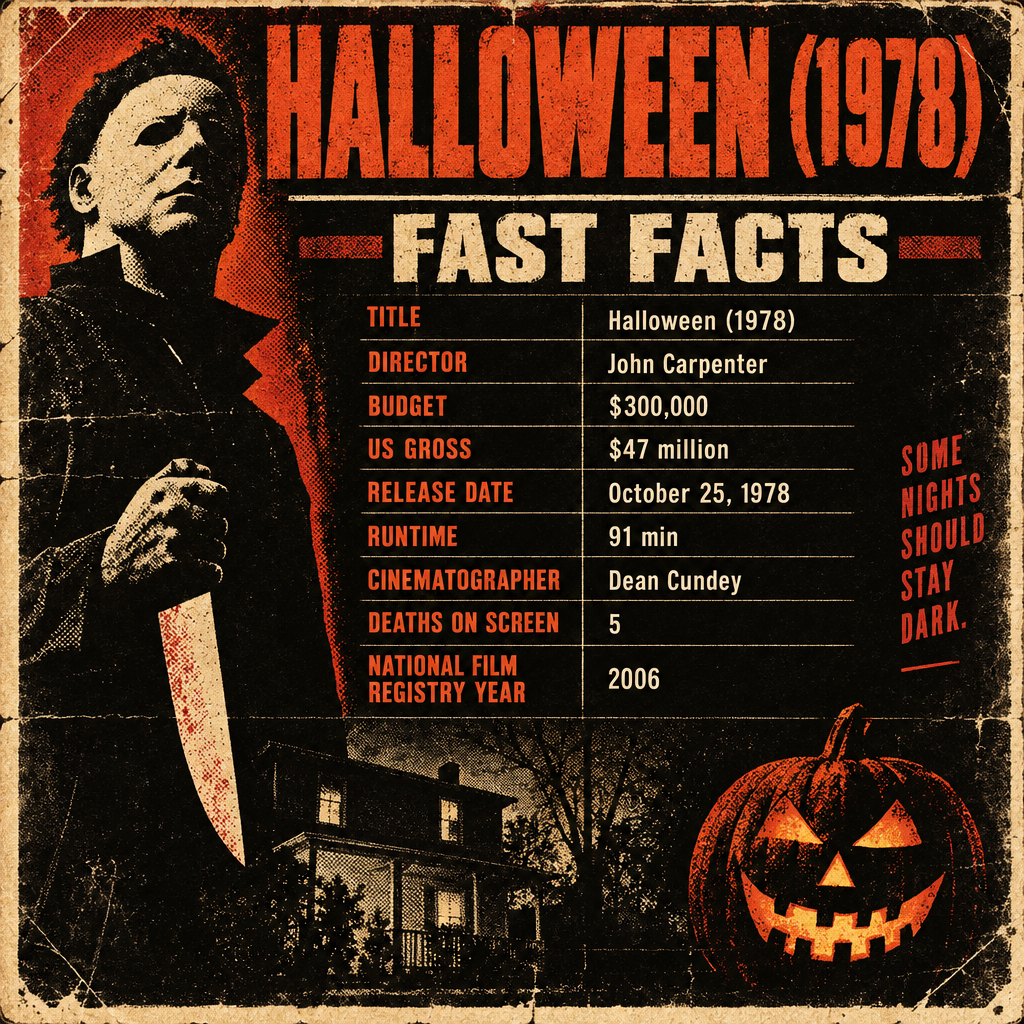
| Detail | Fact |
|---|---|
| Title | Halloween (working title: The Babysitter Murders) |
| Released | October 25, 1978 |
| Director | John Carpenter, aged 30 at the time |
| Writers | John Carpenter and Debra Hill |
| Producer | Debra Hill |
| Financing | Moustapha Akkad, through Compass International Pictures |
| Budget | Roughly $300,000 |
| Shoot | About 20 days, spring 1978, South Pasadena and Hollywood |
| Cinematographer | Dean Cundey, 2.35:1 anamorphic widescreen |
| On-screen deaths | Five, with almost no blood shown |
| US gross | Around $47 million |
| Honours | Added to the National Film Registry in 2006 |
Carpenter was paid $10,000 to write, direct and score the film, plus a percentage of the profits. That percentage turned out to be the best deal of his life.
Where to watch Halloween (1978)
Streaming rights for the original move around more than most classics, because the film sits with the Akkad family’s Trancas and Compass International rather than a major studio.
In recent years it has lived on Shudder and AMC+, and it regularly shows up free with ads on services like Tubi and Pluto TV once October rolls in. You can rent or buy it year-round on Apple TV, Prime Video and YouTube.
If you care about how it looks, buy the disc. The film was shot anamorphic, and the 4K releases from Scream Factory and Lionsgate finally let Dean Cundey’s blue-lit suburban nights breathe. Older TV airings cropped the frame, which hides Michael in exactly the places Carpenter wanted him lurking.
How the movie got made
The story starts with Irwin Yablans, a distributor who had seen Carpenter’s Assault on Precinct 13 (1976) and wanted something cheap and scary from him. His pitch was a killer stalking babysitters. On a flight, he landed on the idea of setting it on Halloween night, a date no horror film had owned.
Yablans brought in Moustapha Akkad, a Syrian-born producer who had just made the epic The Message (1976). Akkad put up the money. Carpenter and his partner Debra Hill wrote the script in roughly ten days.
Hill had been a babysitter herself, and she wrote most of the dialogue for the three girls. Carpenter wrote Dr. Loomis. That split is why Laurie, Annie and Lynda sound like actual teenagers while Loomis sounds like a man reading from the Book of Revelation. Both registers are essential.
They named the town Haddonfield after Hill’s hometown of Haddonfield, New Jersey. Then they shot the whole thing in Southern California in the spring. Pumpkins were nearly impossible to find, and the crew bagged up fake autumn leaves, scattered them for each shot, then swept them up to use again down the street. Look closely and you can spot palm trees in supposedly small-town Illinois.
The mask is the most famous accident in horror history. Production designer Tommy Lee Wallace went to a costume shop and came back with a Don Post Studios Captain Kirk mask, a William Shatner likeness, for less than two dollars. He spray-painted it white, widened the eye holes and messed up the hair. The alternative was a clown mask. Wallace chose correctly.
The terror of not knowing
Open the film and you are inside someone’s head. The camera drifts up to a house in 1963 Haddonfield, slips in through the back door, picks up a kitchen knife and climbs the stairs. You watch a teenage girl, Judith Myers, stabbed through the eyeholes of a clown mask.
Then the mask comes off and the killer is a six-year-old boy.
That opening, shot with a Panaglide rig that looks like one continuous take, tells you the movie’s rules in four minutes. You will spend a lot of time looking at the world the way Michael looks at it. You will almost never learn what he is thinking. The credit sheet calls him “The Shape,” and that is exactly what he is.
Carpenter refuses to explain him. Loomis tries, in the car with Nurse Chambers, and the best he can manage is that the boy had “the blackest eyes, the devil’s eyes.” There is no abusive father, no bullying, no trauma. Rob Zombie’s 2007 remake spent a full hour supplying all of that, and the character shrank with every answer.
That void is the engine of the fear. A psychopath with motives is a crime story. A silent figure who stands across the street in broad daylight, then is simply gone when you look again, is something closer to a ghost. Loomis calls him the boogeyman, and Tommy Doyle, the kid Laurie is babysitting, believes him before anyone else does.
Michael never runs. He walks, he waits, he tilts his head at a body he has just pinned to a wall as if he is curious. That head tilt was Nick Castle’s idea, and it is more disturbing than any amount of screaming.
Carpenter knows exactly what he’s doing
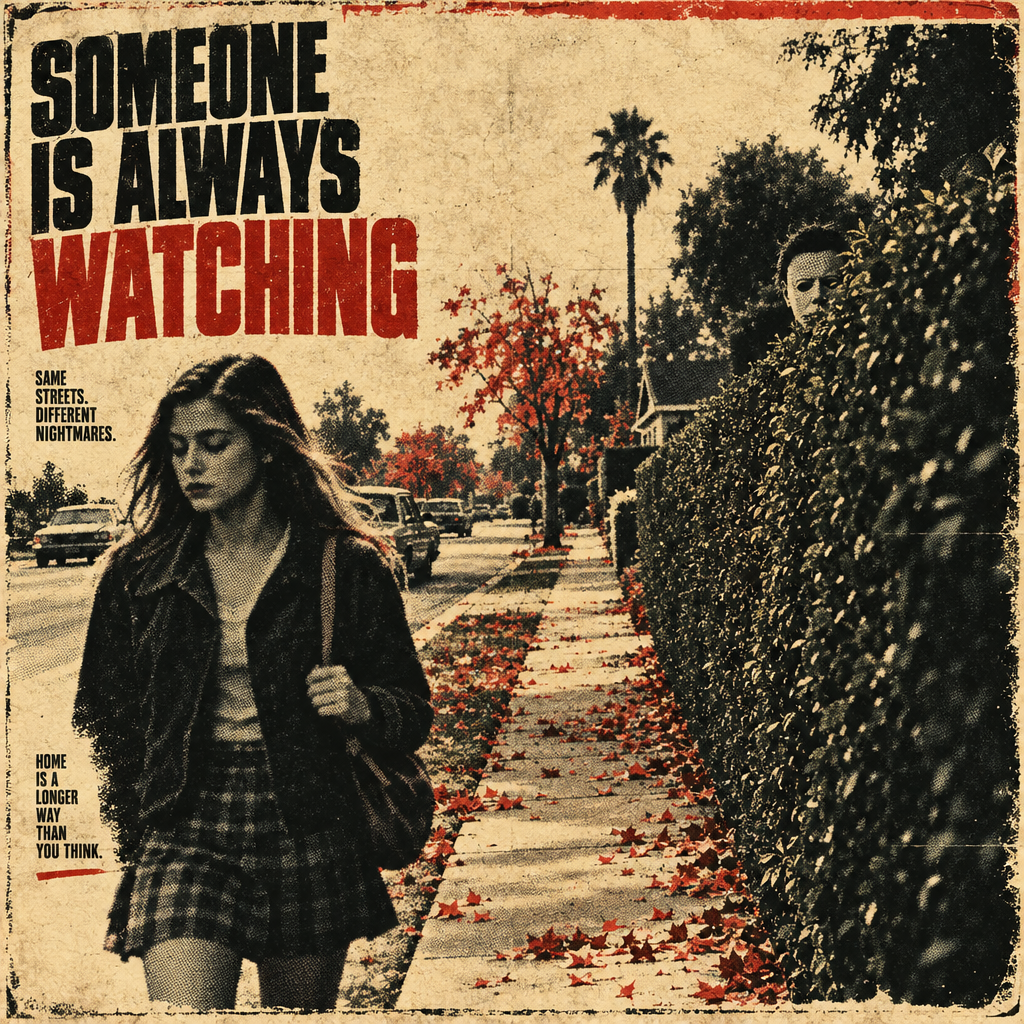
A lot of the terror is geometry. Carpenter and Dean Cundey shot in anamorphic widescreen, a format usually reserved for westerns and war films, and they used the extra width to hide things.
Michael appears at the edge of frame while Laurie walks home from school. He stands behind a hedge, visible for a second, then the hedge is empty. He is a pale smudge among the sheets on a washing line. You are trained within twenty minutes to scan every shot, and once you are scanning, Carpenter can scare you with an empty doorway.
Pacing matters as much as framing. The first hour of Halloween is mostly people talking, driving and smoking in cars. Annie complains about her boyfriend. Lynda says “totally” eleven times. Laurie carries a pumpkin and worries about a chemistry test. The deaths do not start until well past the halfway mark.
Modern audiences sometimes call this slow. It is actually patient, and the patience is a trap. By the time Laurie crosses the street to the Wallace house, you know the geography of both homes, you know who is where, and every lit window is a threat.
Then there is the gore, or rather the lack of it. The film has five on-screen killings, and you see barely a drop of blood. Bob is pinned to a pantry door. Lynda is strangled with a phone cord while Laurie listens on the other end, thinking it is a joke. Carpenter cuts away or holds on reaction instead of the wound.
The MPAA gave it an R regardless, mostly for the topless scene and the atmosphere. It plays today like a PG-13 that happens to be scarier than most R-rated films.
Jamie Lee Curtis is the heart of Halloween
Jamie Lee Curtis was 19, had done a sitcom and some TV guest spots, and was paid $8,000. Her casting was partly a publicity angle, because her mother was Janet Leigh, the woman in the shower in Psycho (1960). That link was free marketing and Carpenter knew it.
It also turned out to be a real performance. Laurie Strode is bookish, a little lonely, the one who cannot get a date while her friends talk about nothing else. Curtis plays her with warmth rather than mousiness. Watch her with Tommy and Lindsey: she is genuinely kind to those kids, and that is why you care when the lights go out.
Laurie is also competent. She notices Michael three separate times during the day. She fights back with a knitting needle, a wire hanger and his own knife. She gets the children out of the house before she thinks about herself. The film never punishes her for being smart.
Carol J. Clover named this figure the “final girl” in her 1992 book Men, Women, and Chain Saws, and Laurie is the model everyone cites. Nancy in A Nightmare on Elm Street (1984) and Sidney in Scream (1996) are direct descendants. Even the gender politics people argue about, the idea that only the virginal survive, come from readings of this film. Carpenter has said for decades that was never the intent: Laurie survives because she is the one paying attention.
Curtis came back for Halloween II (1981), Halloween H20 (1998), Halloween: Resurrection (2002) and the 2018 trilogy. No other actor has played a single horror role across 44 years. The whole franchise is, in a real sense, her career.
Donald Pleasence and the voice of doom
Carpenter wanted Christopher Lee or Peter Cushing for Loomis. Both passed. Donald Pleasence, a respected English stage and screen actor with Dr. No and The Great Escape behind him, said yes, reportedly because his daughter had seen Assault on Precinct 13 and liked it.
He worked for five days and was paid in the low tens of thousands. He hated the script’s ending at first and asked Carpenter what Loomis was thinking in the final moments. Carpenter said he had no idea. That answer, oddly, is why the ending works.
Loomis is named after Sam Loomis, Janet Leigh’s boyfriend in Psycho, one of several nods to Hitchcock. But Pleasence turns him into something new: the man who has stared at evil for fifteen years and knows there is no cure. “I spent eight years trying to reach him, and then another seven trying to keep him locked up.” Every slasher that followed needed a Loomis, the harbinger who warns the town and gets ignored. Crazy Ralph in Friday the 13th is a cheaper model of the same part.
The two leads never share a scene until the last three minutes. When Loomis finally fires six shots into Michael and he topples over the balcony, Laurie asks, “Was that the boogeyman?” Pleasence answers, “As a matter of fact, it was.” Then he looks down at the lawn and the body is gone.
The sound of Michael Myers
Carpenter’s score is the reason you can hum this movie. He wrote it in about three days at Sound Arts in Los Angeles with synth programmer Dan Wyman, on a budget that would not have covered a single orchestral session.
The main theme is in 5/4 time. Carpenter’s father, a music professor, had taught him that rhythm on bongos when he was a kid, and the lopsided count is why the theme never feels settled. Your brain expects a fourth beat to resolve and gets a fifth instead. It is unease you can measure.
There is a famous story about the first cut. Carpenter screened the film without music for a young executive at 20th Century Fox, and she was not scared at all. He went away, laid in the score, and the same woman later saw it finished and was terrified. Carpenter has told that story for decades as proof of how much the music carries.
The stingers matter as much as the theme. Those sharp synth stabs when Michael appears are the closest the film gets to a jump scare. The drifting, four-note “Laurie’s Theme” is the sound of a quiet street at dusk. And when there is no music at all, which is often, you hear Michael breathing behind the mask.
Varèse Sarabande released the soundtrack, and it has been reissued on vinyl by Mondo and Death Waltz. Carpenter re-recorded the theme with his son Cody Carpenter and Daniel Davies for the 2018 film, heavier and slower, and the new version slams. Still, the thin 1978 synth is the one that lives in your head.
The blueprint that everybody copied
Halloween did not invent the slasher. Psycho (1960) gave it the knife and the shower. Peeping Tom (1960) gave it the killer’s point of view. Mario Bava’s A Bay of Blood (1971) gave it the body-count structure, and Bob Clark’s Black Christmas (1974) had already put a faceless killer inside a house full of young women with a phone that would not stop ringing. The Texas Chain Saw Massacre (1974) gave it the masked giant.
What Carpenter did was combine all of it, sand off the rough edges and prove it could make a fortune. $300,000 in, roughly $47 million out. Every distributor in America did the math.
Here is what the imitators lifted, almost item by item:
- A holiday or anniversary as the hook: Friday the 13th (1980), Prom Night (1980), My Bloody Valentine (1981), Happy Birthday to Me (1981), April Fool’s Day (1986).
- A masked, silent killer with a signature look: Jason’s hockey mask arrived in Friday the 13th Part III (1982).
- The killer’s point-of-view camera, used so much in Friday the 13th that it became a joke.
- Teenagers isolated from useful adults, usually babysitting or at camp.
- A harbinger figure nobody listens to.
- A final girl who survives by paying attention.
- A synth score and a stinger for every reveal.
- An ending where the body disappears.
Friday the 13th is the clearest case. Sean S. Cunningham took out a trade ad with the title before he had a script, specifically to ride Halloween’s wave. Paramount picked it up and it made over $39 million from a half-million-dollar budget. The sequel machine started the following year.
Jamie Lee Curtis herself became the face of the boom, headlining Prom Night, Terror Train (1980) and The Fog (1980) within two years. Between 1980 and 1984 the American market was flooded with masked-killer movies, and critics like Gene Siskel and Roger Ebert ran a famous 1980 television segment attacking the whole genre as misogynist junk. Ebert had given Halloween four stars. He was not wrong about either call.
Then Wes Craven complicated the formula with Freddy in A Nightmare on Elm Street (1984), a killer who talks and has powers. A decade later, Craven’s Scream (1996) made the rules explicit, and the characters literally watch Halloween on a television during the party. Randy’s speech about never saying “I’ll be right back” is the slasher explaining itself, and the film it explains is this one.
How Halloween spawned a franchise
The sequels are where the lore gets messy. This timeline keeps it straight.
| Film | Year | Director | Continuity note |
|---|---|---|---|
| Halloween | 1978 | John Carpenter | The original |
| Halloween II | 1981 | Rick Rosenthal | Same night continues, introduces the sibling twist |
| Halloween III: Season of the Witch | 1982 | Tommy Lee Wallace | No Michael, standalone anthology experiment |
| Halloween 4: The Return of Michael Myers | 1988 | Dwight H. Little | Follows II, introduces Jamie Lloyd |
| Halloween 5: The Revenge of Michael Myers | 1989 | Dominique Othenin-Girard | Follows 4 |
| Halloween: The Curse of Michael Myers | 1995 | Joe Chappelle | Follows 5, the Thorn cult |
| Halloween H20: 20 Years Later | 1998 | Steve Miner | Ignores 4 to 6, follows II |
| Halloween: Resurrection | 2002 | Rick Rosenthal | Follows H20 |
| Halloween (remake) | 2007 | Rob Zombie | Separate reboot timeline |
| Halloween II (remake) | 2009 | Rob Zombie | Follows the 2007 film |
| Halloween | 2018 | David Gordon Green | Ignores everything except 1978 |
| Halloween Kills | 2021 | David Gordon Green | Follows 2018 |
| Halloween Ends | 2022 | David Gordon Green | Follows Kills |
Carpenter and Hill wrote Halloween II (1981), and that is the film that reveals Laurie is Michael’s younger sister, adopted after the 1963 murders. Carpenter has admitted he came up with it late one night with a beer because he was out of ideas. It defined the series for 37 years and dragged in cults, bloodlines and a Druid curse by the sixth film.
Halloween III: Season of the Witch (1982) is the strange one. Carpenter and Hill wanted an anthology where every film told a new Halloween story, so there is no Michael, only cursed masks from Silver Shamrock. Audiences rejected it in 1982. Fans now treat it as a cult favourite, and it is honestly a lot of fun once you stop expecting The Shape.
The 2018 Halloween, produced by Blumhouse and Jason Blum with Carpenter as executive producer and composer, threw out every sequel. Laurie is no longer Michael’s sister. She is a grandmother with a fortified house and a lifetime of trauma, and Curtis is tremendous. It opened to more than $76 million in the US and passed $250 million worldwide, the biggest result the series has ever had. Halloween Kills and Halloween Ends followed, with far more mixed reactions.
Rights to the franchise have since moved again, with Miramax and Trancas pursuing new films and a television series. Expect Michael back, because he always comes back. That is the one thing every timeline agrees on.
Michael in video games
You cannot really play Halloween the way you can play Friday the 13th or Alien, but the Shape has crossed over twice. Wizard Video put out a Halloween cartridge for the Atari 2600 in 1983, a crude babysitter-versus-knife game that is now a pricey collector’s item and plays the 5/4 theme in bleeps.
The one worth your time is Dead by Daylight (2016, Behaviour Interactive). The Halloween chapter arrived in October 2016 and added Michael as a killer and Laurie as a survivor, complete with the stalking mechanic that builds his power the longer he watches you. It is asymmetrical rather than true co-op, so if your group wants to survive together instead of hunting each other, look at proper cooperative survival horror games instead.
Why it still works in 2025
A lot of 1978 horror looks quaint now. Halloween does not, and the reasons are practical rather than nostalgic.
It does not depend on effects. There is nothing to date except the hairstyles and the station wagons, and those are part of the texture. The scares are blocking, lighting and music, and those do not age.
It is short. At 91 minutes, there is no fat. Compare it to the 2021 and 2022 sequels, both of which run close to two hours and feel it.
It respects the daytime. Most slashers hide in darkness. Carpenter puts Michael on a sunny sidewalk at 3 p.m., and a white mask in daylight is scarier than any shadow.
And it never answers the question. The boogeyman is still out there on the lawn when the credits roll, with his breathing laid over shots of every empty house you just watched. You walk out of this film and look at your own hallway differently. Forty-plus years on, that is still the job.
Where to go next
If this was your first time with the original, here are the three films that make the most sense afterward. All three are spoiler-free to recommend.
Black Christmas (1974)
Bob Clark’s Canadian sorority-house thriller is the movie Halloween learned the most from. The killer is never shown, the phone calls are genuinely upsetting, and the ending is bleaker than anything Carpenter attempted. It suits you if you liked Halloween’s patience and want something meaner.
Friday the 13th (1980)
Sean S. Cunningham’s camp slasher is Halloween’s loudest imitator and the best way to see how fast the formula got crude. Tom Savini’s effects do the work the music did in 1978. Good for a group night, and the final jolt still gets people.
Halloween (2018)
David Gordon Green’s direct sequel is the one to watch right after the original, because it only requires the original. The tracking shot through Haddonfield on Halloween night is a worthy answer to the 1978 opening, and Curtis makes Laurie’s forty years of fear feel earned. It is far bloodier than Carpenter’s film, so skip it if gore is your limit.
If you liked this
Scream (1996): the slasher that explains Halloween’s rules while following them.
The Fog (1980): Carpenter and Hill’s next film, a ghost story with the same patient dread.
Terror Train (1980): Jamie Lee Curtis in a masked-killer movie on a moving train, a pure boom-era artefact.
If Michael’s near-supernatural quality is what grabbed you, the boogeyman who cannot be killed, our list of horror movies supernatural picks up where he leaves off.
FAQ
Is Halloween (1978) actually scary today?
Yes. It has almost no gore and only a few jump scares, so the fear comes from tension and from Michael appearing at the edge of the frame. Viewers raised on modern horror often find the first hour slow and the last half hour unbearable. Our rating is 4 out of 5.
How much did John Carpenter’s Halloween cost and make?
The budget was roughly $300,000. It earned around $47 million in the US, and estimates of the worldwide total run higher. By return on investment it remained the most successful independent film for years.
Who played Michael Myers in the original?
Nick Castle, a friend of Carpenter’s from film school, played The Shape in nearly every masked scene. Tony Moran appears as the unmasked face in the final confrontation, and Will Sandin plays Michael as a child in the 1963 opening. Castle returned briefly for the 2018 film.
Is the Michael Myers mask really William Shatner?
Yes. It was a Don Post Studios Captain Kirk mask bought for under two dollars, painted white with the eyes widened. Shatner has said he did not know for years.
Do you need to watch the sequels?
Only if you want to. The 2018 Halloween is a direct sequel to the 1978 film and skips every other entry. Halloween II (1981) is the one Carpenter co-wrote, and it is the best of the old continuity. Halloween III has no Michael at all.
Is Laurie Strode Michael’s sister?
In Halloween II (1981) and the films that follow it, yes. In the original 1978 film and in the 2018 trilogy, no. The 2018 film explicitly scrapped the connection.
Where is Haddonfield?
The fictional Haddonfield, Illinois was named after producer Debra Hill’s hometown of Haddonfield, New Jersey. The actual houses are in South Pasadena, California, and the Myers house has since been moved and preserved as a landmark.